

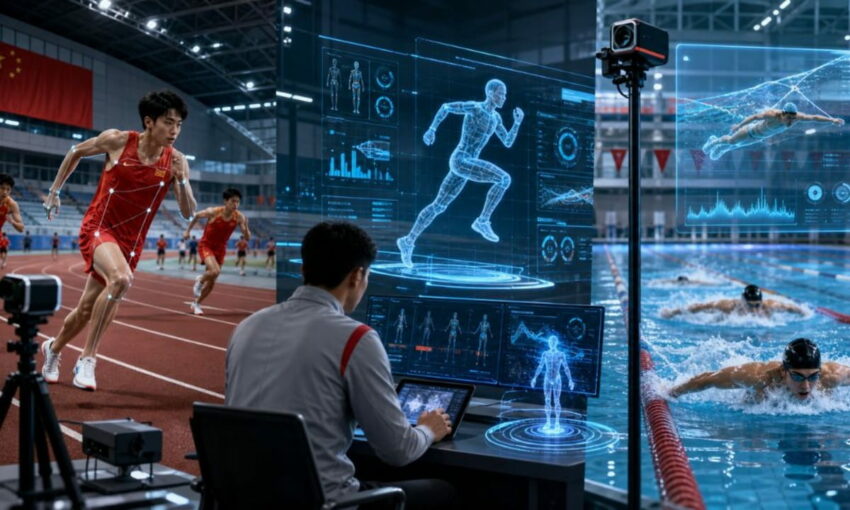
China’s sports industry has entered a new phase driven by AI sports technology, and the race no longer starts only on the track, in the pool, or inside a stadium.
It now starts inside data labs, training centers, smart parks, and sportswear factories.
Chinese sports officials, universities, technology firms, and major athletic brands have started deploying AI sports technology across the country’s sporting system. The shift touches elite athlete training, public fitness programs, sportswear design, retail operations, injury prevention, and performance analysis.
The push also fits tightly into China’s broader technology ambitions. Beijing wants smarter industries, stronger public health systems, and more competitive national teams. Sport now gives it one of the clearest places to test that drive.
The target looks enormous. Chinese officials want a connected, intelligent sports ecosystem running by 2030. Zhu Han, deputy director of sports information under China’s General Administration of Sport, said the country aims to build a digital sports community that functions with greater “intelligence, precision, security and accessibility,” according to Chinese state media reports.
From human eye to data-driven coaching
China now wants sharper measurement added to that mix through AI sports technology.
Swimming shows one of the clearest examples.
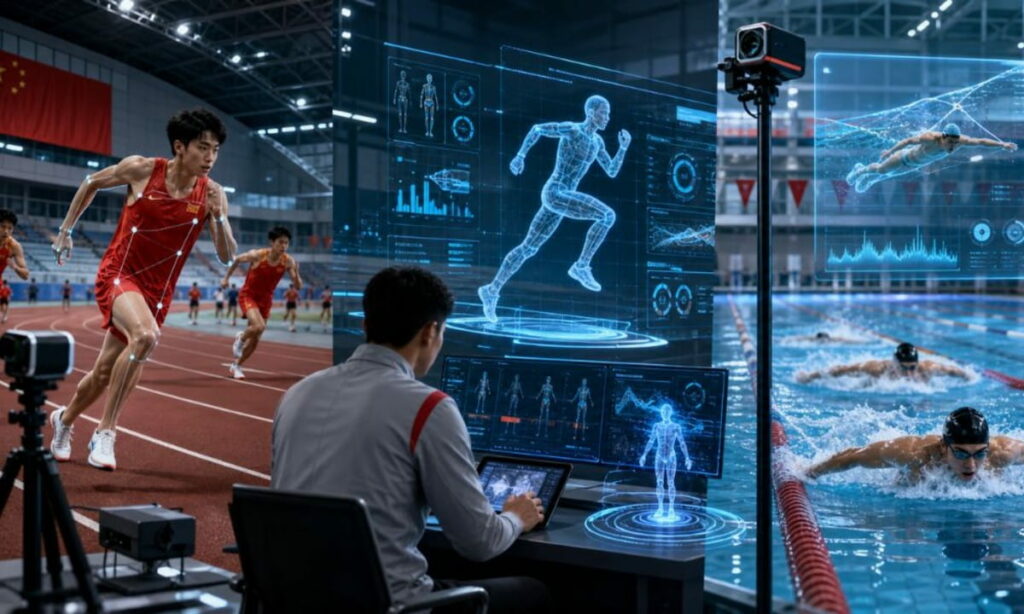
At advanced training centers, camera networks track athletes both above and below the waterline. These systems record lap speed, stroke rhythm, body angle, kick timing, and technical consistency. Software then breaks down each movement and hands coaches a frame-by-frame breakdown of swimmer performance.
That matters because water hides many critical details. A small flaw in body position or arm entry can cost a race in fractions of a second.
People’s Daily reported in 2024 that a 50-meter pool deployed 16 underwater cameras placed every three meters. The system stitched frames together and mapped each swimmer’s path in detail. The report credited a large-scale sports model as a breakthrough of AI sports technology developed through collaboration among Shanghai University of Sport, Baidu, and Shanghai University.
That kind of setup changes what coaching looks like. It does not sideline the coach. It hands the coach sharper evidence.
Track and field has moved in the same direction. Long jump training now uses motion reconstruction tools to study run-up speed, takeoff angle, flight path, body posture, and landing mechanics. Coaches adjust technique using data points that no human eye could previously measure.
Sportswear brands join the race
China’s AI sports technology push does not stop with athletes.
Li-Ning has used digital tracking systems to study elite runners and refine shoe design. The company analyzed marathon runners in Iten, Kenya, one of the world’s most respected distance-running hubs. Researchers gathered 3D running-posture data using portable tracking equipment and channeled it directly into product development.
That connection between sports science and manufacturing marks a significant shift. Brands can study real movement, compress development cycles, and refine shoes or apparel before mass production begins.
Anta Sports moved even more aggressively into AI sports technology with its “AI365” strategy in 2025. The company launched its “AI365” strategy in 2025 to embed smart tools across its entire value chain. Anta said its research and development spending climbed to roughly 2.2 billion yuan in 2025 as it expanded digital systems for design and operations.
The company wants faster design work, lower costs, and stronger customer experiences. Smart systems will cover manufacturing, logistics, retail, and custom product options.
That puts sportswear inside a larger global shift. Athletic brands no longer compete only on logos, endorsements, and materials. They compete on data, too.
Public fitness gets smarter
China also wants AI sports technology woven into everyday exercise.
Smart parks and outdoor gyms have spread across several cities. These spaces track running speed, calories burned, stride frequency, exercise duration, and other fitness data. Some equipment delivers training guidance through connected screens or linked apps.
In Beijing’s Haidian Park, smart tracks display real-time fitness information for runners. In other public spaces, outdoor gym machines offer exercise tips and performance numbers.
The goal stays simple. Make exercise easier to track, safer to follow, and more personal for each user.
Chinese authorities have also discussed a national fitness information platform. The concept bundles gym access, public sports services, exercise guidance, health monitoring, and fitness tracking under one system. Officials have also floated a “fitness code” and a points-based scheme called “sports banking.”
Details stay limited. The direction does not. China wants public fitness to be measurable and connected through the 2026-2030 planning period.
Olympic movement adds global pressure
China’s push also comes as global sports bodies accelerate their own shift toward smart systems.
The International Olympic Committee launched its Olympic AI Agenda in April 2024. The IOC said the agenda would steer the Olympic movement on AI use in athlete support, talent identification, training, judging, event management, and fan engagement.
The IOC also stressed human-centered design. Its digitalization strategy says the Olympic movement wants these tools to support athletes and improve access, not build a system that rewards only the wealthiest programs.
That concern will grow louder as sports technology advances. Sophisticated systems create clear advantages. They also risk widening the gap between wealthy programs and underfunded ones.
Robots enter the conversation

Humanoid robots have also become part of China’s sports technology story.
They do not challenge athletes. Instead, they help researchers study movement, balance, endurance, and body mechanics. Engineers apply sports science findings to improve robotics. Sports scientists borrow from robotic movement models in return.
That overlap explains why sport holds so much value for technology companies. Athletic performance generates clean, measurable data. Every jump, sprint, kick, stroke, and stride carries useful information.
That makes sport a powerful commercial and research frontier at the same time.
The risks China still faces
The rise of AI sports technology also brings real concerns.
Athlete data exposes sensitive health and performance details. Wearable systems and camera networks carry surveillance risks. Teams may also lean too hard on numbers and chip away at instinct, creativity, and personal judgment in the process.
Cost remains another obstacle. Wealthy teams, brands, and governments access better systems. Smaller programs risk falling behind.
So China’s challenge goes beyond building smarter sports systems. It must also show those systems help athletes and citizens without stripping sport of its human character.
For now, the direction looks fixed.
China sees sport as more than entertainment. It sees a public health tool, a business opportunity, and a technology frontier all at once.
The next great sports advantage may not come only from stronger legs, sharper eyes or better coaching. It may come from whoever reads the data first.
Do you think AI sports technology will improve athletic performance without stripping the human feel from sport? Please drop your views in the comments below.