

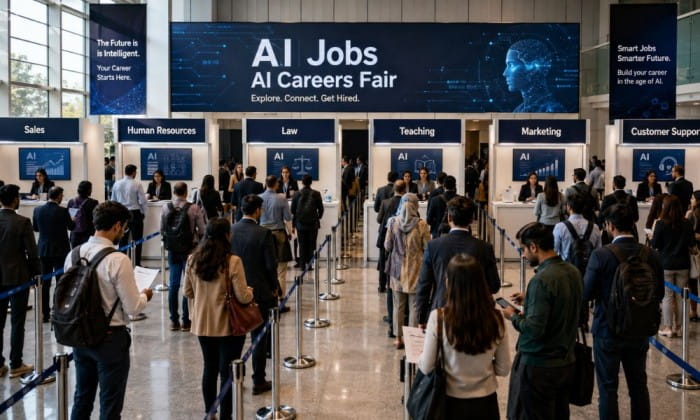
Europe’s employers have moved artificial intelligence out of the engineering department. They now stamp it on openings in sales, human resources, law, teaching, marketing, and customer support.
New figures from Indeed’s Hiring Lab show how far that language has traveled. Most AI job titles in four of Europe’s five largest economies now sit outside technology occupations. Germany leads the shift.
Germany recorded 288 AI-touched titles in the first quarter of 2026. The United Kingdom followed with 160. France counted 138, the Netherlands reached 84, and Spain posted 81.
Those totals dwarf the figures from early 2022. Germany had 72 then. Britain had 61, France had 35, the Netherlands had 21, and Spain had only eight.
Share of tagged listings climbs in five economies
AI job titles made up 4.2% of qualifying title groups in Germany during the first quarter. France reached 3.3%. Britain hit 2.7%, Spain 2.3%, and the Netherlands 2.2%.
Every one of those countries sat below 1% in 2022. The climb took four years.
Pawel Adrjan, director of economic research at Indeed, said the spread suggests,”AI-related skills, tasks and tools are becoming mainstream in the labour market.”
Workplace habits back that up. Eurostat found that 15% of people aged 16 to 74 in the European Union used generative AI for work last year. Broader personal and professional use ran far higher, at 32.7% in 2025.
How did Indeed count the roles?
Indeed treats a title as AI-touched when at least five postings in a single quarter carry AI, GenAI, AGI, or artificial intelligence in the employer’s own wording. The company studied France, Germany, the Netherlands, Spain, and the United Kingdom.
Researchers dropped Italy from the comparison. There, “ai” doubles as a common Italian contraction, and it would have flooded the results with unrelated matches.
The team also stuck to titles instead of full descriptions. A posting can mention the technology in passing. A headline rarely does that by accident.
“Including AI in the job title is a deliberate choice that likely means the employer considers AI as central to the role,” Adrjan said.
Non-tech roles take the lead
Germany places 59% of its AI job titles outside technology work. The Netherlands follows at 58%. France and Britain each stand at 54%.
Spain breaks the pattern. Technology roles still hold 64% of its AI job titles, leaving 36% for everyone else.
“Employers are not only hiring AI specialists, but they are also adding AI to the titles of jobs where the use of AI tools is required – an indication of how AI is already reshaping jobs,” Adrjan wrote.
That distinction carries weight. Companies still need engineers who build the systems. They also want lawyers, teachers, recruiters, and sales staff who can run those systems well.
Familiar jobs pick up new labels
British listings show how quickly the wording spreads. One employer advertised for a “Solution Sales Executive – AI, Data and Analytics.”
Others posted openings for a “Lecturer in Digital Business and AI,” a “Legal Counsel, Privacy, Product & AI,” and an “Operations Specialist, AI Enablement.”
A German human resource listing sought a manager who could ‘use AI in HR to increase efficiency.’ French firms hunted for salespeople to sell AI products and services. Dutch companies wanted marketing and advertising specialists who work with the tools daily.
Most of these AI job titles never mention a lab or a research team.
What job seekers should take from the numbers?
The pattern turns AI fluency into something closer to basic digital literacy. Many of these AI job titles ask for practical command of assisted software rather than deep programming skill.
Résumés will feel that pressure first. A marketer can point to campaign analysis. A lawyer can cite privacy reviews. An HR manager can describe faster onboarding, cleaner records, and better internal training.
Indeed, sorted the emerging non-tech AI job titles into a few clusters. Adoption and consulting work forms one group. Training-data creation and content review make up another. Teachers, coaches, and corporate trainers complete the list.
Workers who explain their own AI workflow clearly will hold a stronger hand as employers sharpen those expectations.
A label alone proves little

Some caution belongs here. AI job titles measure how companies describe work, not how much technology staff actually touch each day. A few employers simply chase applicants with a fashionable phrase.
Even so, the four-year climb resists easy dismissal. Employers across the continent keep tying AI job titles to ordinary professions, quarter after quarter.
Recruiters expect more AI job titles in finance, logistics, health care, and public administration next.
Do you see AI skills turning into a basic requirement in your own field? Or do employers risk adding the label far faster than they change the actual work? Please drop your views in the comments below.