

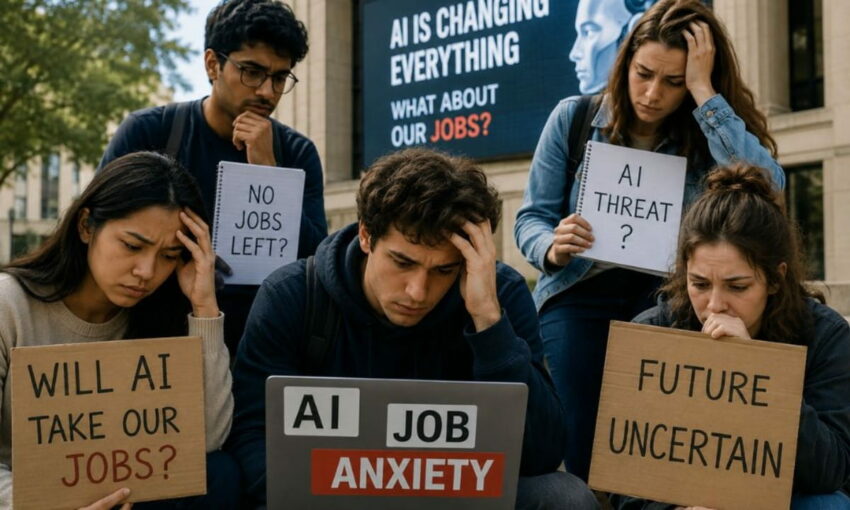
Stanford‘s newest graduates walked into commencement season with AI job anxiety. They had studied inside Silicon Valley, holding degrees from one of the planet’s strongest technology pipelines. They lived minutes from Google, Apple, Meta, and the firms driving the next economy.
Still, many crossed the stage chasing the same question that haunts millions of young workers. Will AI open doors, or slam them shut?
The unease broke open when Google CEO Sundar Pichai spoke on June 14 at Stanford’s 135th commencement. Pichai, who earned a master’s degree there, joked that advisers had warned him to skip AI. The advice landed for a reason.
Some graduates rose and left as he talked. Others lifted signs against Google’s AI work and its government deals. One read, “ICE Spies With Google AI.” Students also waved Palestinian flags and challenged Google’s technology ties to Israel. Roughly 100 to 200 of the 6,000 graduates joined the walkout, then held their own “People’s Commencement” nearby.
The scene exposed how sharply AI splits even Stanford, a school woven into the rise of modern computing. Beneath the protest ran a quieter current of AI job anxiety.
Stanford built the AI era, then met its backlash
Stanford did not watch the AI boom from the sidelines. It helped spark it.
Computer scientist John McCarthy first used the term “artificial intelligence” at Stanford. Google’s founders, Larry Page and Sergey Brin, trained there. OpenAI chief Sam Altman attended, too. Fei-Fei Li, among the field’s most cited researchers, still teaches on campus.
fwThat pedigree hands graduates rare access to the AI economy. Yet it also drops them into the heart of AI job anxiety.
For some, AI signals discovery and opportunity.
“I feel optimistic about AI,” said Ifdita Hasan, a computer science and AI graduate. “I think AI gives us the opportunity to learn more about the universe. It’s a tool that people should try to use and try to adapt to.”
Hasan said fear trails every new tool. She likened today’s mood to the early internet.
“This is what happens. It happened with the internet,” she said.
Jobs, ethics, and classrooms feed the worry
Other graduates spoke with less ease. Their words traced the AI job anxiety spreading across campus.
Atash Heil, an Earth Systems graduate, said AI had raced ahead faster than students could absorb.
“It’s already had such a big impact in such a small time,” Heil said.
Heil also pushed back on AI-made art. People, he argued, should stay at the center of culture.
“I want art to be made by humans. That’s what makes it art, right?” he said.
His concern stretched further. Heil wants firms to hold tougher standards as they ship powerful tools.
“It has to be done ethically, and it’s not being done ethically these days,” he said.
The worry reaches the classroom, too. Lucy Zimmerman, a computer science graduate and teaching assistant, watched AI reshape how students work. She spotted a gap between take-home grades and exam scores.
“I think it’s really impacted how people are learning,” Zimmerman said.
Some Stanford courses revived proctored exams and oral tests to curb AI-assisted cheating. Zimmerman fears the AI job anxiety could trail students long after they leave.
“I’m worried about future generations,” she said, “and for my generation.”
Graduates step into a colder market
Timing makes the debate bite harder. Recent graduates meet a softer job market, which deepens the AI job anxiety.
New York Fed figures show early-career graduates still battle unemployment and underemployment. A Stanford Digital Economy Lab study sharpened the alarm. Its November 2025 update found a 16% relative drop in employment for workers ages 22 to 25 in AI-exposed roles, including software development, customer service, and clerical work. Older workers in those same jobs held steady or grew.
That stings at Stanford, where a diploma once read like a golden ticket into Big Tech. Now, some fear AI may thin entry-level openings before careers even start. Coding tools speed up veterans. They may also shrink the call for junior hires, which feeds the AI job anxiety.
Even so, most graduates still hold offers or plan further study. The AI job anxiety springs from doubt, not ruin.
Harry Kaplan, a Management Science and Engineering graduate, said the road ahead stayed murky.
“It’s too early to tell,” Kaplan said.
Then he caught the campus mood in a line.
“It’s an exciting place to be. It feels like we’re at the edge of something.”
Energy costs widen the unease
AI stirs questions past paychecks. Psychology graduate Colbey Harlan said he leans on AI for creative writing. It helps people start projects and break through blocks, he said.
Yet he frets over data centers, power demand, and the environmental bill of fast AI growth.
“I’m not a fan of how it’s destroying the environment. Data centres are taking a lot of resources, a lot of energy,” Harlan said.
His view mirrors a wider rift among young people. Many find AI useful. Many also dread what follows when companies sprint ahead of schools, workers, and lawmakers. That gap keeps AI job anxiety alive.
A class caught between promise and peril
Stanford’s graduates now carry two truths at once.
They hold deeper access to the AI future than nearly any students on earth. They also see its dangers up close. They know AI can boost climate research, quicken coding, aid writing, and widen discovery. They still worry about surveillance, war, cheating, lost jobs, fading creativity, and energy strain. That mix fuels their AI job anxiety.
The clash defined Stanford’s commencement. The same technology that sparked excitement also triggered walkouts. The same industry that dangles opportunity also breeds AI job anxiety.
For the class starting work in 2026, AI no longer reads like a distant trend. It feels like the floor beneath their feet.
AI is reshaping schools, careers, and creativity faster than most people predicted. Do you see AI as an opportunity or a threat? Please share your views in the comments and join the conversation.