

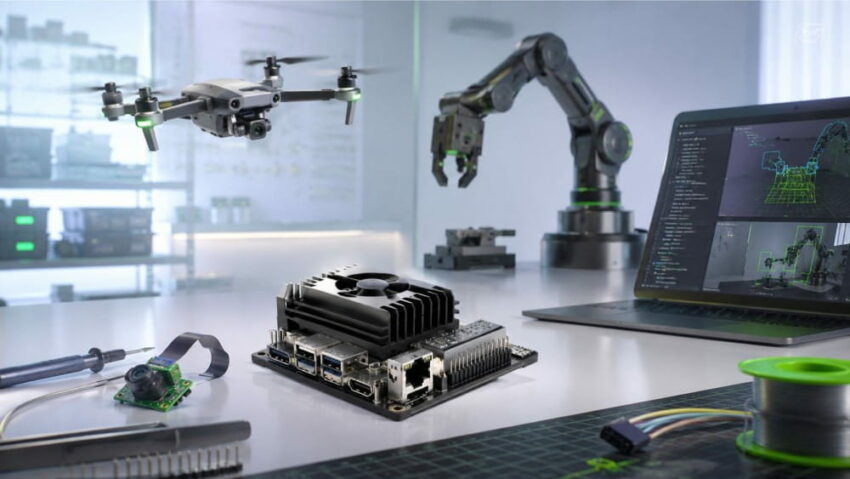
NVIDIA is pushing generative AI out of data centers and into machines that operate in the physical world.
The company has unveiled NVIDIA Jetson Orin Nano 2, a compact edge robotics computer built for drones, robots, and computer vision systems. NVIDIA is positioning the board as an entry-level platform for developers who want AI models to reason locally instead of relying on constant cloud access.
The launch comes as smaller AI models become more capable. NVIDIA says small and medium models can now reach accuracy levels that required much larger frontier models a year ago.
“The Jetson Orin Nano 2 computer puts that breakthrough within reach of millions of developers, delivering the performance and energy efficiency needed for real-time reasoning at the edge,” Deepu Talla, vice president of robotics and edge AI at NVIDIA, said.
Local processing can help robots interpret language, analyze images, and react without waiting for a remote data center.
More AI performance at the edge
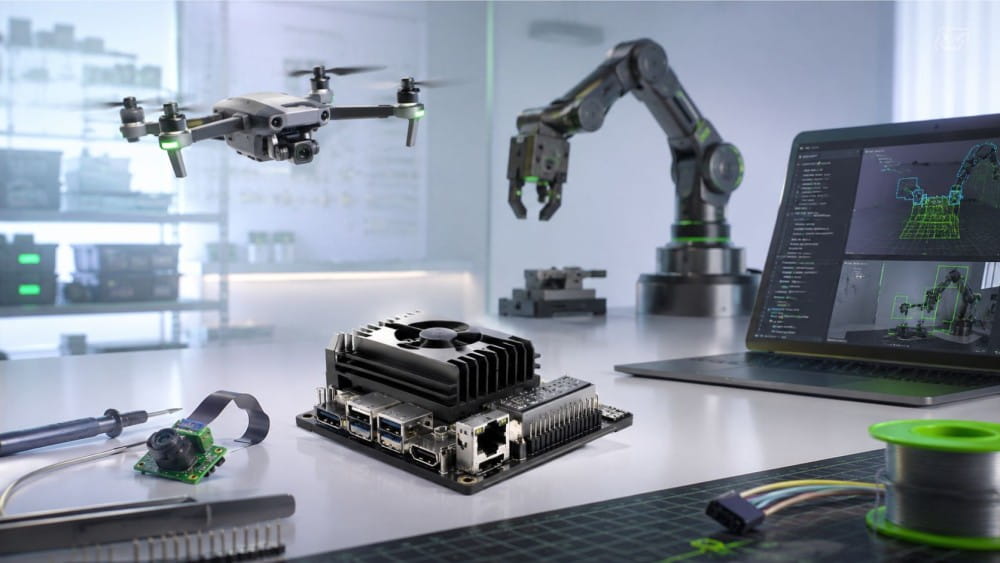
NVIDIA Jetson Orin Nano 2 delivers 78 trillion operations per second, or TOPS, of AI compute. It also includes 8 GB of memory and an eight-core Arm CPU.
NVIDIA says the board provides twice the inference performance of the Jetson Orin Nano Super. The company attributes the improvement to upgraded Tensor Cores and higher memory bandwidth while keeping the same compact form factor.
In 15-watt mode, the new system uses 40% less power while matching the performance of its predecessor, according to NVIDIA.
That matters for battery-powered machines. Drones and mobile robots have limited room for cooling and large batteries.
Jetson Orin Nano 2 runs NVIDIA’s open software stack, Jetson agent skills, and the wider Jetson AI ecosystem. It can run large language models and vision-language models optimized for memory-efficient inference. NVIDIA named Cosmos, Nemotron, Gemma 4, and Qwen 3 as examples.
More than 3 million developers already build on NVIDIA’s robotics stack, the company said.
Wing evaluates smarter delivery drones

Alphabet-owned Wing is evaluating NVIDIA Jetson Orin Nano 2 for future delivery drone applications.
Wing already uses Jetson Orin Nano Super and NVIDIA’s software stack across its delivery fleet. The company is exploring the new board to improve real-time perception and reasoning while reducing energy demands.
“Drone delivery depends on AI that can enable fast, reliable understanding of the real world,” Dinuka Abeywardena, head of perception at Wing, said. “Wing is exploring Jetson Orin Nano 2 to give us a path to more responsive, energy-efficient drones that can help make deliveries quicker and more dependable for customers.”
Wing has not publicly set a timeline for moving the new hardware from evaluation to production flights.
A drone that processes visual information onboard can respond to changing conditions without depending entirely on a network connection.
Matic brings AI reasoning into homes
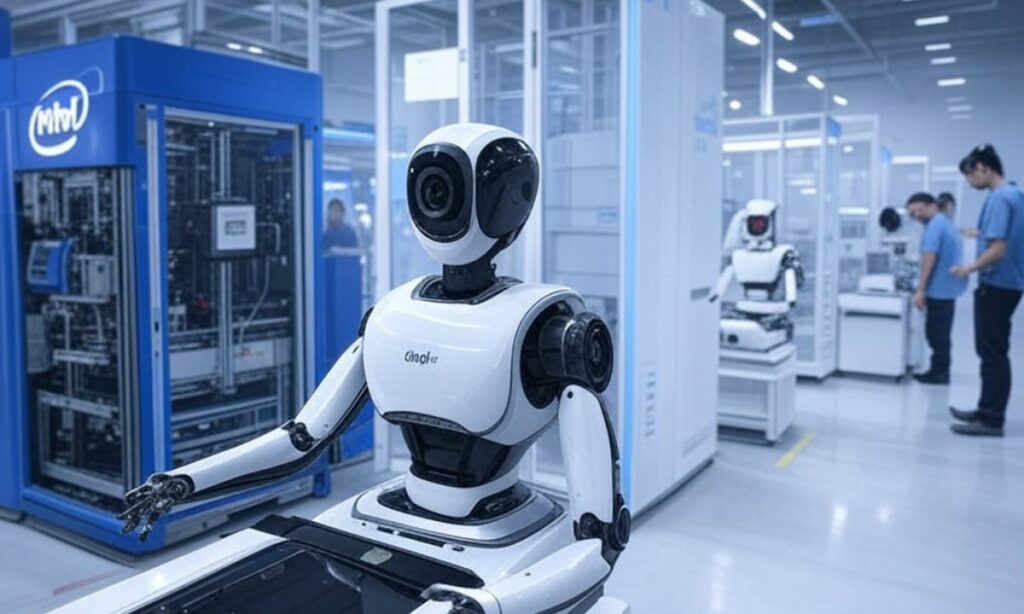
Matic Robots is adopting NVIDIA Jetson Orin Nano 2 for its home cleaning robotic services.
The company expects Jetson Orin Nano 2 to support conversational AI, gesture detection, precision mapping, semantic understanding of rooms and objects, and autonomous cleaning.
“Home robots need to understand people, map spaces precisely, understand the layout of objects and spaces, and clean autonomously in dynamic and constantly changing environments,” Navneet Dalal, cofounder and CEO of Matic Robots, said.
“With Jetson Orin Nano 2, Matic can run state-of-the-art AI models at the edge in a compact home robotics platform built for real-time perception, interaction, and navigation.”
Cognex and Doosan Bobcat are also among the first companies NVIDIA identified as adopting or exploring the new platform.
NVIDIA expands its physical AI ecosystem
NVIDIA is also building a broader hardware and software network around NVIDIA Jetson Orin Nano 2.
AAEON, ADLINK, Advantech, Aetina, Antmicro, Aptiv, Auvidea, AVerMedia, Connect Tech, ForeCR, Seeed Studio, and other partners are developing carrier boards, customized software, hardware systems, and reference designs.
The ecosystem could help companies move faster from prototypes to commercial products without building every hardware layer themselves.
The bigger test will come when developers put increasingly capable small models into real machines. If local AI can deliver fast reasoning without heavy cloud dependence, edge computing could become a core layer of physical AI.
Would you trust drones and home robots to make more decisions locally with AI? Please share your views in the comments.