

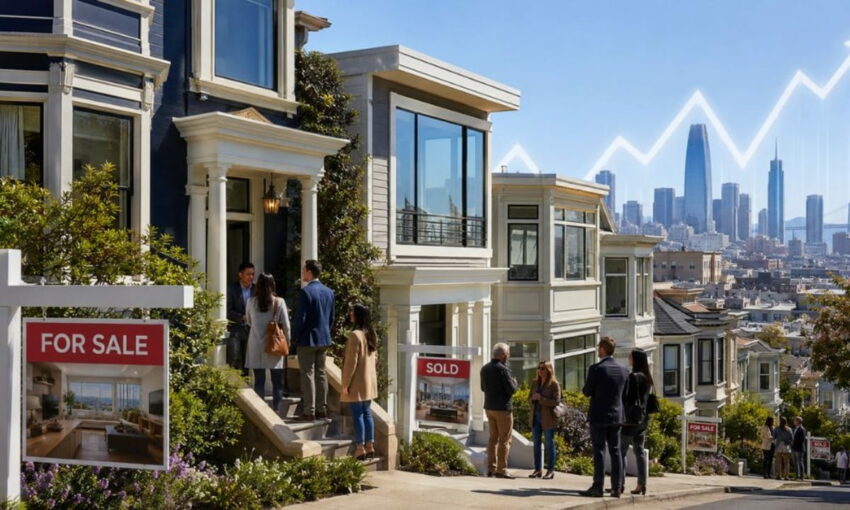
San Francisco’s housing market has shifted into overdrive again, and this time the engine runs on AI wealth.
Employees at the city’s biggest artificial intelligence firms are landing enormous payouts as initial public offerings pile up. That cash is flooding into one of the country’s priciest markets, and it shows. Houses sell within days. Bidders fight over luxury listings. Renters absorb the spillover. The AI wealth boom has handed a new class of cash-rich buyers the keys to a market that already had few homes.
The numbers tell the story plainly. By March 2026, the median sale price for a San Francisco home topped $2 million, an 18% jump from a year earlier, according to brokerage Compass. Homes also flew off the market. Properties sat for an average of 29 days, the quickest turnover since spring 2022.
Open houses now feel like contests.
“My joke is that you have to show up to whatever the open house is. Be there a half-hour early. Have a bag of cash with you. Be willing to pay. It’s ridiculous,” said Quintin Mecke, executive director of the Council of Community Housing Organizations.
Stock payouts ignite fresh demand
The pressure traces straight back to equity.
Workers at top AI companies often hold shares long before their employers go public. When firms open the door for staff to sell, fortunes change hands fast.
OpenAI offered the clearest case yet. More than 600 current and former staffers cashed out shares last fall in a deal worth $6.6 billion, the Wall Street Journal reported in May. Roughly 75 of them walked away with $30 million apiece.
A single payout like that can turn a renter into a luxury buyer overnight.
“If somebody’s thinking about it wisely, they’ll be thinking: ‘Well, I have this large sum of money coming my way. What is a large purchase that I may need to acquire at some point?’ And the home is on that very short list,” said Drew Wilkerson, a real estate adviser with Sotheby’s International Realty.
OpenAI and Anthropic both run their operations from downtown San Francisco, which ties the city directly to the AI wealth surge. SpaceX, with its sprawling Southern California base, has fed the broader tech-wealth cycle too. The rocket company priced a record offering at $135 a share this week, valuing it near $1.77 trillion.
Buyers race to beat the next surge

Agents say the fiercest fights break out at the top of the market.
Wilkerson and fellow agent Spencer Hsu both report swelling demand for homes priced at $5 million and up. Hsu figures about 80% of his clients work in AI.
Many of those buyers worry prices will climb even higher once more listings convert AI wealth into another round of cash.
“Just this last week, I had five calls from new buyer clients who said: ‘I know that OpenAI and Anthropic and SpaceX and these IPOs are going to happen. I want to try to get in the market before that wave of money comes,'” Wilkerson said.
Hsu summed up the mindset bluntly.
“‘I might as well just buy it now,'” Hsu said.
That logic pushes prices up before a company even rings the bell. Buyers chase the deal out of fear. Sellers sense the heat. Agents raise their targets. The loop keeps spinning.
A pattern the city knows well
San Francisco has lived through this before.
The dot-com surge minted a millionaire class in the late 1990s, and many of those workers poured stock gains into property. Facebook, Twitter, and other firms sparked a second wave after their early-2010s debuts.
Today’s AI wealth echoes those earlier windfalls, only larger.
Ken Rosen, who chairs the University of California, Berkeley’s Fisher Center for Real Estate and Urban Economics, remembers how fast it all moved.
“Shares went up like crazy … house prices soared,” Rosen said.
Yet today’s cycle looks different. AI valuations have soared to staggering heights. Twitter once priced its debut at $26 a share and Facebook at $38, while SpaceX commanded $135. Many key players also sit inside the city rather than in Silicon Valley, about 50 miles south, so more staff want to settle near downtown offices.
“The interesting tension … in San Francisco is you have this extremely high demand, but inventory doesn’t really ever rise to meet that,” Wilkerson said.
Tight supply still caps the market
San Francisco has wrestled for years to build enough homes.
City officials trimmed permit timelines recently, yet the process still trails other major U.S. cities. Builders face steep costs, neighborhood resistance, and decades of restrictive zoning. Mayor Daniel Lurie signed a rezoning law in December to clear the way for taller, multi-unit projects, though fresh supply will arrive far too slowly to cool the AI wealth frenzy.
Renters feel the heat most.
Zumper’s May report pegged the average one-bedroom at roughly $4,000, an all-time high, with two-bedrooms near $5,500. Downtown, SoMa, Mission Bay, Pacific Heights, and Hayes Valley have posted some of the steepest jumps, the San Francisco Chronicle reported.
Daryl Fairweather, Redfin’s chief economist, warned that anyone buying at the peak could lose value if the climb stalls.
When the boom turns
Confidence runs high, but so does the risk.
Some owners want to sell into the rush, then balk because they would have to buy back in at the same brutal prices. Rosen offered a reminder from history.
“Booms are always followed by busts. Always,” Rosen said.
After the dot-com crash, prices slid for years rather than rising.
“House prices corrected downward for the next four years, five years”, Rosen said. “Easy come, easy go.”
For now, the city sits at the heart of a new AI wealth cycle.
AI firms have pulled jobs, capital, and global attention back to San Francisco, and they have sharpened its oldest problem in the process. Too much money is chasing too few homes.
What do you think — will the AI wealth boom breathe new life into San Francisco, or push more longtime residents out the door? Please drop your comments below.