

Steve Eisman thinks the AI boom rests on a narrow foundation. The Big Short investor who bet against the U.S. housing market before the 2008 crisis now argues that record AI infrastructure spending leans on the success of just two companies: OpenAI and Anthropic.
Eisman laid out his case Tuesday on CNBC’s “Fast Money.” He estimates that these two startups drive roughly 70% of AI-related revenue at Microsoft, Amazon, Alphabet’s Google, and Oracle. He also pegs their share of cloud revenue at these giants at 25% to 35%.
“The futures of these massive companies, in a sense, are a bet that OpenAI and Anthropic are going to succeed,” Eisman said.
That dependency worries him because so much money now rides on it. By some estimates, the largest technology firms will funnel roughly $750 billion into data centers this year, and much of that AI infrastructure spending targets capacity that will not earn a cent for years.
A narrow base under a massive bet

The concern is that AI infrastructure spending has climbed quicker than the customer base behind it. Firms worth trillions of dollars keep building enormous computing systems in response to demand from a small cluster of frontier labs.
Eisman sees a second pressure point in China. Chinese developers ship open-weight models at far lower prices, and he believes those models are starting to win users.
“The Achilles’ heel of this whole story … is if something bad happens to Anthropic and OpenAI … the Chinese open-end models, open-weight models are much cheaper. And if they start really taking a lot of market share and it sounds like, from what I’m hearing, that they’re starting to, you could have a big price war. And then we have a problem,” he said.
A price war would ripple straight into AI infrastructure spending. Cheaper models would squeeze what developers pay cloud providers, and that pressure would hit the economics of costly GPU clusters and sprawling data centers.
Why does the spending keep climbing?

Recent earnings complicate the bearish case against AI infrastructure spending. Cloud demand continues to accelerate rather than cool.
Amazon said AWS sales grew 37% year over year last quarter, its fastest pace in more than four years. Microsoft reported 43% growth in Azure and other cloud services. Google Cloud surged 82% as customers chased AI capacity.
Critics still flag a gap. Big tech may spend around $750 billion on AI this year while collecting closer to $175 billion in AI revenue. Yet that comparison mixes timelines, because a large data center takes about two years to build and fill. Most of this year’s outlay will not ring the register until 2028.
Prices tell a bullish story, too. If the industry had overbuilt, computing costs would slide. Instead, Amazon raised its AI cloud prices in January for the first time in nearly two decades, then lifted them again on July 1. Even so, AI lifts revenue well outside the cloud, which keeps AI infrastructure spending looking justified to the companies writing the checks. Google uses its models to sharpen search, and Meta uses them to place ads people actually click.
Anthropic’s surge fuels the buildout
Anthropic shows why the hyperscalers keep expanding, and why AI infrastructure spending has not slowed. The Claude maker said its annualized revenue crossed $47 billion in May, up from about $9 billion at the end of 2025.
The company raised $65 billion at a $965 billion valuation, filed confidentially for a U.S. stock listing in June, and expects its first operating profit this quarter. Demand has run so hot that Anthropic has capped usage and turned some partners away.
Eisman wants harder numbers before he fully commits, though.
“It’ll be nice when Anthropic goes public, so we can see real numbers and then see every quarter how they’re doing,” he said. “Until then, it’s just anecdotal.”
Burry sees a bigger danger
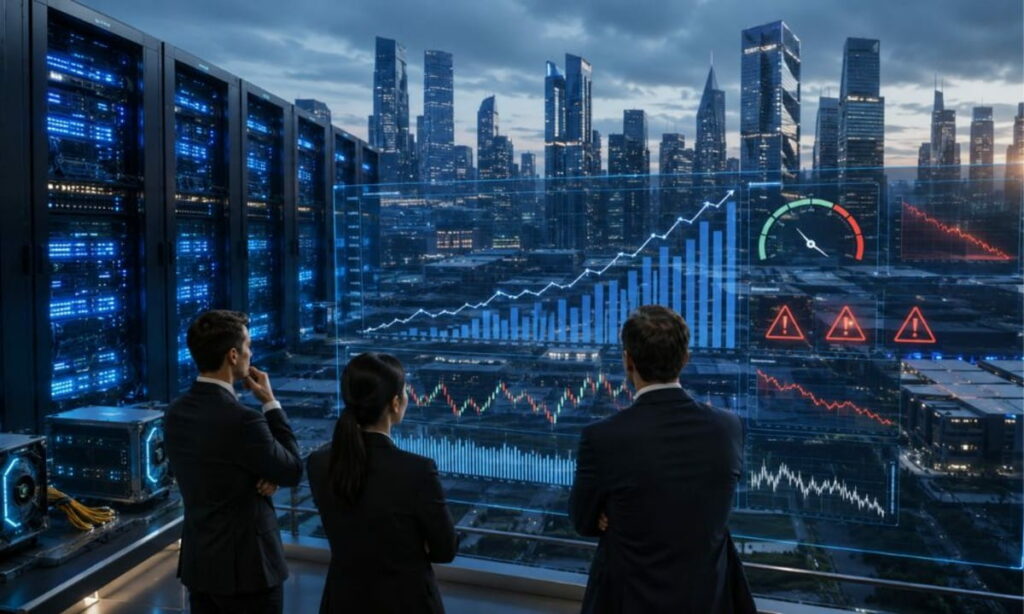
Michael Burry, another “Big Short” investor, frames the risk around AI infrastructure spending more aggressively. He questions whether real customers drive AI demand, or whether a web of companies keeps financing, investing in, and buying from one another.
Burry has backed his skepticism with bearish bets against Nvidia and other firms tied to the buildout. His warnings carry more weight as financing grows tangled, with Nvidia and Wall Street firms crafting arrangements that could steer hundreds of billions toward chips and data centers.
That financing could keep AI infrastructure spending flowing. It could also deepen the damage if prices fall or demand disappoints.
Eisman’s warning does not predict a crash. It targets concentration. If OpenAI and Anthropic keep growing, the hyperscalers may hold enough demand to justify their AI infrastructure spending. If cheaper rivals seize real share, however, the math could flip fast.
Do you think Big Tech leans too hard on OpenAI and Anthropic, or does surging cloud demand justify the record spending? Please share your views in the comments.