

Cambridge scientists will lead a new national hub that pairs artificial intelligence with lab-grown human tissue, and the project could reshape AI drug development across Britain.
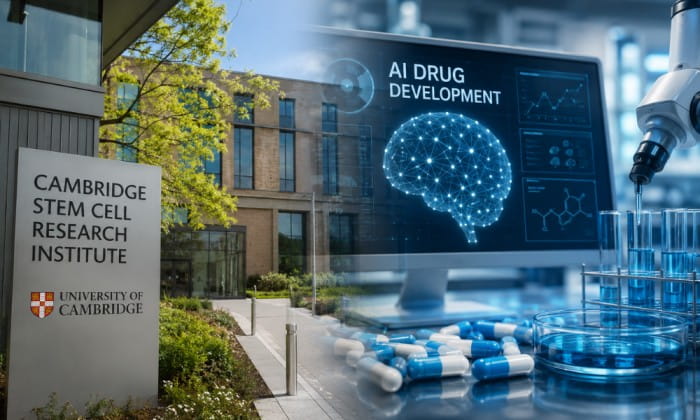
The Medical Research Council announced the £20 million investment on Aug. 12, backing what it calls the UK Pre-clinical Translational Models Hub. The Cambridge Stem Cell Institute will run it from the Jeffrey Cheah Biomedical Centre on the Cambridge Biomedical Campus.
Researchers plan to combine organoids, stem cell models, bioengineering, clinical data and AI drug development tools to create a more advanced pipeline for testing potential medicines. Scientists expect this to give them a quicker perspective of whether a medicine will work on humans, not just in a dish or an animal.
That question drives the whole effort. Too often, a promising compound performs well in early experiments, then stumbles once human trials begin. The hub aims to close that gap, and its leaders believe better human models can help.
Why human models sit at the center
Organoids anchor the plan. These tiny, lab-grown structures replicate key features of real human organs, so researchers can observe disease behavior and measure how tissue reacts to a candidate drug.
Professor Matthias Zilbauer will direct the hub. He works as an honorary consultant at Cambridge University Hospitals, and he has spent a decade building a biobank of more than 1,000 patient-derived organoid lines.
That collection gives AI drug development real fuel. Computers can scan patterns across thousands of samples, then flag which biological signals matter most. Researchers can test those leads in living tissue and feed the results straight back into the models.
“Over the past decade, we’ve seen the enormous potential of patient-derived organoids and other approaches that do not rely on the use of animals to transform the way we develop new medicines.”
He added that patient tissue retains its owner’s biology, which sharpens every test.
“Because these miniature human tissues retain many of the unique biological characteristics of the individual patient, they allow us to understand disease more accurately and test potential treatments before they ever reach the clinic.”
How does AI drug development fit the pipeline?

The hub treats computing as a partner, not a bolt-on. AI drug development here means software that reads huge biological datasets, spots hidden relationships, and points scientists toward targets worth chasing.
The design creates a loop. Algorithms surface a lead. Human tissue tests it. Fresh results then train the next round of AI drug development analysis. Each pass should make the predictions sharper.
Cambridge brings deep organoid experience to that loop. Its teams already study the technology across many diseases, and they connect stem cell biology with genomics and treatment research.
The funding also pushes AI drug development toward precision medicine. Computers can probe why one patient responds to a therapy while another does not, which helps researchers match treatments to biology rather than to broad disease labels.
Zilbauer said that shift carries clear stakes for patients and budgets.
The initiative could “ultimately lead to more effective, personalised therapies while reducing the time and cost of drug development”.
A national network, not a single lab

The hub will act as a shared resource for the whole country, and AI drug development sits at its core rather than at its edges. Universities, NHS trusts, and companies will all get access to its models, samples, and data.
Professor Bertie Göttgens, director of the Cambridge Stem Cell Institute, will co-lead the work. He wants to connect expertise that usually stays scattered.
“By bringing together hospitals, research institutes and industry partners in Cambridge and across the UK, the Hub will accelerate the development and use of new, more accurate research tools that better reflect human biology to improve the development of new therapies,” said Göttgens.
The partner list runs deep. The Wellcome Sanger Institute, the MRC Laboratory of Molecular Biology, the Milner Therapeutics Institute, and Royal Papworth Hospital NHS Foundation Trust all join in. Industry heavyweights AstraZeneca and GSK will contribute too, which pulls AI drug development closer to commercial pipelines.
Fewer animals, faster answers

The project also chases a second prize: less reliance on animal testing. Human cell systems cannot replace every animal study yet. Still, regulators and researchers increasingly treat advanced models as a real alternative where the science holds up.
Chris McDonald, the UK’s science minister, welcomed the money and tied AI drug development to jobs and growth.
“Too many medicines that work in animals go on to fail in people,” McDonald said. “The Preclinical Translational Models Hub will allow scientists to test treatments on human tissue, grown from patients’ own cells, so we can tell much earlier what will genuinely work.”
The stakes reach beyond one campus. If the model works, AI drug development could help teams drop weak candidates sooner, back stronger ones faster, and give lab discoveries a better shot at becoming real treatments.
Cambridge now has to prove it.
What do you think? Can AI paired with human organoids truly shorten the road to new medicines, or will clinical trials stay the toughest hurdle? Please share your view in the comments.