

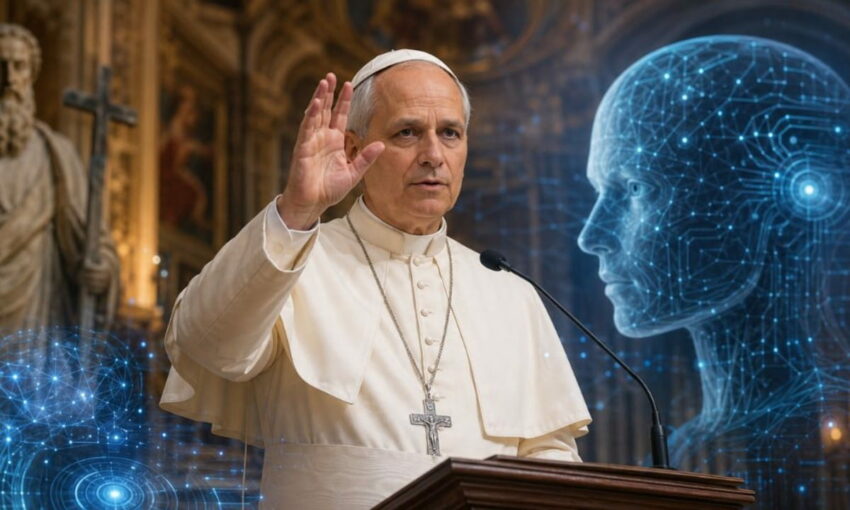
Pope Leo XIV has placed AI ethics at the heart of his first major teaching document, calling on governments, tech firms, and civic leaders to defend workers, children, and human dignity as smart machines reshape modern life.
The Vatican released the encyclical, “Magnifica Humanitas,” on May 25. Leo signed the text on May 15, the 135th anniversary of Pope Leo XIII’s “Rerum Novarum,” the 1891 letter that shaped Catholic social teaching during the Industrial Revolution. Vatican officials said the new document places AI ethics and the protection of the human person at the center of church teaching amid the rise of advanced computing systems.
Leo connected industrial-era labor struggles with today’s fast-moving digital economy. He argued that machine learning tools can help society, but only when people guide them with conscience, accountability, and public oversight.
The pope did not reject technology outright. Instead, he warned against letting profit motives, military ambitions, or private interests decide how powerful systems affect jobs, classrooms, public truth, and warfare.
A direct message to Silicon Valley on AI ethics
“Technology should not be considered, in itself, as a force antagonistic to humanity,” Leo wrote. He added that “the pursuit of greater profits cannot justify choices that systematically sacrifice jobs.”
The encyclical pushes for stronger government oversight of private AI firms and clearer AI ethics standards across the industry. It also urges worker retraining programs, job protection, critical thinking education for students, and tighter safeguards for children exposed to violent, sexual, or false online content.
Leo wants humans to keep final say over weapons decisions. During his May 25 address at the Vatican, he said smart systems already shape society and change how nations fight wars. He called for AI to be “disarmed,” meaning freed from designs that turn it into a tool of domination, exclusion, or death. That call now sits at the core of the church’s AI ethics framework.
Anthropic co-founder joins Vatican event

The pope presented the encyclical inside the Synod Hall, joined by religious leaders, academics, and tech figures. Christopher Olah, co-founder of Anthropic and head of its interpretability research, appeared as one of the listed speakers on AI ethics and the future of advanced systems.
Leo thanked Olah during the presentation. He said the church wanted “to find the way for humanity, in this time of artificial intelligence.” He then added, “What a great sign of hope that, with our differences, we can listen to one another.”
Olah told the audience that tech companies need outside moral pressure because business and geopolitical forces can pull them away from public duty. He said outside voices matter for serious AI ethics work.
“Every frontier AI lab—including Anthropic—operates inside a set of incentives and constraints that can sometimes conflict with doing the right thing,” Olah said. He later told the audience, “We need moral voices that the incentives cannot bend.”
Olah framed the Vatican gathering as the start of a longer partnership between builders of advanced systems and outside communities that can judge their social impact.
“Today is just the beginning—the start of a long collaboration between those of us who are building this and those who can see what we, from inside, cannot,” he said.
Work, children, and algorithmic harm
The pope described employment as more than a paycheck. He called work part of human growth, purpose, and social stability. Furthermore, he warned that a highly technical society could still fail people if only a small slice of citizens find meaningful work, raising fresh AI ethics questions about automation.
The document also stretches the church’s focus beyond labor. Leo cautioned that algorithmic systems can hurt people when they shape access to health care, jobs, security, or public services through flawed data. During his address, he said he heard concerns about software that blocks people from essential needs based on injustice buried inside training data, a major worry inside any AI ethics debate.
Children received special attention. Leo urged schools and families to help young people think sharply about digital content. He warned that early, unsupervised exposure to social platforms and connected devices can damage sleep, attention, emotional control, and relationships.
Weapons, slavery, and a wider warning

The encyclical also takes on autonomous weapons. Leo said such systems make war easier to start and harder for humans to control. Therefore, he argued, military force must stay a last resort tied to legitimate self-defense. That stand will likely shape global AI ethics talks at the United Nations and beyond.
The document also confronts slavery. Leo apologized for the Vatican’s historical role in the practice and tied that past to modern forms of exploitation. He warned that new digital tools could widen inequality if leaders fail to protect vulnerable communities.
The timing carries weight. “Rerum Novarum” spoke to factory workers, struggling families, and the poor during industrial upheaval. “Magnifica Humanitas” now turns the same moral lens on digital power, automation, algorithmic governance, and machine-driven warfare, giving the church a lasting voice in AI ethics.
The text gives Catholic leaders a fresh reference point for AI regulation debates. It also hands policymakers and tech executives a moral challenge as they race to build stronger systems.
Leo’s core message stays simple: people must lead technology, not the other way around.
What do you think? Should governments move faster to regulate AI companies, or should innovation come first? Please share your views in the comments.