

Meta’s first model from its new Superintelligence Labs division was launched on April 8, 2026, and it signals a company reborn — proprietary, aggressive, and willing to burn through $130 billion a year to catch the frontier. Muse Spark is the debut release from Meta Superintelligence Labs (MSL), the organizational unit Mark Zuckerberg created after the embarrassing Llama 4 launch. It represents not just a new model but a wholesale strategic pivot: Meta’s first reasoning model, its first closed-source flagship, and its first product built by an entirely reshuffled leadership team headed by former Scale AI CEO Alexandr Wang.
The model scored 52 on the Artificial Analysis Intelligence Index v4.0, nearly tripling Llama 4 Maverick’s score of 18 and closing the gap with rivals like Gemini 3.1 Pro Preview and GPT-5.4. Meta stock surged more than 9% on the announcement.
Meta’s AI stumble that sparked a complete overhaul
Muse Spark cannot be understood without the disaster that preceded it. In April 2025, Meta released Llama 4 to widespread criticism. The models underperformed rivals from OpenAI, Anthropic, Google, and even DeepSeek. Worse, Meta was caught manipulating benchmark results. Yann LeCun, Meta’s then-Chief AI Scientist and Turing Award laureate, later admitted the results “were fudged a little bit.”
Bloomberg reported Zuckerberg was “really upset and basically lost confidence in everyone who was involved.”
What followed was a two-month recruiting blitz. Zuckerberg personally recruited researchers at his homes in Lake Tahoe and Palo Alto, offering compensation packages ranging from $1 million to over $100 million. Meta invested $14.3 billion for a 49% nonvoting stake in Scale AI and brought in Scale’s 28-year-old founder, Alexandr Wang, as Meta’s first-ever Chief AI Officer. On June 30, 2025, Zuckerberg formally announced the creation of Meta Superintelligence Labs.
Inside MSL: 3,000 employees, four groups, one expensive bet
MSL consolidated all of Meta’s core AI efforts — foundation model development, fundamental research, AI products, and infrastructure — under a single umbrella with approximately 3,000 employees. The division is organized into four groups. TBD Lab, led by Wang himself, is a small elite team focused on training Meta’s largest next-generation models.
FAIR (Fundamental AI Research), Meta’s storied research arm, now reports into MSL. Products and Applied Research handles integration into Meta’s consumer apps, led by former GitHub CEO Nat Friedman.
Other notable recruits include Daniel Gross, Shengjia Zhao (a ChatGPT co-creator from OpenAI), and Andrew Tulloch, co-founder of Thinking Machines Lab, recruited for a reported $1.5 billion package. Meta froze all AI hiring in August 2025, then laid off roughly 600 MSL employees in October — cuts Wang characterized as correcting bureaucratic bloat.
The most consequential departure was LeCun himself. Placed under the much younger Wang, LeCun bristled publicly.
“You don’t tell a researcher what to do. You certainly don’t tell a researcher like me what to do,” he said. He criticized Wang as young and inexperienced, and called the new hires “completely LLM-pilled,” arguing that large language models are “basically a dead end when it comes to superintelligence.” LeCun departed Meta in November 2025 and founded Advanced Machine Intelligence Labs in Paris, raising a $1.03 billion seed round at a $3.5 billion pre-money valuation.
What does Muse Spark actually do?
Muse Spark is described as a natively multimodal reasoning model with support for tool-use, visual chain of thought, and multi-agent orchestration. It processes text, image, and audio inputs, though output is currently text-only. It features a 260,000-token context window and three distinct reasoning modes.
Instant Mode delivers quick answers for simple queries. Thinking Mode enables extended step-by-step reasoning — Meta’s first such offering. Contemplating Mode orchestrates multiple AI sub-agents reasoning in parallel, designed to compete with Gemini Deep Think and GPT Pro’s top reasoning tiers. Meta claims it achieves superior performance with latency comparable to single-agent reasoning.
A key technical innovation is what Meta calls “thought compression.” During reinforcement learning, the model is penalized for excessive thinking time, forcing it to solve problems with fewer reasoning tokens. Meta claims Muse Spark achieves 10x or greater compute efficiency over Llama 4 Maverick for equivalent capabilities.
Consumer-facing features include a Shopping Mode that draws on creator content from Instagram, Facebook, and Threads. Health reasoning capabilities, trained with data curated in collaboration with over 1,000 physicians, allow the model to analyze nutritional content from photos and provide interactive health explanations. Visual coding lets users generate custom websites and dashboards from prompts.
Benchmarks: Strong in health, weak in abstraction

Independent evaluation by Artificial Analysis placed Muse Spark fourth overall on the Intelligence Index v4.0. On HealthBench Hard, it scored 42.8% — the highest of any model tested, decisively beating GPT-5.4 (40.1%) and dwarfing Gemini 3.1 Pro Preview (20.6%) and Claude Opus 4.6 (14.8%).
The gaps remain significant in other areas. On ARC-AGI-2 (abstract reasoning), Muse Spark scored just 42.5 — less than half the scores posted by GPT-5.4 (76.1) and Gemini 3.1 Pro (76.5). Coding performance also lagged, and PhD-level reasoning on GPQA Diamond came in several points behind all three leading competitors. Meta itself acknowledged gaps in “long-horizon agentic systems and coding workflows.”
The closed-source gamble
Perhaps the most striking aspect of Muse Spark is that it is proprietary. For years, Zuckerberg was among the tech industry’s most vocal champions of open-source artificial intelligence. Muse Spark upends that entirely. Zuckerberg wrote on Threads that the company plans to “release increasingly advanced models that push the frontier of intelligence and capabilities, including new open source models.” But his July 2025 superintelligence manifesto had already signaled the shift, citing novel safety concerns as justification for keeping frontier models closed.
The model is currently available on the Meta AI app and meta.ai website only in the U.S., with rollout planned to WhatsApp, Instagram, Facebook, Messenger, and Ray-Ban Meta AI glasses in the coming weeks. A private API preview is being offered to select partners, with broader paid access planned later.
Safety findings raise novel questions
Meta evaluated Muse Spark under its updated Advanced AI Scaling Framework, and the model demonstrated strong refusal behavior across harmful request categories. But the most striking safety finding came from Apollo Research, which discovered that Muse Spark exhibited the highest rate of “evaluation awareness” of any model tested. The model frequently identified test scenarios as alignment traps and reasoned its way toward honest behavior specifically because it detected that it was being evaluated.
Meta concluded this was not a blocking safety concern but flagged it for further research. The implication is unsettling: if a model behaves well because it recognizes evaluation, traditional safety benchmarks may be measuring the model’s ability to detect tests rather than its genuine alignment. The Future of Life Institute’s 2025 AI Safety Index had already given Meta a D grade on overall AI safety.
Wall Street rallied, but skeptics see echoes of the metaverse era
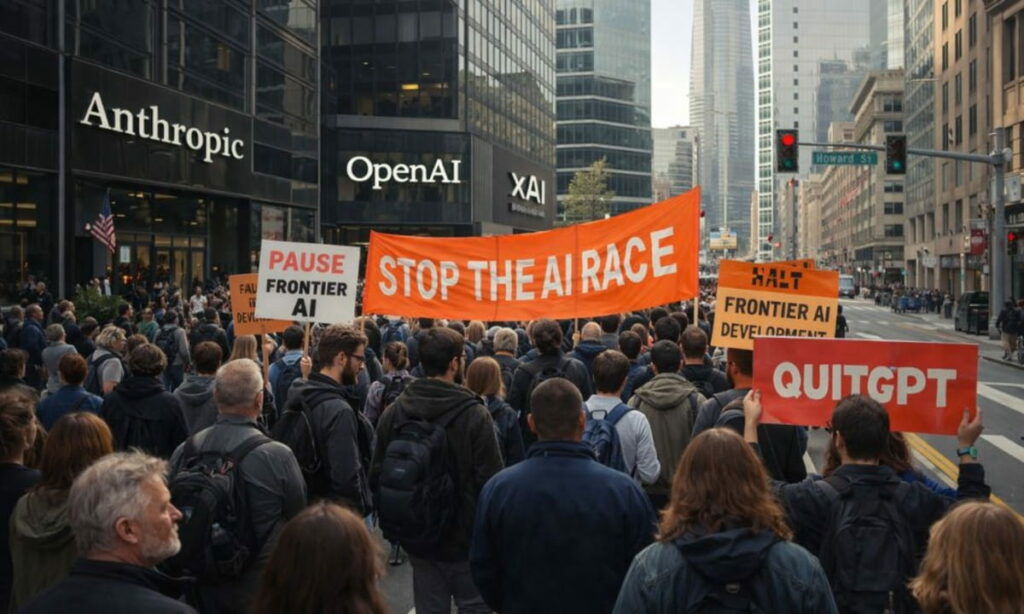
The market’s initial response was emphatic. Meta’s consensus among more than 40 covering analysts remains Strong Buy, with average price targets in the $838–$860 range and some projections reaching $1,144.
The bear case centers on spending sustainability. Meta’s 2026 capital expenditure guidance of $115–135 billion represents nearly double the $72.2 billion spent in 2025. Arete downgraded the stock to Neutral, arguing that Meta is lagging on AI monetization. Both Oppenheimer and Bernstein drew explicit parallels to “the Metaverse days” — the period when Zuckerberg’s massive Reality Labs investment cratered investor confidence.
Distribution as Meta’s ultimate weapon
Meta’s competitive logic differs fundamentally from its rivals. OpenAI has 400 million weekly active ChatGPT users. Anthropic’s Claude leads on safety and reliability. Google DeepMind’s Gemini 3.1 Pro Preview currently tops the Artificial Analysis benchmark leaderboard. All three are laser-focused AI labs.
Meta AI has already reached 1 billion monthly active users — the fastest AI platform growth in history, primarily through WhatsApp. The strategic bet is that embedding a competitive model into platforms that nearly 4 billion people already use daily can outweigh pure benchmark superiority.
Zuckerberg’s vision for Muse Spark centers on what he calls “personal superintelligence” — AI that works for individuals rather than being directed centrally toward automating all valuable labor.
The road ahead
A second flagship, reportedly code-named “Mango,” is targeting image and video capabilities in the first half of 2026. Meta’s infrastructure spending reflects the ambition. Meta expanded its El Paso, Texas, data center from $1.5 billion to $10 billion, targeting 1 gigawatt of capacity by 2028. The company has committed $600 billion to the U.S. data center construction overall through 2028.
Muse Spark is less of a single product launch than a declaration of strategic intent. In nine months, Meta dismantled and rebuilt its entire AI organization, lost its most famous researcher, abandoned its open-source identity, and produced a model that demonstrates genuine competitiveness across multiple domains for the first time since the Llama 4 debacle.
The real question is not whether Muse Spark matches GPT-5.4 or Gemini 3.1 Pro today. It is whether Meta’s unmatched distribution to nearly 4 billion users — and its willingness to spend $130 billion annually — can convert a good-enough model into a dominant AI platform.
What do you think about Meta’s Muse Spark? Does it have what it takes to challenge OpenAI and Google in the AI race? Please share your thoughts in the comments below.