

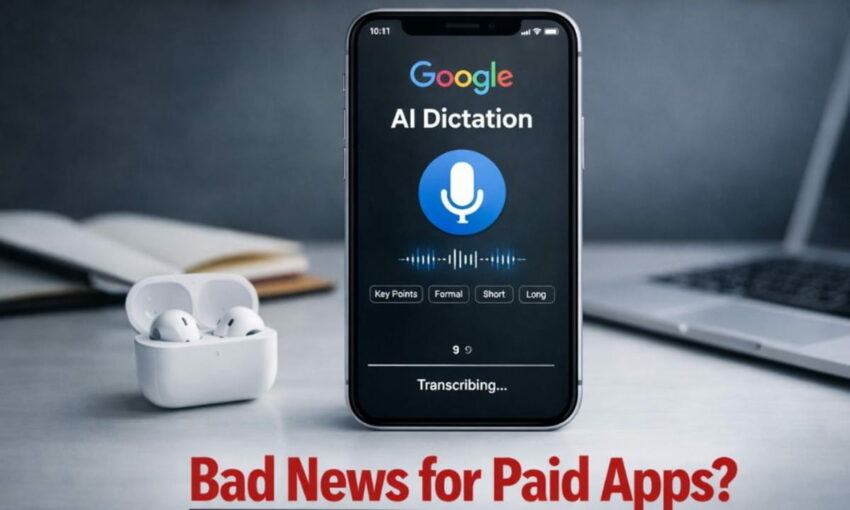
Google did not hold a press event. It did not send a news release. It simply dropped a new AI dictation app into the iOS App Store on April 6 and walked away.
The app, called Google AI Edge Eloquent, converts spoken words into clean, professional text — entirely on the user’s device, without sending a single byte of voice data to the cloud. No subscription. No usage cap. No hidden fees.
That last part matters enormously. Wispr Flow, which raised $30 million from Menlo Ventures and has secured $81 million in total, charges users through a paid Pro tier. SuperWhisper and Willow operate on similar subscription models. Google just walked into that market and offered the same core functionality for free — making it the most accessible AI dictation app available today.
What does the app actually do?
Google AI Edge Eloquent is not a basic voice recorder. The Google AI dictation app targets professionals who dictate frequently and need output that looks edited before they even touch it.
Once users download its Gemma-based automatic speech recognition models, the app begins transcribing speech in real time. When the user hits pause, it automatically filters out filler words like “um” and “ah” and polishes the text.
The app description puts it plainly: “Google AI Edge Eloquent is an advanced dictation app engineered to bridge the gap between natural speech and professional, ready-to-use text. Unlike standard dictation software that transcribes stumbles and filler words verbatim, Eloquent utilizes AI to capture your intended meaning. It automatically edits out ‘ums,’ ‘uhs,’ and mid-sentence self-corrections, outputting clean, accurate prose.”
Four built-in formatting tools let users reshape their dictated content further. “Key points” extracts the main ideas as a bulleted list. “Formal” rewrites the transcript in a more professional tone. “Short” condenses it. “Long” expands it. Together, those tools turn raw speech into a finished draft in seconds — something no standard AI dictation app has managed to offer completely free, until now.
Privacy first — and that is the real story
The offline capability is more than a convenience feature. It addresses a concern that has quietly grown into a dealbreaker for enterprise users and privacy-conscious professionals.
The growing demand in 2026 for artificial intelligence tools that process data locally rather than sending it to third-party servers has become a primary consideration in enterprise and professional software procurement, and Eloquent addresses it in the first toggle the user sees. For anyone evaluating an AI dictation app for workplace use, that single feature changes the conversation entirely.
Users can switch between fully local processing and an optional cloud mode. When cloud mode is on, the app uses cloud-based Gemini models for text cleanup. When it is off, nothing leaves the device. That choice puts users in control rather than assuming they consent to remote processing.
The personal context dictionary represents the one point where Google’s wider data ecosystem appears — briefly and optionally. Users who sign in with a Google account can allow Eloquent to import frequently used words from their recently sent Gmail messages, building a vocabulary profile without manual configuration. Users who prefer to stay completely disconnected can add custom words manually instead.
Google takes on startups — with a structural cost advantage
The transcription market has recently seen a surge in wrapper apps — tools built on top of OpenAI’s Whisper or other open-source models — that charge significant monthly subscriptions for the same cleanup features Google now offers for free.
“This isn’t just about a dictation app,” said tech analyst Marcus Thorne. “It’s a demonstration to developers that Google’s Gemma models can handle complex, real-time linguistic tasks on standard mobile hardware without a $20-a-month subscription gate.”
Google absorbs its inference costs through its wider AI Edge infrastructure. Startups charging subscription fees cannot easily compete on price against a company that built the underlying model and runs it on-device for nothing. Every paid AI dictation app in the market now has a serious problem on its hands.
What comes next?
Google updated the App Store listing and removed references to the Android app, but added that the iOS keyboard version is coming soon. That addition would let users dictate directly into any app without switching screens — a significant upgrade for professionals who live inside email, notes, or messaging tools.
The app currently carries zero ratings and no official marketing. Google appears to be watching whether organic demand justifies a broader rollout before committing to a full launch campaign.
The app falls under the Google AI Edge brand rather than Google’s consumer product umbrella — the same initiative that provides developers with tools and SDKs to run AI models locally on Android and iOS devices. That positioning signals a dual purpose: a real consumer tool and a showcase for what on-device Gemma models can do in practical, everyday settings.
The speech-to-text market just changed. The question is how fast rivals respond — and whether any of them can match a free AI dictation app backed by one of the world’s largest AI operations.
Have you tried offline AI dictation tools yet — and do you think on-device processing is the future of voice-to-text technology? Drop your thoughts in the comments and let us know what you think.