

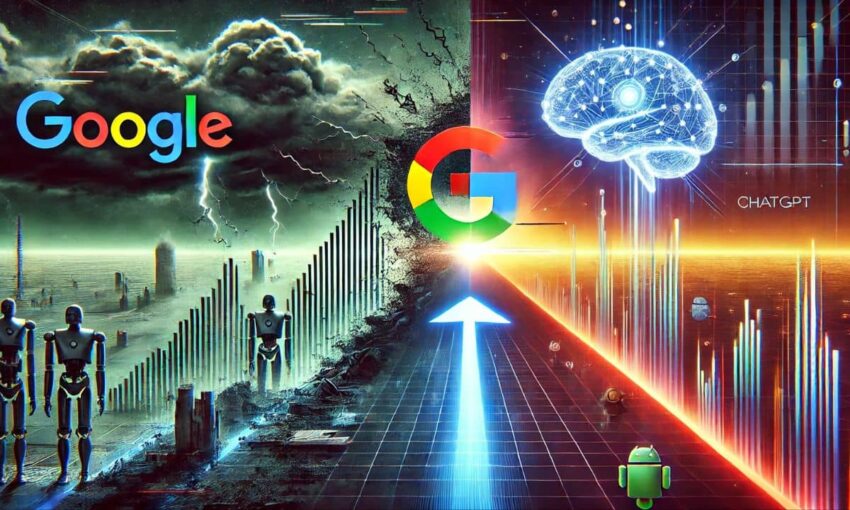
The technology world has witnessed this story before. Twenty-seven years ago, Google emerged as a startup and systematically dismantled Yahoo’s search empire. By late 1999, Google commanded nearly 60% of the search market while Yahoo watched its dominance crumble. Today, Google maintains approximately 80% of global search traffic, while Yahoo clings to a modest 3% market share.
History appears to be repeating itself with artificial intelligence as the disruptive force. OpenAI’s ChatGPT has captured more than 80% of AI-powered search activity as of May 2025. Google’s AI search offerings trail significantly at just 5.6% market penetration. This dramatic shift mirrors the dot-com era transformation that originally elevated Google to supremacy.
The emergence of generative AI search represents a fundamental challenge to Google’s business model. Traditional search methodologies face obsolescence as users increasingly prefer conversational AI interfaces. The question facing Google leadership becomes whether the company can adapt quickly enough to maintain market leadership.
Investment community divided on Google’s future

Bank of America Global Research recently assembled more than 200 institutional investors to assess Google’s competitive position. The discussions revealed sharply divided opinions about the company’s prospects in an AI-dominated landscape.
Optimistic investor perspectives highlight several advantages:
Google possesses unmatched first-party data assets spanning Gmail, Android, YouTube, and Google Maps. This proprietary information could prove decisive as foundational AI models become standardized commodities across the industry.
The company demonstrates superior capabilities in understanding consumer purchase intent and monetizing advertising relationships. Deep partnerships with advertisers and publishers create substantial switching costs for competitors attempting market entry.
Traditional search behaviors remain deeply ingrained in user routines. Billions of daily searches represent habitual patterns that resist rapid change. This behavioral inertia provides Google with time to develop competitive AI solutions.
Google’s diversified business portfolio includes undervalued assets like Google Cloud, YouTube, and Waymo autonomous vehicles. These platforms offer significant growth potential independent of search market dynamics.
Pessimistic viewpoints focus on emerging threats:
User migration toward AI alternatives like ChatGPT reduces engagement with traditional Google Search. Declining search volume directly impacts advertising revenue streams that fund Google’s operations.
Google’s AI Overviews feature provides direct answers without requiring users to click sponsored advertisements. This functionality undermines the pay-per-click model that generates most of Google’s revenue.
Apple’s potential partnership switch from Google to ChatGPT in Safari browsers poses an existential threat. Department of Justice antitrust proceedings could accelerate this transition, eliminating billions in high-margin iPhone search traffic.
Bank of America analysts concluded that Google’s strategic response remains fluid. Post-antitrust resolution, the company could implement aggressive competitive measures to regain its market position.
Transformation from search engine to AI assistant

Generative artificial intelligence fundamentally alters user expectations for search experiences. Google must evolve beyond link-based results toward outcome-focused solutions that prioritize answer quality over traffic volume.
Adam Behrens, CEO of New Generation, projects significant changes by 2030. “Google won’t be a list of links,” Behrens explains. “It’ll be a service where you get answers, then actions.” He emphasizes that brands must “be shoppable, searchable, and ready for whatever agent your customer is using.”
This transformation requires Google to reimagine its core value proposition. Instead of directing users to external websites, AI-powered search delivers comprehensive answers and facilitates immediate actions. Success depends on seamless integration between information discovery and task completion.
Revenue implications and market dynamics
Semrush data reveals that AI-driven search users convert at 4.4 times the rate of traditional searchers. These high-value interactions justify premium advertising rates despite potentially lower search volumes.
Google has initiated several strategic pivots to address competitive pressures:
The company launched Smart Bidding Explore, enabling advertisers to target context-driven queries such as “how to buy a home.” This approach moves beyond keyword matching toward intent-based advertising.
Paid subscription tiers for AI search include AI Pro and Ultra services targeting power users willing to pay for enhanced capabilities.
Advertisement integration appears throughout free AI features, including AI Overviews and Workspace applications. This strategy maintains revenue streams while offering competitive AI functionality.
Gemini AI embedding across Workspace subscriptions creates additional revenue opportunities from existing enterprise customers.
Vertex AI expansion within Google Cloud provides enterprise-grade AI model development tools, addressing business-to-business market opportunities.
Zero-click search challenge intensifies
Google faces growing pressure from zero-click searches that provide answers without generating advertisement clicks. These queries represented 27.2% of U.S. searches, increasing from 24.4% the previous year.
ChatGPT’s momentum continues to accelerate with 5.5 billion visits during May 2025. This traffic represents approximately 80% of all generative AI search activity. Google Gemini attracts roughly 13.5% of generative AI engagement, highlighting the competitive gap.
International competitors add complexity to Google’s strategic challenges. China’s DeepSeek chatbot commands nearly 90% of Chinese conversational AI traffic while raising data privacy concerns for global expansion.
StatCounter global statistics show ChatGPT leading with approximately 79.8% of AI search referrals. This dominance spans multiple geographic markets and demographic segments.
Strategic imperatives for Google’s survival
Google must execute several critical initiatives to maintain competitive relevance:
Search platform transformation toward proactive, conversational AI capabilities requires fundamental infrastructure changes. Traditional keyword-based algorithms must evolve into context-aware systems capable of multi-turn conversations.
First-party data leverage combined with expanded advertising models that reward quality outcomes over click volume. This shift requires new performance metrics and advertiser education programs.
Revenue measurement evolution, with average revenue per user becoming more important than total search volume. Premium AI services justify higher pricing despite potentially smaller user bases.
Ecosystem integration connecting non-search products into unified AI-enhanced platforms. YouTube, Gmail, Maps, and Cloud services must work seamlessly together to create comprehensive user experiences.
Baruch Labunski, founder of Rank Secure, maintains optimism about Google’s adaptation capabilities. “AI will cause significant changes to Google over the next five years and most are positive,” Labunski states. He emphasizes Google’s technical resources and market position advantages.
However, successful evolution requires immediate action rather than gradual adjustment. Google’s strategic execution over the next eighteen months will determine whether the company reclaims AI leadership or follows Yahoo’s path toward market irrelevance.
The artificial intelligence revolution presents both an existential threat and an unprecedented opportunity. Google’s response will shape the future of internet search and determine whether today’s dominant platforms can successfully navigate technological disruption.
How do you think Google will adapt to the AI search revolution? Have you noticed changes in your own search habits with the rise of ChatGPT and other AI tools?
Do you believe Google can maintain its dominance, or if we are witnessing the next major tech disruption? Please share your views below.