

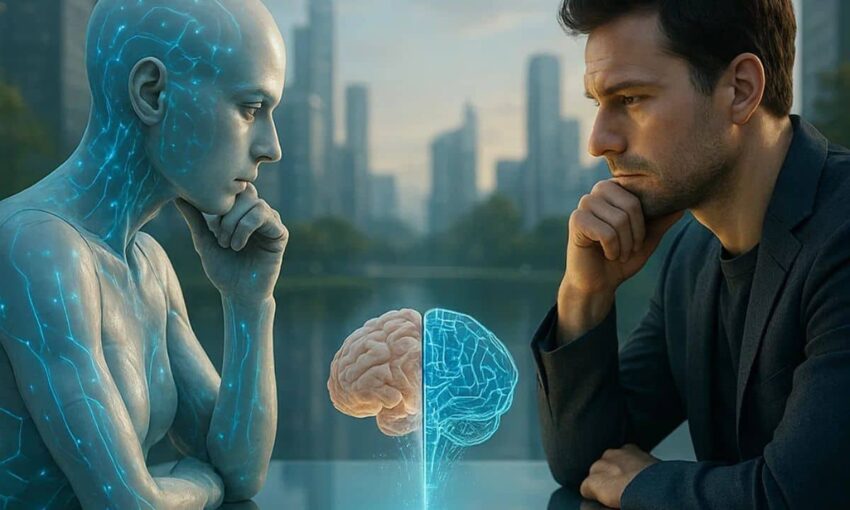
Researchers from China’s leading scientific institutions have published remarkable evidence suggesting artificial intelligence systems naturally develop thought processes similar to human cognition. The breakthrough study, conducted by teams at the Chinese Academy of Sciences (CAS) and South China University of Technology, appears in the prestigious journal Nature Machine Intelligence and could reshape our understanding of machine learning capabilities.
The research focused on how major AI platforms like OpenAI’s ChatGPT and Google’s Gemini process and categorize everyday objects. Scientists discovered that these large language models spontaneously create organizational frameworks that closely mirror human mental structures for understanding the physical world.
This discovery addresses whether artificial intelligence can truly replicate sophisticated human thinking. While AI excels in data processing, language translation, and creative applications, experts have debated its capacity for deeper cognitive functions like abstract reasoning and conceptual understanding. These new findings suggest the gap may be narrower than previously thought.
“Examining how humans conceptualize and organize natural objects provides crucial insights into perception and cognitive processes,” the research team explained in their published work.
Research methodology and experimental design
The scientists employed multiple research approaches, combining behavioral testing, computational analysis, and brain imaging techniques. Their primary tool was the “triplet odd-one-out” assessment, a well-established method in cognitive psychology research. This test presents three items and requires the selection of the item that differs from the others.
Two distinct AI models underwent evaluation: ChatGPT-3.5, which processes text-based information, and Gemini Pro Vision 1.0, which analyzes visual content. Researchers presented both systems with 1,854 real-world objects spanning diverse categories, including animals, plants, food items, furniture, and vehicles. The models completed sorting tasks that generated over 4.7 million individual judgments.
This extensive dataset enabled researchers to map the “similarity frameworks” underlying each model’s object recognition systems. The analysis revealed 66 distinct dimensions that the AI systems used to differentiate and connect various items.
These dimensions extended beyond basic categorization like “living” or “manufactured.” The models demonstrated sophisticated understanding through attributes, including temperature associations, textural properties, age-appropriate usage, material composition, and environmental contexts. This complexity suggests genuine conceptual comprehension rather than simple pattern matching.
“Modern AI can differentiate between photographs of cats and dogs, but the fundamental distinction between this ‘identification’ and human ‘comprehension’ of these animals has remained unclear,” explained He Huiguang, professor at the CAS Institute of Automation.
Striking parallels between artificial and human intelligence
To validate their findings, researchers compared AI judgments with data from human participants completing identical tasks. The results showed remarkable convergence in conceptual groupings between artificial and human intelligence.
Brain imaging studies provided even more compelling evidence. The research revealed that AI internal data structures, known as embeddings, demonstrated strong correlation with activity patterns in specific human brain regions. Particularly notable was alignment with the parahippocampal cortex, a brain area crucial for processing environmental information and visual scene interpretation.
The similarity between AI processing methods and human cognitive patterns was especially pronounced in multimodal systems like Gemini, which handles both visual and textual information, compared to text-only models like ChatGPT.
“These results offer convincing evidence that object representations in large language models, while not identical to human cognition, share fundamental characteristics reflecting essential aspects of human conceptual knowledge,” the researchers stated.
Implications for artificial intelligence development
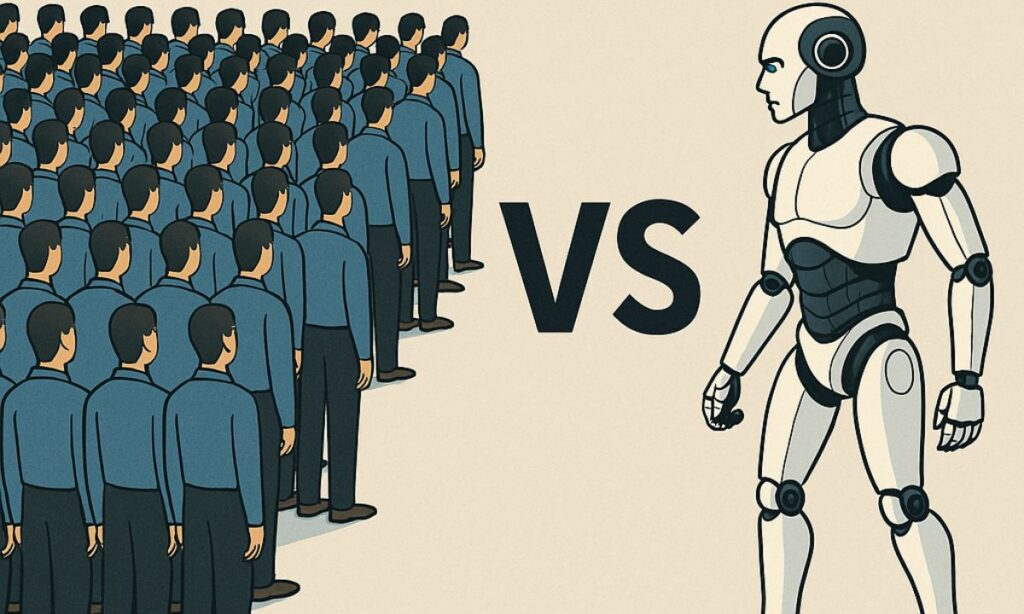
These discoveries carry profound implications for future AI advancement. The research suggests that machines can naturally develop internal cognitive structures aligned with human conceptual frameworks without specialized training for specific tasks. This capability could enable more intuitive human-AI collaboration across numerous applications.
Potential applications span intelligent robotics, educational technology, mental health assessment tools, and autonomous systems. The findings could accelerate progress toward artificial general intelligence (AGI) by demonstrating that current AI architectures already possess basic cognitive capabilities.
The researchers emphasized important limitations in their findings. AI representations, while similar to human thinking, are not identical and lack certain sensory dimensions like spatial arrangement or shape recognition in text-trained models. Enhanced multimodal AI systems incorporating diverse sensory inputs may bridge these remaining gaps.
Global competition in AI research
This breakthrough emerges amid intense international competition in artificial intelligence development. While Western companies like OpenAI and Google maintain market leadership, Chinese research contributions are proving increasingly vital to foundational AI science.
The study’s use of publicly available models like ChatGPT-3.5 and Gemini Pro Vision demonstrates that significant advances are occurring in accessible systems rather than proprietary research platforms. This accessibility could accelerate broader AI development and application.
As debates continue regarding AI’s cognitive potential, this research provides empirical evidence supporting the possibility that artificial systems can develop representations closely resembling human world understanding.
How do AI systems that mirror human thought processes impact your daily life and work? Please share your views below.