

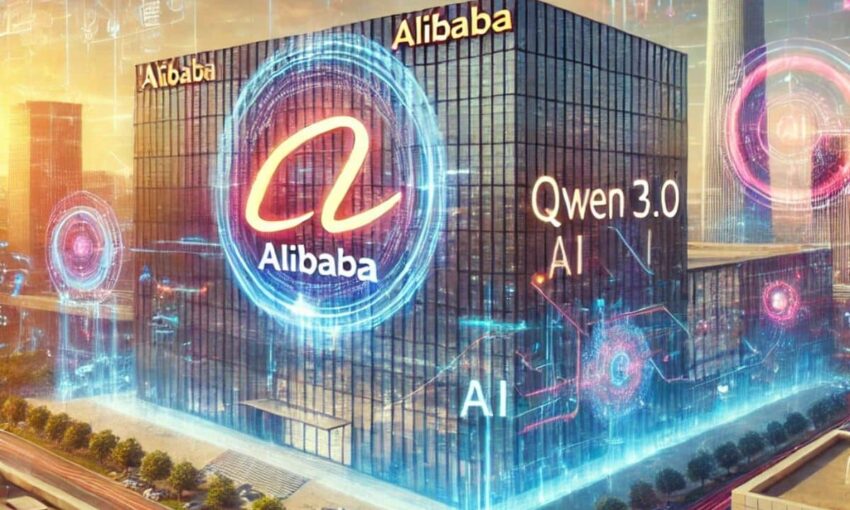
Alibaba Group rolled out its newest artificial intelligence system, Qwen 3.0, on Monday, strengthening its position in China’s increasingly competitive AI landscape. The launch underscores the mounting rivalry among Chinese technology giants as they develop domestic alternatives to American-created models such as OpenAI’s GPT-4.
The company showcased its latest innovation at the 2024 Alibaba Cloud Summit held in Beijing. The cloud computing division presented Qwen 3.0 as its most sophisticated iteration to date. This comprehensive package includes text-processing capabilities alongside multimodal functions that can process images, audio content, and video inputs.
During the presentation, Daniel Zhang, who leads Alibaba Cloud Intelligence, declared, “Qwen 3.0 represents a transformative milestone for business and consumer artificial intelligence applications across China.”
Strategic open-source and enterprise approach
The Qwen 3.0 ecosystem comes in various configurations, ranging from streamlined versions to robust enterprise solutions. Alibaba has partially open-sourced the Qwen portfolio, a strategic decision intended to foster wider implementation within China’s rapidly expanding AI development community.
The company offers smaller Qwen variants at no cost. Larger, more powerful versions are available through Alibaba’s cloud services for commercial applications. This dual strategy reveals Alibaba’s ambition to establish dominance across government and private sectors in industries, including financial services, production, educational systems, and medical technology.
Company representatives highlighted substantial enhancements over previous Qwen 2.5 models, particularly in logical reasoning capabilities, software development functionality, and support for multiple languages.
Global aspirations beyond Chinese markets
Alibaba clearly positioned Qwen 3.0 as more than just a regional product. The technology giant is presenting Qwen as a worldwide competitor, aiming to challenge offerings from Microsoft, OpenAI, Google DeepMind, and Anthropic.
While American AI development has flourished with substantial investment and innovation, Chinese enterprises are rapidly advancing. Beijing has also aggressively promoted homegrown technological development, particularly after Washington limited access to advanced semiconductors essential for training sophisticated AI models.
Qwen 3.0’s international expansion faces potential obstacles. Alibaba must navigate complex regulatory environments and address wariness toward Chinese technologies in Western marketplaces.
Technical advancements in Qwen 3.0
According to Alibaba, Qwen 3.0 delivers enhanced logical reasoning, expanded context retention, and improved content safety features. These advancements address critical concerns for enterprise clients worried about data security and inaccurate outputs.
The models demonstrate improved handling of complex instructions while generating more precise and sophisticated text. The company identified enhancements in alignment methodology and prompt interpretation as fundamental improvements.
Alibaba reported that Qwen 3.0 can now process over 200,000 tokens simultaneously, enabling analysis and summarization of extensive documents. This capability places it in direct competition with recent models from OpenAI and Anthropic, which also feature extended context processing.
Another notable advancement is Qwen’s expanded language support. The system now performs tasks across more than 30 languages, including English, Chinese, Japanese, Spanish, and French. This enhancement strengthens Alibaba’s appeal to international customers.
Multimodal innovation
A significant advancement in Qwen 3.0 is its multimodal functionality. The system can interpret not only text but also visual content, audio, and video. This development aligns with broader industry movement toward versatile AI systems capable of processing multiple data formats concurrently.
Alibaba demonstrated Qwen 3.0 producing textual descriptions from images, responding to video-based questions, and creating audio responses to written prompts.
This integrated multimodal approach brings Qwen closer to the comprehensive “AI assistant” concept that organizations like OpenAI and Google DeepMind are actively pursuing.
Business strategy and collaborative initiatives

Alibaba Cloud announced the immediate availability of Qwen 3.0 for its business clients. The company also plans to incorporate Qwen into its enterprise software offerings, including DingTalk communication platform and Alibaba’s e-commerce infrastructure.
The company is actively establishing partnerships with Chinese businesses, government organizations, and educational institutions. Alibaba anticipates substantial AI demand from these sectors in coming years.
Qwen 3.0 will additionally support Alibaba’s public cloud infrastructure, where developers can customize the models for specific applications.
Intensifying domestic competition
Alibaba’s announcement increases pressure on competitors, including Baidu, Tencent, and ByteDance. Baidu recently updated its Ernie AI platform, while ByteDance continues significant investment in large language model research through its AI Laboratory.
Chinese companies are working urgently to decrease dependence on American technologies. The government’s current five-year strategic plan explicitly identifies artificial intelligence as a crucial element of future economic development.
Market analysis from EqualOcean suggests China’s large model sector could exceed $10 billion by 2026.
Industry Context: DeepSeek R2 and reasoning evolution

While Alibaba advances Qwen, other Chinese organizations are making progress. DeepSeek, an AI startup with backing from Tencent and prominent Chinese universities, announced plans to release DeepSeek R2 in mid-2025.
DeepSeek R2 focuses on advanced reasoning capabilities, addressing a significant limitation in many existing AI systems. The company states that its forthcoming model can maintain extended logical sequences, provide more reliable source citations, and modify reasoning approaches based on user requirements.
This represents a shift from generating primarily creative content toward producing verifiable, logic-based results. Industry analysts suggest DeepSeek R2 could challenge established competitors both domestically and internationally.
Huawei’s challenge to Nvidia’s market leadership
Simultaneously, Huawei is making strategic advances in AI hardware development. According to the Wall Street Journal, Huawei has created a new artificial intelligence chip to compete with Nvidia’s industry-leading H100 GPUs.
The processor, named Ascend 910B, reportedly delivers competitive training performance at reduced costs. Huawei targets Chinese cloud providers and AI developers affected by U.S. export restrictions.
If successful, Huawei’s initiative could disrupt the AI hardware supply chain and lessen China’s reliance on imported semiconductor technology.
Broader implications
Alibaba’s Qwen 3.0 launch provides further evidence that Chinese technology leaders are narrowing the gap with American competitors. The coming year likely will witness numerous AI model releases, hardware introductions, and intensified global competition as the struggle for AI leadership accelerates.
With emerging organizations like DeepSeek entering the market and companies, such as Huawei enhancing hardware capabilities, the global artificial intelligence ecosystem appears positioned for significant transformation through 2025.
As Daniel Zhang concluded at the summit, “The future belongs to those who can transform intelligence into practical value.”
The rapid evolution of AI technology in China and globally affects businesses and consumers alike. What’s your perspective on these developments? Do you see Alibaba’s Qwen 3.0 as a serious challenger to Western AI systems? Are you concerned about the growing technological competition between China and the United States?
Please share your thoughts below.