

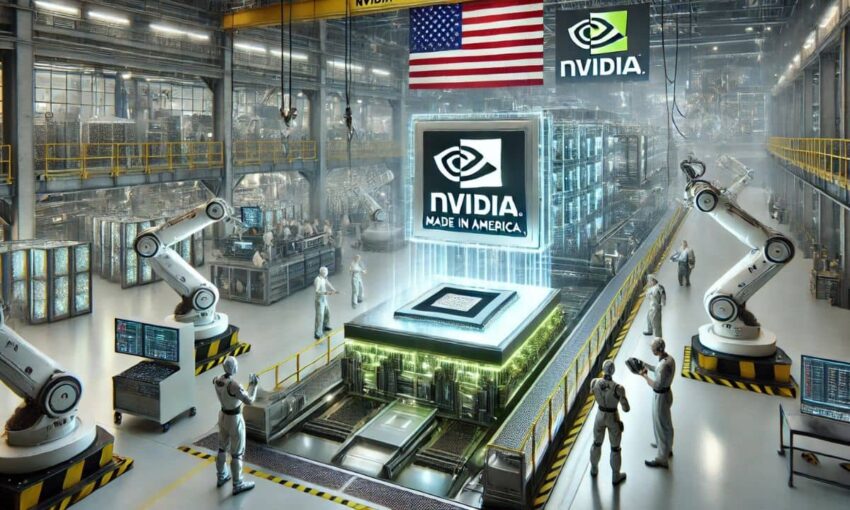
NVIDIA has begun making its advanced AI supercomputers and Blackwell chips entirely in the United States. This marks the first time the company will produce its complete AI infrastructure on American soil. The move could reshape global AI manufacturing.
American-made AI: A manufacturing renaissance
NVIDIA has secured over 1 million square feet of production space in Arizona and Texas. The new Blackwell AI chips are already being made at TSMC’s Phoenix facility. Supercomputer assembly plants are being built with Foxconn in Houston and Wistron in Dallas.
Full production of chips and artificial intelligence systems will ramp up within the next 12-15 months. Experts see this as both a tech advancement and a response to supply chain concerns.
Bolstering national technology infrastructure
This shift comes as demand for secure AI computing resources surges worldwide. NVIDIA projects its plan will create about $500 billion worth of AI infrastructure in the U.S. over four years.
“The engines of the world’s AI infrastructure are being built in the United States for the first time,” said NVIDIA founder and CEO Jensen Huang. “This helps us meet growing demand, strengthens our supply chain, and boosts our resiliency.”
The move does more than reduce foreign dependencies. It helps strengthen America’s position in the competitive global AI market.

International collaboration for domestic production
NVIDIA has partnered with several tech manufacturers. TSMC makes Blackwell chips in Phoenix, Arizona. Foxconn builds AI supercomputers in Houston, Texas. Wistron constructs another AI facility in Dallas, Texas. Amkor and SPIL handle packaging and testing in Arizona.
This network creates a complete domestic pipeline from silicon wafers to working AI systems.
AI factories: The next evolution in computing
Central to NVIDIA’s plan is the concept of the AI factory. These differ from standard data centers. They’re built specifically for training and running massive AI models for various applications.
NVIDIA’s Blackwell-powered supercomputers will power these AI factories. They will handle model training and operations at unprecedented scale.
The company expects dozens of gigawatt-scale AI factories across the U.S. in coming years. This could create hundreds of thousands of high-skill jobs and generate trillions in economic value.
Digital innovation in manufacturing
NVIDIA will use its own advanced technologies in these factories. Omniverse will create digital twins of each facility. The Isaac GR00T robotics platform will automate manufacturing. AI systems will manage materials, quality control, and logistics.
This blend of digital and physical systems marks a major advancement in manufacturing methods. It aligns with Industry 5.0 principles of smart, adaptable production.
Strategic and economic implications
NVIDIA’s initiative aligns with Washington’s focus on tech independence and supply chain security. The 2022 CHIPS Act helped lay the groundwork for this domestic expansion. As computing power increasingly determines economic strength, NVIDIA’s commitment to America-made products could shift global innovation leadership. The strategy positions America competitively in the international AI race.
The future of AI infrastructure
NVIDIA’s announcement positions the U.S. as a leader in end-to-end AI hardware production. While China and the EU advance their own capabilities, NVIDIA’s comprehensive approach sets a new standard.
In the coming decade, AI factories will likely become crucial economic engines. With trillions in projected impact, NVIDIA’s strategy may redefine how nations develop AI capabilities.
The integration of chip manufacturing, supercomputer assembly, and advanced software platforms creates a unique ecosystem. This holistic approach could become a template for technology sovereignty worldwide.
As AI continues transforming industries from healthcare to transportation, NVIDIA’s domestic production initiative represents more than manufacturing. It signals a fundamental shift in how nations view critical technology infrastructure.
These facilities will serve as the foundation for next-generation AI applications in fields ranging from scientific research to autonomous systems, powering innovations that could reshape the global economy.
What do you think about NVIDIA’s move to bring AI supercomputer manufacturing to American soil? Will this domestic production strategy give the U.S.A. a competitive edge in the global AI race, or are there potential drawbacks we should consider?
We want to hear from industry professionals, tech enthusiasts, and concerned citizens alike. Please share your thoughts in the comments below on how this manufacturing shift might impact America’s technological future.