

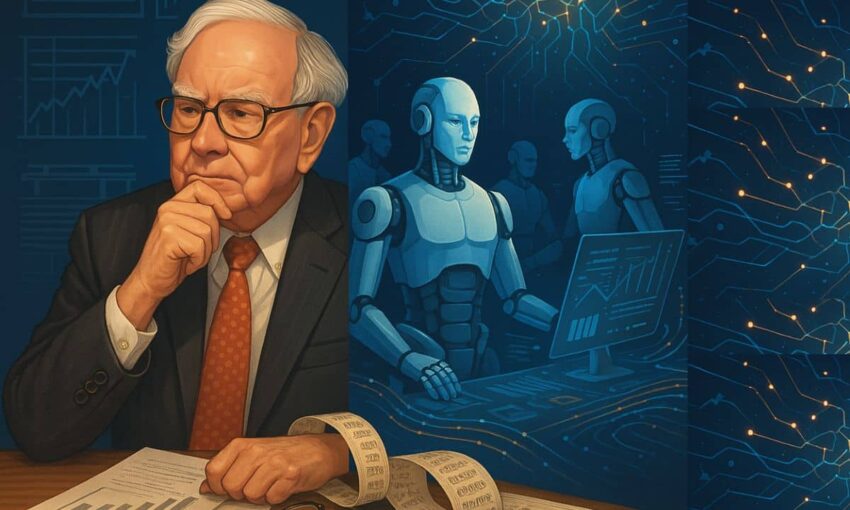
The investment world has long associated Warren Buffett with railroads, insurance companies, and consumer staples—traditional businesses with predictable cash flows. Yet a closer examination of Berkshire Hathaway’s current portfolio reveals a surprising pivot toward artificial intelligence. The “Oracle of Omaha” has committed over 23% of his company’s massive $259 billion portfolio to just two tech behemoths at the forefront of the AI revolution: Apple and Amazon.
This strategic concentration signals that perhaps the world’s most celebrated value investor sees the future of business through a decidedly high-tech lens.
Apple: The core of Buffett’s portfolio faces growing headwinds
Constituting an extraordinary 22.1% of Berkshire Hathaway’s equity holdings, Apple represents Buffett’s most significant wager on the digital future. This outsized stake demonstrates remarkable conviction in the iPhone creator’s long-term prospects, even as market analysts increasingly express reservations.
While Apple captured the leadership position in global smartphone shipments during Q4 2024 with 23% market share, its financial performance has shown signs of moderation. The December 2024 quarter saw revenue climb just 4% to $124 billion—hardly the explosive growth that initially attracted many tech investors. Net income growth of 10% to $2.40 per diluted share appears impressive at first glance, but a closer examination reveals this improvement stemmed more from aggressive share repurchases than organic business expansion.
The intensifying economic conflict between the United States and China presents perhaps the most formidable challenge to Apple’s business model. President Trump’s second administration has dramatically escalated trade tensions, implementing tariffs on Chinese imports that now average 145%—seven times higher than rates under the previous administration. This policy shift strikes at the heart of Apple’s manufacturing strategy, as the company produces the majority of its flagship iPhones in Chinese facilities.
With smartphones generating more than half of Apple’s total revenue, these heightened tariffs present a strategic dilemma: either absorb the additional costs and watch profit margins deteriorate, or increase prices and potentially alienate price-sensitive consumers. Further complicating matters, rising nationalist sentiment among Chinese consumers threatens Apple’s position in what has historically been one of its most crucial growth markets.
Apple’s much-anticipated embrace of artificial intelligence has also delivered mixed results thus far. The “Apple Intelligence” ecosystem, introduced alongside the iPhone 16 in October 2024, was expected to catalyze a significant upgrade cycle among existing customers. However, consumer response has been tepid, with no substantial sales acceleration materializing in the months following the launch.
Despite these mounting challenges, the investment community maintains cautious optimism. Among the 40 analysts tracking Apple, the median price target suggests potential appreciation of 32% to $250 per share from its current $189 valuation. However, the company’s forward price-to-earnings ratio of 26, while below its two-year average of 30, appears increasingly difficult to justify against projected earnings growth of just 10% through fiscal 2026.
Nonetheless, Buffett’s unflagging confidence in Apple’s ecosystem dominance, customer loyalty, and innovation capacity appears to outweigh these near-term concerns, explaining its commanding position within Berkshire’s investment strategy.
Amazon: The modest allocation hiding enormous AI ambitions
In contrast to Apple’s dominant portfolio presence, Amazon occupies a mere 0.7% of Berkshire Hathaway’s equity investments. However, this relatively modest allocation belies the company’s extraordinary influence across e-commerce, cloud computing, advertising, and increasingly, artificial intelligence applications.
Amazon demonstrated robust performance in Q4 2024, with revenue expanding 10% year-over-year to reach $187 billion. The company’s profitability surged dramatically, with GAAP earnings per share increasing 86% to $1.86, powered primarily by accelerating growth in its high-margin advertising and cloud computing divisions.
Amazon Web Services (AWS) continues to serve as the company’s most strategic asset, maintaining its position as the world’s preeminent cloud platform by both revenue and customer base. This infrastructure leadership provides Amazon with unique advantages in commercializing artificial intelligence technologies, combining unmatched computing resources, an extensive enterprise client network, and early implementations of generative AI solutions.
The company has aggressively integrated AI technologies throughout its vast retail ecosystem. These innovations include AI-powered tools that enhance seller listing capabilities, sophisticated algorithms that optimize warehouse operations, and advanced robotics systems capable of natural language interactions. To date, Amazon has developed or initiated nearly 1,000 distinct generative AI applications—all designed to simultaneously reduce operational expenses and enhance customer satisfaction.
Amazon’s advertising business represents another area of impressive momentum, with related revenues climbing 18% in the most recent quarter. Perhaps most significantly, the company recently unveiled its Amazon Retail Ad Service, enabling third-party retailers to incorporate sponsored content within their digital properties. Should this initiative gain widespread adoption, it could substantially strengthen Amazon’s already formidable position in the digital advertising landscape.
Looking forward, analysts project 14% earnings growth for Amazon in the coming year. While its price-to-earnings multiple of 32 might appear elevated at first glance, this valuation deserves context—Amazon has consistently outperformed consensus earnings expectations, exceeding analyst estimates by an average of 22% across the previous four quarters.
For investors with extended time horizons, particularly those who recognize AI’s transformative potential in retail and cloud services, Amazon at its current $179 share price represents a compelling opportunity despite its premium valuation.

AI: The strategic thread uniting Buffett’s technology thesis
While Warren Buffett built his legendary investment reputation by identifying businesses with sustainable competitive advantages and dependable cash generation, his largest current holdings reflect growing appreciation for companies leveraging artificial intelligence as a fundamental competitive differentiator. Both Apple and Amazon have committed substantial resources to machine learning, generative AI, and automation—technologies poised to revolutionize productivity, personalization, and profitability across industries.
Notably, Buffett’s approach to AI investment appears distinctly practical rather than speculative. Apple and Amazon are implementing AI in tangible, revenue-generating applications—from hardware optimization and content recommendation to advertising algorithms and operational efficiency improvements. For Buffett, this pragmatic deployment of cutting-edge technology, rather than merely chasing innovation trends, likely underpins his substantial commitment to these two technology leaders.
Should investors follow Buffett’s AI investment blueprint?
While much of the investment community remains captivated by emerging AI startups and specialized semiconductor manufacturers, Berkshire Hathaway’s portfolio construction suggests that sustainable long-term value creation may reside with established enterprises already demonstrating AI’s capacity to enhance fundamental business operations. Both Apple and Amazon satisfy this criterion, albeit with distinctly different risk-reward characteristics.
Apple offers unparalleled brand loyalty and consistent financial returns, though increasingly complicated by regulatory scrutiny and geopolitical tensions. Amazon, through its aggressive deployment of AI across its diversified business units, potentially offers greater growth potential, balanced against correspondingly higher execution uncertainties.
For investors seeking exposure to artificial intelligence’s transformative potential without embracing highly speculative alternatives, Buffett’s carefully constructed portfolio may provide an instructive framework for balancing innovation and investment prudence.
What’s your take on Buffett’s technology thesis? As artificial intelligence reshapes industries and investment landscapes, seasoned and novice investors alike must reconsider traditional approaches.
Please share your perspective on whether Buffett’s balanced AI strategy through established tech giants offers the optimal path forward.