

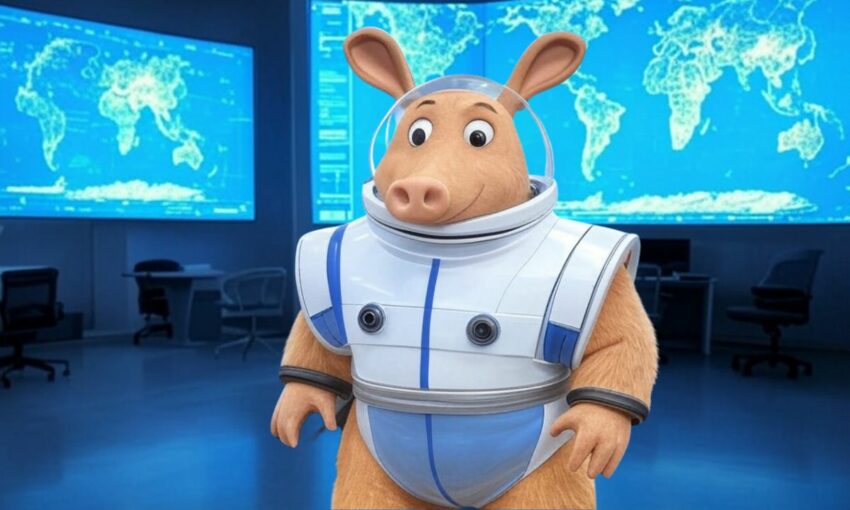
A revolutionary advance in meteorological science has emerged as researchers unveil Aardvark Weather, a cutting-edge AI-powered weather forecasting system developed through an international partnership between the University of Cambridge, the Alan Turing Institute, Microsoft Research, and the European Centre for Medium-Range Weather Forecasts (ECMWF). This innovative technology promises to deliver weather predictions with remarkable speed and precision, fundamentally changing how we anticipate atmospheric conditions.
The dawn of the new forecasting era
Conventional weather forecasting has historically depended on numerical weather prediction (NWP) models, complex systems that simulate atmospheric behavior through sophisticated mathematical equations. These traditional methods demand enormous computational power, typically requiring supercomputers to run nonstop simulations to generate reliable forecasts.
Aardvark Weather takes a fundamentally different approach, employing artificial intelligence to directly analyze raw meteorological data collected from diverse sources including satellites, ground stations, weather balloons, maritime vessels, and aircraft. This technological leap means a single researcher with a standard desktop computer can now produce highly accurate forecasts in minutes, effectively democratizing access to sophisticated weather prediction capabilities.
Remarkable performance with minimal resources
What truly distinguishes Aardvark Weather is its extraordinary efficiency. The platform operates at speeds tens of times faster than traditional forecasting systems while consuming thousands of times less computational resources.
Perhaps most impressively, despite utilizing merely 10% of the input data required by conventional systems, Aardvark has outperformed the United States’ Global Forecast System (GFS) across several critical meteorological variables. This dramatic reduction in resource requirements translates to significantly lower operational expenses and substantially decreased energy consumption, contributing to environmental sustainability goals while improving forecast quality.

Tailored forecasting for every need
Aardvark Weather’s flexibility represents another breakthrough in meteorological science. Its AI architecture enables the rapid development of specialized forecasting models designed for specific applications or geographical regions.
Agricultural operations in Africa could benefit from customized temperature and precipitation forecasts, while renewable energy providers in Europe might leverage tailored wind predictions to optimize power generation. Such personalization was previously unattainable with conventional systems due to their inherent rigidity and substantial resource requirements.
Bringing advanced forecasting to all nations
By dramatically reducing dependence on expensive computational infrastructure, Aardvark Weather creates unprecedented opportunities for developing nations to access sophisticated weather prediction technology.
Dr. Scott Hosking, Director of Science and Innovation for Environment and Sustainability at the Alan Turing Institute, emphasized this potential, stating that this technological breakthrough could “democratize forecasting” by making powerful prediction capabilities available worldwide. This accessibility would provide valuable support to policymakers, emergency response planners, and industries that depend on accurate weather information to operate safely and efficiently.
Strengthening protection against natural disasters
Precise and timely weather forecasts are critical to effective disaster management and emergency response. Dr. Anna Allen, the study’s lead author from the University of Cambridge, highlighted how Aardvark Weather establishes a foundation for more accurate predictions of extreme weather events including hurricanes, wildfires, and tornadoes.
These enhanced forecasting capabilities enable authorities to issue earlier warnings with greater confidence, potentially preserving lives and reducing economic damage associated with severe weather phenomena.
Complementing traditional forecasting methods
The emergence of AI-powered systems like Aardvark does not signal the obsolescence of traditional NWP approaches. Rather, these advanced AI models can work in concert with established methods, providing rapid initial forecasts that can subsequently be refined using conventional techniques. This complementary methodology ensures meteorological services can deliver both the immediacy and accuracy required by diverse user groups, from emergency services needing rapid assessments to long-term planners requiring detailed analysis.
Navigating the road ahead
While Aardvark Weather represents a significant breakthrough, its widespread implementation faces several important challenges. Ensuring consistent reliability of AI-generated forecasts across diverse climatic zones and seamlessly integrating these new technologies with existing meteorological systems remain critical priorities.
Furthermore, maintaining forecast accuracy over time necessitates continuous model training with current meteorological data as climate patterns evolve.
Researchers are developing protocols to validate AI system’s predictions against real-world observations, establishing confidence intervals that indicate prediction reliability. They’re also exploring methods to make AI’s decision-making process more transparent, addressing a common concern with machine learning applications in scientific fields.
Additionally, the team is collaborating with meteorological agencies worldwide to develop implementation frameworks that incorporate Aardvark into existing weather service infrastructure. These partnerships aim to establish standardized approaches for transitioning from purely computational models to hybrid systems that leverage traditional physics-based methods and AI predictions.
Expanding applications beyond traditional forecasting
Beyond improving standard weather predictions, Aardvark Weather’s capabilities open new possibilities for specialized applications. The research team is exploring how the system might be adapted to predict air quality, pollen counts, and other environmental factors affecting public health. Early tests suggest the AI framework can be trained to recognize patterns in these domains with similar efficiency gains.
The system’s reduced computational requirements also make it particularly well-suited for integration with mobile applications and Internet of Things (IoT) devices. This could enable hyperlocal weather predictions that account for urban microclimates and other localized phenomena that traditional models typically miss due to resolution limitations.
Climate researchers are additionally investigating whether Aardvark’s approach might improve climate change projections by identifying subtle pattern shifts that conventional models struggle to capture. While the AI system won’t replace complex climate models, it could highlight areas requiring closer examination with traditional methods.
The human element in an AI weather future
As AI systems like Aardvark become more prevalent in meteorology, the role of human forecasters will evolve rather than disappear. Meteorologists with expertise in traditional forecasting and AI interpretation will be increasingly valuable, serving as critical interpreters who can contextualize machine predictions and recognize when unusual circumstances might compromise AI forecasts.
Educational programs are already being developed to prepare the next generation of meteorologists for this hybrid approach. These curricula combine traditional atmospheric science with data science and AI literacy, ensuring graduates can work effectively in this transformed field.
Conclusion
The introduction of Aardvark Weather marks a pivotal transformation in meteorological science. By harnessing artificial intelligence, this innovative system delivers faster, more efficient, and customizable weather forecasts, making sophisticated meteorological insights accessible to a wider audience. As the technology matures and integrates with current systems, it holds tremendous potential to enhance disaster preparedness, support diverse industries, and contribute meaningfully to global sustainability initiatives.
The years ahead will likely see a gradual integration of AI-powered forecasting into mainstream meteorological services, with Aardvark Weather and similar systems complementing rather than replacing traditional approaches. This technological evolution promises more accurate, timely, and accessible weather predictions—benefits that will ripple through countless sectors of society, from agriculture and energy production to emergency management and everyday planning.
Share your thoughts below on how AI weather forecasting might affect the meteorologists’ roles – is Aardvark Weather a game-changer or just another tech trend?