

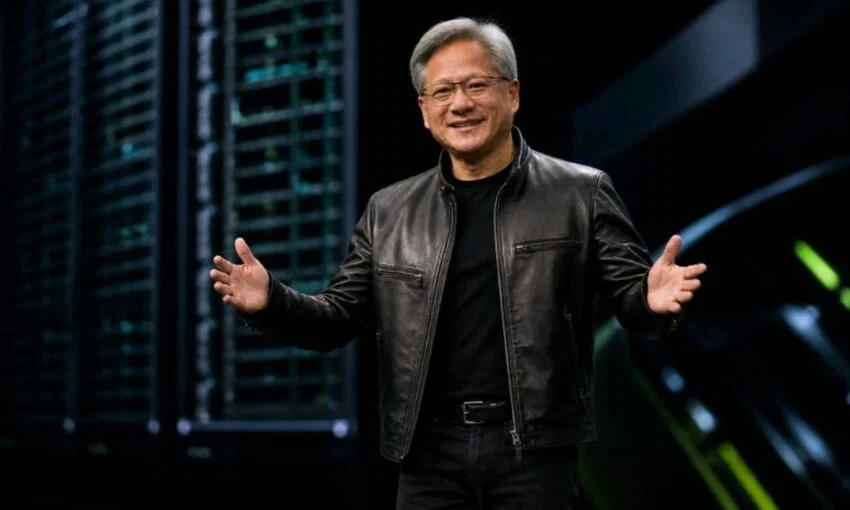
Nvidia CEO Jensen Huang pushed back hard against growing fears that artificial intelligence will wipe out jobs across the American economy, telling a high-profile audience Monday that the technology will drive hiring on a massive scale rather than trigger mass unemployment.
Huang made his case during a conversation with CNBC anchor Becky Quick at the Milken Institute Global Conference. His remarks landed at a moment when workers, business leaders, and economists cannot agree on whether artificial intelligence AI will strengthen the labor market or hollow it out.
Huang did not hedge. The Nvidia CEO argued that AI will fuel new factories, new infrastructure, and entirely new categories of work. He framed the coming shift as a national industrial opportunity.
“AI creates jobs,” Huang said, adding that “AI is [the] United States’ best opportunity to re-industrialize” itself.
That argument cuts directly to the heart of the current debate. AI tools have already moved into offices, call centers, design studios, newsrooms, and software teams. That pace has alarmed workers who fear employers will use the technology to cut headcount, freeze entry-level hiring, and hand more work to software platforms.
Huang rejected that reading. He argued that people confuse a task with a complete job. Software may absorb parts of a role, he said, without eliminating the person who holds it.
He told the audience that critics “misunderstand that the purpose of a job and the task of a job are related.”
Job fear meets infrastructure boom
Huang’s defense also reflects the company he leads. Nvidia manufactures the chips that power the AI infrastructure. Its processors run inside data centers, cloud networks, and advanced computing systems worldwide. That gives the company a direct financial stake in how the public views the technology.
Still, the economic case behind Huang’s claim extends beyond chip revenue. The physical infrastructure that AI demands requires electrical workers, construction crews, data-center engineers, cooling system specialists, and power-grid planners. None of those roles disappears into software.
Goldman Sachs Research reported in March 2026 that 300 million jobs globally are exposed to automation. But the same analysis found that the AI buildout could generate substantial new work in power and data-center infrastructure. Goldman estimated that roughly 500,000 net new jobs in the United States will need to be filled by 2030 just to meet rising power demand. Data-center-related construction employment has already risen by 216,000 positions since 2022.
That context strengthens Huang’s argument on one level. The technology may threaten some office-based tasks, but it also demands a large and growing physical economy to support it. Servers need buildings. Buildings need power. Power systems need skilled workers. Companies also need employees who can manage, operate, and improve the tools themselves.
Nvidia amplified that message beyond the Milken stage.
In a recent company post, Nvidia quoted Huang directly: “AI has created more than half a million jobs. Companies that use AI grow faster. When they grow faster, they hire more people.”
Economists still see disruption ahead

The broader labor picture is more complicated than Huang’s optimism suggests.
The World Economic Forum’s Future of Jobs Report 2025 projected that job disruption from AI and automation could affect 22% of global employment by 2030. The report forecast 170 million new roles and 92 million displaced roles, producing a net gain of 78 million jobs. But it also warned that nearly 40% of existing job skills will need to change and that the widening skills gap now ranks as the top concern among employers worldwide.
That gap matters. A laid-off content writer cannot move overnight into a data-center engineering role. A customer-service worker may need months of retraining before shifting into technical support. New jobs and displaced workers do not automatically match up.
The International Monetary Fund has raised similar concerns. IMF research found that roughly 40% of global employment faces exposure to artificial intelligence. In advanced economies, that share climbs to about 60%. The IMF warned that some workers may gain productivity through technology while others face lower wages, reduced hiring opportunities, or outright job losses.
Executives talk about growth. Workers worry about replacement. Economists see both outcomes unfolding at once.
Huang warns fear could slow adoption
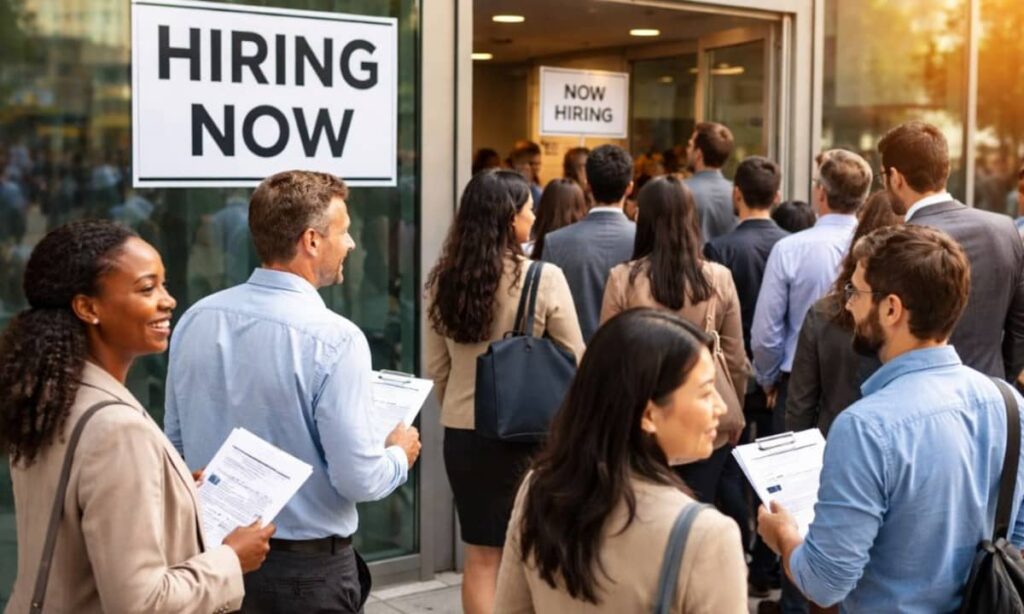
Huang also took aim at the darker predictions circulating around AI. He argued that extreme warnings risk scaring Americans away from tools that could help them compete in a changing economy.
The Nvidia chief said his concern centers on people becoming “so afraid of it” that they avoid the technology entirely.
That warning carries real weight. Companies have already started rewarding workers who use AI tools effectively. Employees who build those skills gain speed, sharper output, and stronger leverage in negotiations. Those who avoid the tools risk falling behind as job descriptions shift around them.
Huang’s message carries a clear challenge for workers and policymakers alike. He does not want the United States to treat AI as a threat first and a tool second. He wants the country to lead the next industrial wave rather than watch it pass.
That case will not silence the fear. The technology has already reshaped hiring in tech, media, design, and customer support. Entry-level workers face the heaviest pressure because early-career tasks, including writing, coding support, research, and routine analysis, fall squarely in AI’s strongest zones.
The next stage will define the argument. Companies can use AI to cut costs and reduce headcount. Or they can use it to grow faster, expand output, and hire for roles that did not exist five years ago. Governments can wait for disruption to arrive, or they can invest in workforce training before workers fall behind.
The Nvidia chief has staked his position clearly. He sees AI as a job engine. Economists see a harder road ahead. Workers are still waiting for proof that the next wave of growth will reach them, too.
Do you believe what the Nvidia CEO says about AI creating more opportunities for workers? Or will it make job security harder to count on? Please share your view in the comments below.