

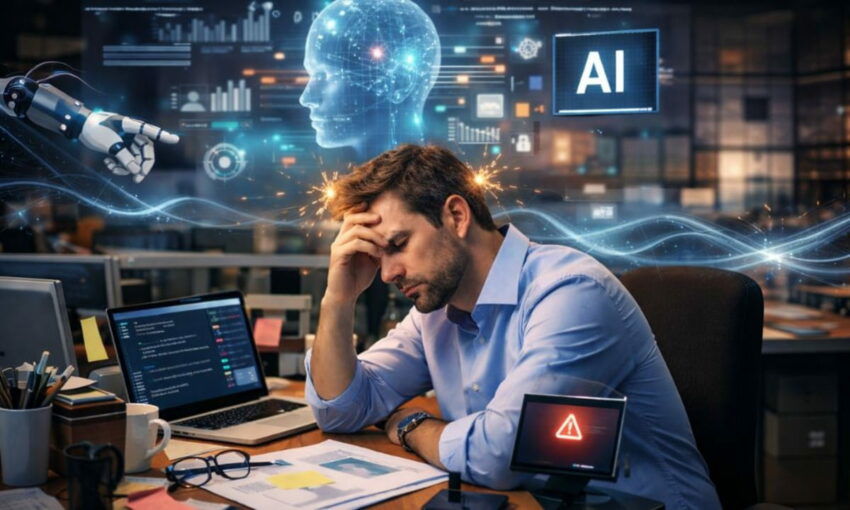
A quiet crisis is building inside modern workplaces. As artificial intelligence becomes more embedded in daily operations, a growing number of workers feel less liberated. They are feeling burned out. Researchers have a name for it now: AI brain fry. Far from the productivity utopia technology companies promised, a heavy reliance on AI tools is creating a new category of mental strain. The human brain, it turns out, was not designed to supervise machines at scale.
Study reveals hidden cost of AI multitasking
A new study published in Harvard Business Review surveyed roughly 1,500 employees who use AI tools as a core part of their daily work. The findings expose an uncomfortable side effect of the AI revolution: cognitive overload is rising alongside productivity.
Workers who regularly switched between multiple AI platforms reported sharply higher levels of decision fatigue. Errors have increased, too, with the increasing dependence on AI tools. One in seven respondents said they experienced measurable mental exhaustion from managing several AI systems during a workday.
Julie Bedard, a managing director and partner at Boston Consulting Group and a co-author of the study, said the data signals an early and underappreciated risk.
“The AI can run out far ahead of us, but we’re still here with the same brain we had yesterday,” Bedard said.
She added that intensive AI oversight — verifying outputs, adjusting prompts, toggling between tools — quietly drains mental bandwidth in ways workers often do not anticipate.
“Specifically, there are ways in which intensive oversight of AI causes a lot of cognitive exhaustion,” she said.
The productivity paradox at the heart of AI adoption
The research introduces a concept that analysts are calling the AI productivity paradox. The AI tools designed to ease workloads can increase pressure depending on how they are deployed.
Employees who used AI to automate repetitive, low-skill tasks reported lower stress and stronger output. But workers tasked with monitoring multiple AI systems reported the opposite: mounting fatigue, diminished focus, and slower turnaround.
Bedard said AI fundamentally changes the scope of what any individual employee is responsible for managing.
“AI allows us to really extend our capabilities, basically extending our workload and our sphere of accountability at work,” she said.
When organizational expectations scale faster than human capacity, the results are predictable. Workers feel stretched beyond their cognitive limits.
“AI brain fry causes a lot of mental fatigue so we feel like it’s beyond our brain’s capability to handle those tasks,” Bedard added.
Real workers describe the exhaustion
For Jack Downey, head of strategy, operations, and product at Webster Pass Consulting, AI brain fry is not a theoretical concept. It is a daily reality.
Downey builds automation systems and uses AI tools extensively throughout his workday. He said the fatigue he experiences now is qualitatively different from anything he felt before.
“There’s a point that usually happens after a full day where I just kind of feel exhausted in a way that I didn’t feel in a normal workday before AI,” Downey said.
The source of that exhaustion, he explained, is the rhythmic stop-and-start nature of AI-assisted work. Tasks do not complete instantly. Workers must stay mentally engaged across variable time windows — seconds for some tasks, minutes for others.
“You’re constantly waiting and you’re changing gears,” Downey said.
To stay efficient, he often runs multiple AI processes in parallel. That requires constant context switching, which compounds mental fatigue over time.
The perfectionism trap AI enables
Beyond task management, AI tools introduce another psychological challenge: the compulsion to keep improving.
Because generative AI can iterate endlessly, users — particularly those with perfectionist tendencies — find it difficult to declare a project finished. There is always another refinement available.
Downey described the pull firsthand.
“The capacity of AI is so endless that it can be really hard to just say no and stop whatever the next improvement is that you want,” he said.
He said he often catches himself investing extra time into optimizing prompts or refining workflows beyond any practical need.
“As a perfectionist, that often can result in not knowing when to stop,” he said.
His solution is self-imposed deadlines. Setting firm cutoffs for both himself and the AI systems he runs prevents projects from spiraling into indefinite revision cycles.
Organizations must rethink how AI is integrated

The study lands at a moment when corporate investment in artificial intelligence is accelerating globally. Many businesses adopted AI tools rapidly, layering them on top of existing workflows without restructuring how work is actually organized.
That approach, researchers warn, may be backfiring.
Bedard said companies cannot simply add AI on top of legacy processes and expect healthy outcomes.
“We need to redesign how we do our work — where we don’t just keep exactly what we did yesterday and put AI on top of it,” she said.
The research also points to a clear managerial variable. Workers reported significantly lower AI-related fatigue when supervisors established clear expectations around tool usage and offered structured training. When that guidance was absent, the cognitive burden of managing AI systems fell entirely on individual employees, increasing the risk of burnout.
What AI brain fry means for the future of work
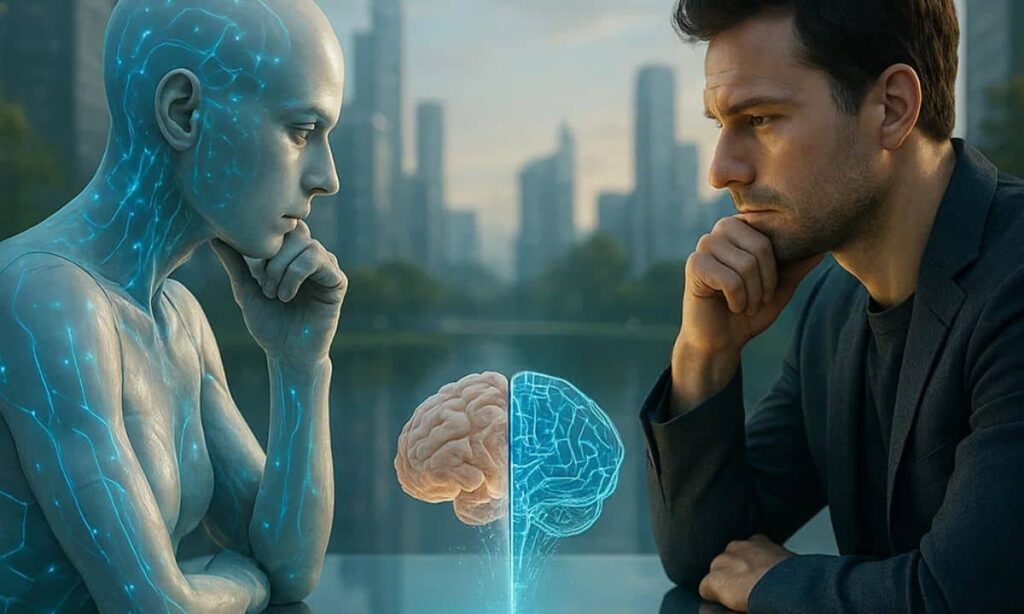
Workers showing signs of AI brain fry were more likely to report slower decision-making, elevated fatigue, and a higher incidence of workplace errors. Left unaddressed, that pattern poses a direct threat to the productivity gains businesses are chasing.
The answer is not retreating from artificial intelligence. The technology is too deeply embedded to walk back. But the path forward requires a more human-centered approach to AI integration — one that accounts for cognitive load, not just output capacity.
As AI capabilities expand, the challenge facing employers is no longer purely technical. It is neurological. The machines are moving fast. The people operating them need better support structures to keep pace without burning out.
The next phase of the AI-powered workplace will not be won on processing power alone. It will be shaped by how well organizations learn to protect the minds behind the machines.
Have you experienced AI-related mental fatigue at work due to the excessive use of AI tools? Please share your experience in the comments below.