

A debate over artificial intelligence in modern warfare has pushed OpenAI to renegotiate key terms of its agreement with the U.S. military. The company confirmed it will tighten protective measures to prevent its technology from being used to monitor American citizens.
The move came after sharp public criticism started following a contract between OpenAI and the U.S. Department of Defense. The deal involved deploying its AI systems in classified military operations, a disclosure that triggered immediate backlash from users and technology advocates alike.
OpenAI CEO Sam Altman admitted the initial rollout of the agreement was poorly handled. The company now says the updated contract will explicitly bar its systems from being used in domestic surveillance operations.
“The issues are super complex, and demand clear communication,” Altman wrote in a public post addressing the controversy. “We were genuinely trying to de-escalate things and avoid a much worse outcome, but I think it just looked opportunistic and sloppy.”
The revised contract language aims to reassure both the public and lawmakers that OpenAI tools will not be turned on U.S. civilians.
New safeguards added to AI defense agreement

Under the revised terms, OpenAI systems are prohibited from use in “intentional domestic surveillance of U.S. persons and nationals.” The restriction represents one of the clearest boundaries ever placed on AI technology within a U.S. defense contract.
OpenAI also clarified that intelligence agencies, including the National Security Agency, would not gain automatic access to its systems through the existing Pentagon deal. Any such use would require a separate, standalone contract modification.
The company had previously maintained that its original agreement already offered robust protection. OpenAI argued its framework contained “more guardrails than any previous agreement for classified AI deployments, including Anthropic’s.”
Despite those assurances, mounting online pressure and concerns from within the tech industry pushed the company to strengthen the contract language further.
The episode underscores the growing scrutiny facing AI developers as their products become embedded in national security infrastructure.
Public backlash hits OpenAI after Pentagon announcement
User reaction was swift and severe once the Pentagon partnership became public.
Market intelligence firm Sensor Tower reported that ChatGPT app uninstall rates spiked by roughly 200 percent above typical daily levels in the days following the announcement. The numbers reflected deep concern among everyday users about the potential misuse of commercial AI tools.
At the same time, competing AI platforms saw renewed interest. Anthropic’s Claude model rose to the top of Apple’s App Store chart and held that position for several consecutive days after the news broke.
The contrast illustrates how rapidly public trust has become a decisive factor in the AI market. As more people rely on large language models for daily tasks, concerns about data privacy, military use, and surveillance are shaping user behavior.
Many users expressed worry that tools built for productivity could eventually be repurposed for autonomous weapons systems or citizen monitoring.
Dispute with Anthropic intensified debate over military AI
The OpenAI controversy emerged amid a separate and significant standoff between the Pentagon and rival AI developer Anthropic.
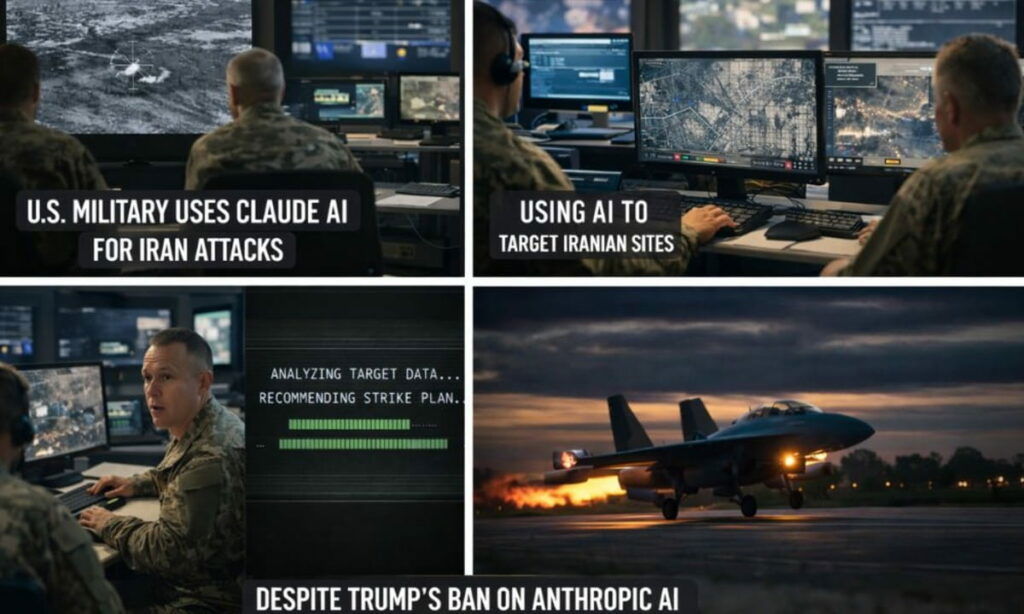
The Trump administration recently blacklisted Anthropic’s Claude model after the company declined to eliminate a core policy barring its technology from use in fully autonomous weapons. Anthropic has held firm to the principle that AI should not have independent authority over lethal-force decisions.
Despite that blacklisting, CBS News reported this week that Claude may still have been deployed in intelligence operations linked to the ongoing U.S.-Israel conflict involving Iran. The Pentagon did not issue any public comment on those reports.
Together, both episodes reveal how quickly artificial intelligence is becoming a central and contested component of modern military strategy.
AI already plays a growing role in modern defense systems
Governments around the world are already deploying AI-driven platforms to process intelligence data, automate threat detection, and accelerate battlefield decision-making.
Palantir, a U.S.-based defense analytics company, is one of the most prominent players in this space. Its systems are in active use by the United States, Ukraine, and NATO for intelligence gathering, surveillance operations, and counterterrorism efforts.
Britain’s Ministry of Defence recently awarded Palantir a contract worth £240 million to scale up its data analytics capabilities for national defense use.
Palantir’s defense platform, known as Maven, integrates satellite imagery, battlefield intelligence, and real-time data streams. AI models then process that information to flag potential threats and inform command-level decisions.
Louis Mosley, who leads Palantir’s UK operations, described the system as enabling commanders to make “faster, more efficient, and ultimately more lethal decisions where that’s appropriate.”
Experts warn about risks of AI decision systems
Despite its expanding role in defense, AI technology remains deeply controversial in military applications.
Large language models are known to produce inaccurate or fabricated outputs, a problem commonly called hallucination. In a civilian context, such errors are often harmless inconveniences. In a military setting, they could have catastrophic consequences.
Military officials stress that human oversight remains a non-negotiable requirement. Lt. Col. Amanda Gustave, chief data officer for NATO’s Task Force Maven, said the system is designed with human supervision built into every stage of its operation.
She said it would “never be the case” that an AI system would make battlefield decisions independently, adding that human review is always part of the process.
Still, researchers warn that the Pentagon’s conflict with Anthropic could erode the ethical standards that currently govern AI in warfare.
Oxford University professor Mariarosaria Taddeo put it bluntly.
“With Anthropic out of the Pentagon, the most safety-conscious actor is now out from the room,” she said. “That is a real problem.”
AI regulation battles likely to intensify
The controversy surrounding OpenAI’s Pentagon contract is not an isolated incident. It reflects a much broader global reckoning over how AI should be used in conflict zones and national security operations.
Governments increasingly view AI as a strategic asset, capable of speeding up intelligence analysis and giving military forces a decisive edge. At the same time, civil liberties groups, technology researchers, and ordinary users are demanding firmer boundaries around how these tools can be used.
OpenAI’s decision to revise its defense contract terms signals how high the stakes have become. For AI developers, protecting public trust is now just as important as winning government contracts.
The challenge ahead is clear: tech companies must drive national security innovation while drawing hard lines against privacy violations and autonomous lethal force. Neither goal is simple.
As AI systems grow more capable and governments deepen their reliance on machine-driven decision-making, the debate over oversight, accountability, and ethics in military AI is only going to grow louder.
What do you think? Should AI companies be allowed to partner with the military, or does that cross a line? Do strict ethical guardrails make AI safer, or do they simply push less scrupulous actors to fill the gap?
Please share your views in the comments below and join the conversation.