

Wall Street had a rough week. The AI scare trade gripped markets with force, triggering a sweeping selloff across technology, payments, and logistics stocks. IBM took the hardest hit, suffering its worst single-day drop in a quarter century.
The trouble started with a weekend research note from Citrini Research, a boutique investment firm. The note sketched a hypothetical scenario in which rapid AI advancement destabilizes large segments of the global economy. Authors framed it explicitly as a thought experiment — not a forecast. Investors did not treat it that way.
When the market closed on Monday, IBM had shed 13% of its market value. The decline marked its steepest one-day loss since 2000. Billions in shareholder wealth evaporated in hours. The move reignited a persistent question: are legacy enterprise tech companies fatally exposed to the next wave of AI disruption — and is the AI scare trade now powerful enough to punish even market leaders?
AI scare trade spreads beyond tech
The AI scare trade cast a wide net. DoorDash, American Express, KKR, and Blackstone each tumbled at least 6%. Uber, Mastercard, Visa, Capital One, and Apollo Global Management fell 4% or more. The breadth of the decline caught many traders off guard.
Market participants quickly recognized the episode for what it was — a classic AI scare trade in motion. The pattern is familiar. When headlines suggest AI could hollow out a business model or squeeze profit margins, institutional money moves fast to the exits. Fundamental analysis comes later.
The Citrini note imagined a mid-2028 economy reshaped by autonomous AI agents. In that scenario, white-collar work becomes increasingly automated. Transaction fees erode—consumer spending shifts in ways that favor leaner, AI-native platforms. Payment processors face margin pressure as intelligent systems shop for cheaper alternatives to established financial rails. Delivery giants find their competitive moats narrowed by AI-powered logistics rivals.
The AI scare trade fed on every line of the report. The authors had stated their intentions plainly.
“What follows is a scenario, not a prediction,” the note read. Even so, the analysis landed hard in a market already nervous about how fast AI is rewriting the rules of commerce.
IBM caught in the AI scare trade crosscurrents
IBM’s decline was compounded by a separate but related headline. Anthropic announced that its Claude Code tool can help modernize COBOL — an aging programming language deeply embedded in IBM’s mainframe business. The news poured fuel on an already active AI scare trade, sparking speculation that AI could fast-track the retirement of legacy systems that have historically anchored IBM’s revenue base.
The AI scare put IBM in an uncomfortable spotlight. The company has invested heavily in enterprise AI, hybrid cloud, and automation services. It has positioned itself as a partner — not a casualty — of the AI era. Monday’s selloff suggested the market is not fully convinced.
Incumbent technology firms face a paradox, one that the AI scare trade has now made impossible to ignore. AI creates new consulting, infrastructure, and automation revenue. At the same time, it threatens older income streams tied to maintenance contracts and transaction processing. Balancing those realities is proving harder than many executives anticipated.
Michael O’Rourke, chief market strategist at Jonestrading, put the AI scare trade reaction in sharp relief. He noted that this market has shrugged off hard economic data before — only to buckle under a speculative thought piece.
“I have seen this market exhibit incredible resilience in the face of actual negative news,” he said. “Now a literal work of fiction sends it into a tailspin.”
Taleb warns of deeper volatility
Risk analyst and author Nassim Taleb raised his voice regarding the unease surrounding the AI scare trade. He cautioned that equity markets may be significantly mispricing structural risk in software companies while overestimating how durable today’s AI leaders will prove to be.
His warning landed at a vulnerable moment. Stocks have gyrated in recent weeks as geopolitical tensions simmer and interest rate expectations shift. AI-linked equities, once the engine of market gains, are showing real signs of fatigue — making each new round of the AI scare trade more damaging than the last.
Thomas George, portfolio manager at Grizzle Investment Management, acknowledged that the Citrini report raises legitimate concerns — even in a best-case outcome.
“Certainly you don’t feel great after reading it,” George said. “I’m sure it leaves anyone holding these stocks with less conviction.” That erosion of conviction, analysts noted, is precisely what keeps the AI scare trade alive.
Overreaction or early warning from the AI scare trade?
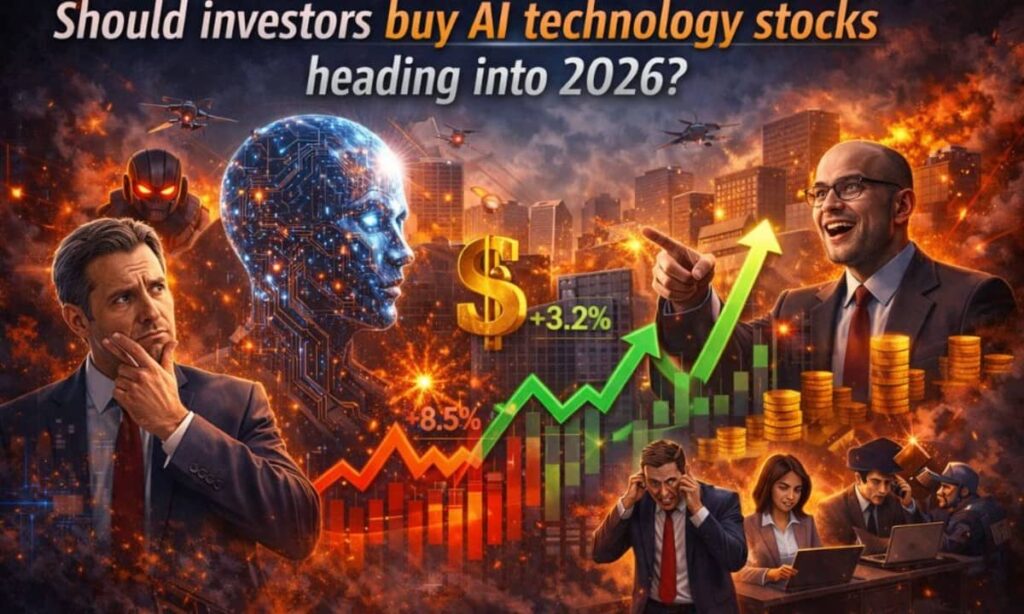
Not every market watcher is alarmed by the latest scare. Many analysts pointed to the indiscriminate nature of the selling as evidence of panic rather than precision. Private credit firms, insurance brokers, cybersecurity companies, and real estate service providers were all swept up in the decline. That kind of broad-based retreat typically signals a risk-off mood rather than a sector-specific reassessment driven by genuine AI disruption risk.
Defenders of the status quo argue that AI adoption is uneven, regulatory frameworks remain incomplete, and most AI tools still depend on integration with existing enterprise systems. That integration work plays to the strengths of established players with deep client relationships and institutional trust built over decades — factors the AI scare trade often overlooks in its rush to sell.
Still, the episode exposed something important. Investors know the AI upside story well. They are far less certain about who absorbs the costs when disruption arrives. Markets have not yet found a reliable framework for pricing those second-order effects. And until they do, the AI scare trade will remain a recurring force.
IBM’s drop to a 25-year low is a striking symbol. Even companies actively positioning themselves to lead the AI transition are not insulated from violent swings in market sentiment. As AI capabilities advance and economic implications grow clearer, the volatility is unlikely to subside.
Monday’s selloff may prove to be a short-lived panic. Or it may mark the beginning of a more serious repricing of AI risk across the broader economy. Either way, the AI scare trade is now a permanent feature of the investment landscape — and every company with legacy exposure should take note.
Is the AI scare trade a rational market correction or Wall Street overreacting to its own fears? Please share your views in the comments below.