

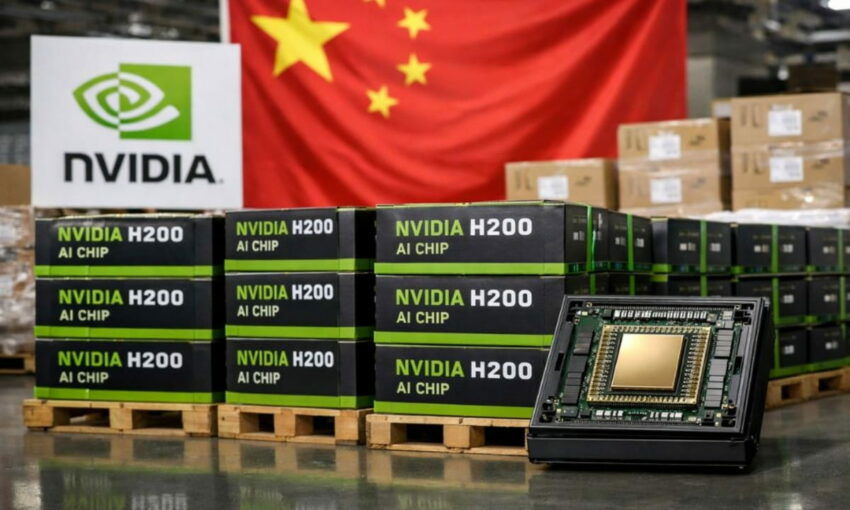
Beijing has given the green signal to import Nvidia’s cutting-edge H200 chips, marking a pivotal move in China’s technology strategy as the nation balances urgent computing demands against its push for semiconductor independence.
The approval came this week during a high-profile visit by Jensen Huang, Nvidia’s chief executive. With this agreement, the weeks of uncertainty that had surfaced after Chinese customs authorities halted shipments over unresolved regulatory concerns comes to an end.
This initial clearance covers several hundred thousand H200 processors, representing Nvidia’s second-most powerful AI chip and one of the most contested technologies in the escalating U.S.-China tech rivalry. Washington had authorized exports earlier this month, but Beijing retained final say over whether the advanced hardware could cross its borders.
That permission has now arrived, though with limitations.
Tech giants get priority access to advanced H200 chips
Sources close to the matter indicate China’s three largest internet companies will receive the first allocations of H200 processors. The firms remain unnamed, but additional companies have already lined up for subsequent approval rounds.
The distribution strategy reveals Beijing’s focus on established players already investing heavily in data center expansion and large-scale artificial intelligence development. These technology giants are working to narrow the gap with American rivals like OpenAI while meeting surging demand for cloud infrastructure, advanced language models, and consumer AI applications.
Chinese companies have reportedly ordered more than 2 million H200 units—a staggering figure that exceeds Nvidia’s available supply and underscores the intense appetite for high-performance computing power amid lingering regulatory uncertainty.
Performance gap drives desperate demand for foreign chips
The H200 chips deliver approximately six times the processing capability of Nvidia’s H20 chip, previously the most advanced processor the company could legally sell to Chinese buyers. This performance difference carries enormous implications.
Modern artificial intelligence systems demand massive parallel computing resources. Superior chips translate directly into lower costs, faster development cycles, and reduced energy consumption. For China’s technology sector, H200 access could dramatically accelerate progress across search algorithms, recommendation engines, autonomous vehicle systems, and enterprise automation platforms.
Chinese semiconductor manufacturers have improved their capabilities, with Huawei producing processors positioned near Nvidia’s H20.
However, they remain significantly behind the H200 chips, particularly in memory bandwidth capacity and efficiency when training large-scale AI models.
This technological reality explains why Beijing’s import decision carries implications extending far beyond a single hardware shipment.
Strategic pragmatism replaces absolute self-reliance
The approval doesn’t represent a wholesale policy reversal. Chinese authorities continue to evaluate acceptable levels of foreign semiconductor dependence while constructing domestic manufacturing capabilities.
Officials are reportedly considering conditional approval mechanisms. One proposal would require companies to purchase quotas of domestically produced chips before qualifying for imports. This framework aims to sustain demand for local manufacturers while preventing sudden disruptions to AI development timelines.
The approach reflects China’s dual objectives: securing advanced AI capabilities immediately while avoiding deeper long-term reliance on external suppliers.
The government hasn’t publicly disclosed qualification criteria for future H200 chips shipments or specified how many companies will receive access. Industry observers suggest this ambiguity serves a deliberate purpose.
Diplomatic timing and financial pressure converge
Huang’s China visit appears instrumental in breaking the regulatory logjam. He arrived in Shanghai last week for Nvidia’s annual internal gatherings before traveling to Beijing and other cities for partner meetings.
The timing also responds to mounting pressure from Chinese firms that have committed substantial capital to new data center facilities. These installations require top-tier processors for efficient operation. Continued delays impose both financial costs and competitive disadvantages.
Despite years of tightening export restrictions, China remains critically important to Nvidia’s global business. Demand for the H200 in the Chinese market remains robust, even under current constraints.
Uncertain path forward raises questions
This first approval batch resolves immediate concerns while creating new uncertainties. The size of future shipments remains undefined. Whether smaller enterprises, startup ventures, or research institutions will gain access remains unclear.
Beijing is opting for practical needs over strict policy consistency.
China isn’t abandoning its domestic chip development push—it’s buying critical time.
The decision on H200 chips demonstrates that artificial intelligence has become too strategically important to delay, despite intensifying geopolitical tensions.
The global AI competition now extends beyond pure innovation into supply chain control, economic leverage, and strategic patience. This week’s approval confirms China’s recognition of these hard realities.
As the semiconductor wars continue to reshape technology development worldwide, Beijing’s calculated move reveals the complex challenges facing nations pursuing both technological leadership and supply chain sovereignty.
What’s your take on China’s chip strategy following the latest agreement on H200 chips? Please share your perspective in the comments below.