

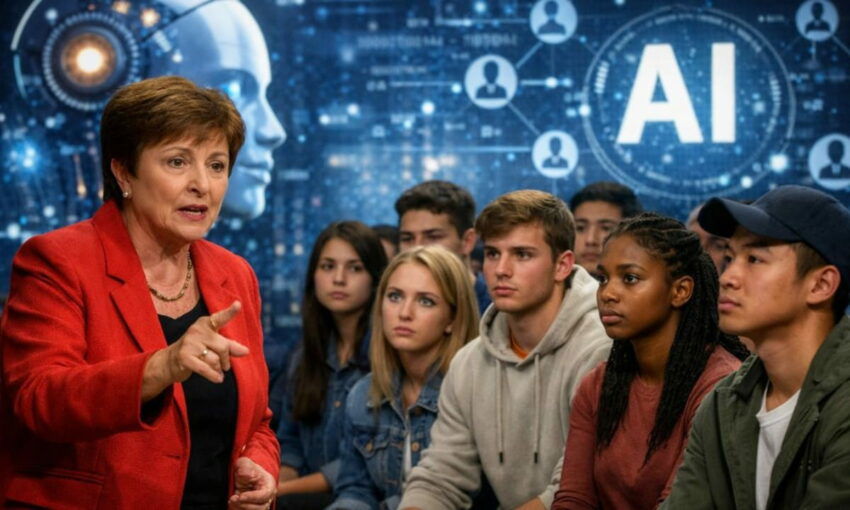
Artificial intelligence took center stage at this year’s World Economic Forum, competing for attention alongside geopolitical tensions and President Donald Trump’s presence in the Swiss Alps. While tech executives celebrated AI’s potential, global economic leaders delivered a far grimmer assessment. The most striking AI warning comes from Kristalina Georgieva, who leads the International Monetary Fund.
Georgieva painted AI as a transformative force that’s already remaking employment markets faster than most governments can respond. Young workers trying to launch their careers face obstacles akin to surviving a natural disaster.
“Tasks that are eliminated are usually what entry-level jobs present,” she explained during a forum panel. “So young people searching for jobs find it harder to get to a good placement.”
Her AI warning comes as mounting data shows automation has moved from distant threat to current reality. IMF research presented at the gathering indicates AI will impact approximately 60% of positions in developed nations and roughly 40% of roles globally. About half of the affected workers might experience improved productivity and better compensation. The other half confronts task automation, stagnant wages, or shrinking opportunities.
AI warning for entry-level positions
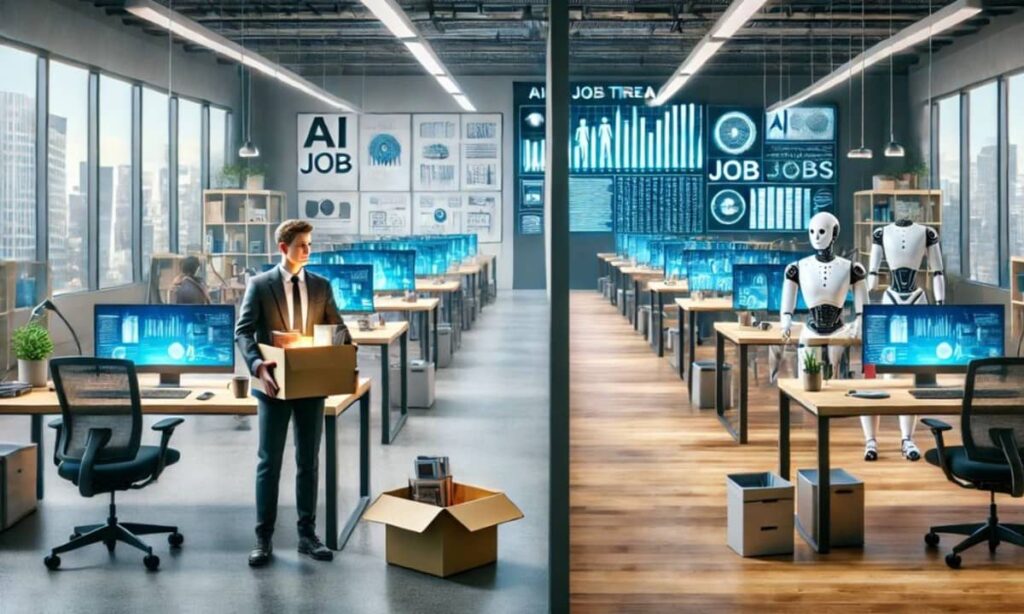
The IMF director emphasized that starting positions are especially at risk because they center on repetitive or administrative duties. These functions are increasingly shifting to software platforms that process information more rapidly and cheaply than human employees.
Signs of early job losses have already appeared. Challenger, Gray & Christmas, a consulting group, documented nearly 55,000 American job eliminations linked to AI last year. Beginning-level roles represented a significant portion of those cuts.
Analysis from the Brookings Institution confirms this AI warning. Their data revealed automation threatens junior positions like marketing analysts, sales representatives, and graphic designers at rates two to three times higher than management jobs.
Georgieva identified deployment speed as her greatest worry. She noted market-based adoption is outpacing regulatory frameworks, leaving officials scrambling to establish safety protocols or equity guidelines.
“Wake up. AI is for real, and it is transforming our world faster than we are getting a handle on,” she declared to attendees.
Economic inequality threatens to deepen
The IMF’s evaluation extends well beyond young worker employment. Georgieva projected that AI will likely expand income disparities throughout communities. Employees whose positions benefit from AI tools can boost output and earn higher salaries. Those in unaffected roles risk losing ground.
She cautioned that this trend could apply sustained pressure on middle-income earners. As compensation increases faster at the top, workers in jobs without AI-driven efficiency improvements may find themselves caught between high earners and low-paid service employees.
“The middle class, inevitably, is going to be affected,” she stated.
This challenge emerges during an uncertain worldwide economic rebound. The IMF recently upgraded its global expansion projection to 3.3%, climbing from 3.1%. Nevertheless, Georgieva stressed growth remains insufficient to easily manage climbing public obligations and enormous investment requirements connected to AI infrastructure development. Global government debt approaches 100% of GDP based on IMF calculations.
Potential benefits for lower-wage workers
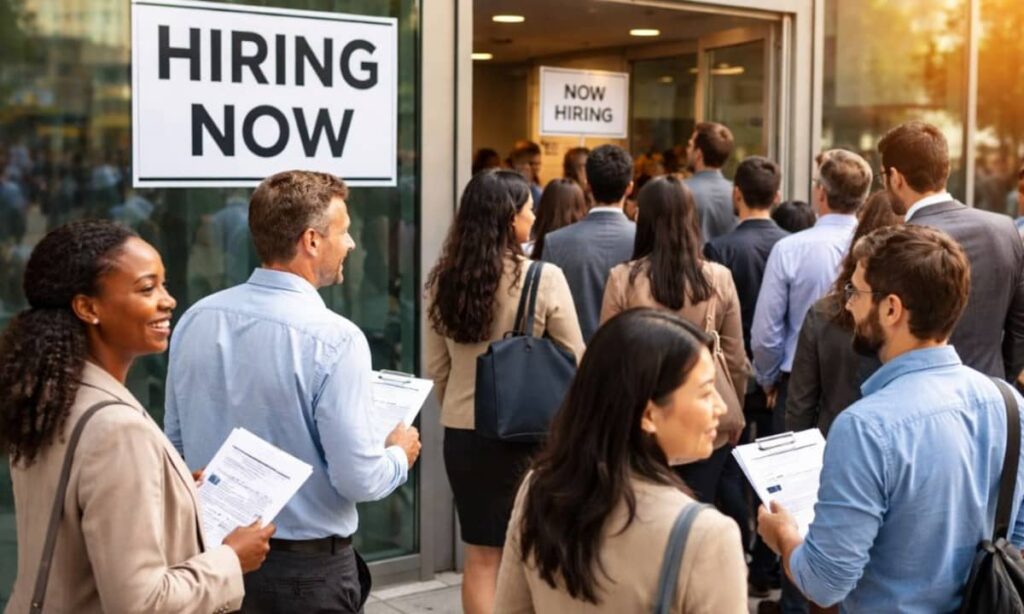
Despite these concerns, Georgieva described a situation where AI might indirectly help workers earn less. She referenced an economic “spillover” dynamic created by increased earnings among AI-assisted professionals.
When productivity climbs for top earners, their expanded purchasing power can drive demand in neighborhood service industries, including restaurants, shops, and personal care businesses. This pattern can produce moderate employment gains at the wage scale’s bottom.
“One in 10 jobs is already enhanced by AI,” Georgieva noted. “And the people in these jobs are paid better. When they’re paid better, they spend more money in the local economy.”
Evidence suggests these outcomes are realistic. A worldwide PwC survey discovered that workers possessing AI skills earned average wage increases of 56% versus comparable positions lacking such expertise. Independent academic research has demonstrated that each new technology position can create multiple additional local service jobs through heightened consumer expenditures.
Yet Georgieva cautioned that this generates what she termed an “accordion of opportunities,” widening for certain workers while narrowing for others. Middle-income employees risk being excluded, stated the IMF chief in her AI warning.
Technology executives offer contrasting perspectives
Not everyone at Davos mirrored the IMF’s alarm. Microsoft’s Satya Nadella discussed emerging knowledge work categories developing alongside AI. He contended that shifting information structures could reduce corporate hierarchies and forge new professional trajectories instead of destroying them.
Nvidia CEO Jensen Huang emphasized the AI boom’s infrastructure component. He characterized the ongoing data center and semiconductor manufacturing expansion as history’s largest construction initiative. This growth fuels demand for electricians, metalworkers, and building specialists, with compensation rising amid worker shortages.
International implications require attention
Additional policymakers underscored that benefit distribution equals growth importance. European Central Bank President Christine Lagarde warned that AI demands substantial capital and energy resources. Without unified standards, its advantages could cluster in nations and corporations already controlling those assets.
World Trade Organization Director-General Ngozi Okonjo-Iweala said AI could elevate productivity up to 40% by 2040 through reduced trade expenses. Those gains, she explained, require widespread implementation. If technology access remains limited to wealthy countries, worldwide inequality will intensify.
Georgieva concluded with an appeal for rapid, coordinated action. Economic spillover effects may cushion some impact, she acknowledged, but without inclusive safeguards, AI threatens to abandon young workers, middle-income earners, and developing nations.
What’s your take on the AI warning as the AI impact on job markets becomes apparent? Please share your views below.