

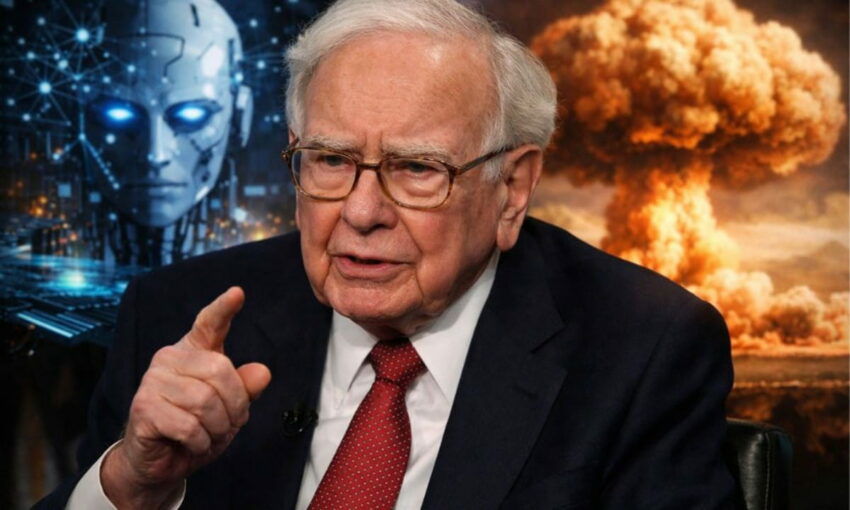
Warren Buffett has witnessed the evolution of global risk across seven decades of investing. The billionaire now sees AI dangers emerging on a scale that mirrors the existential threat of nuclear weapons. Undoubtedly, this comparison reflects his deep concern about technology outpacing human control.
The Berkshire Hathaway chairman shared his warnings during a two-hour CNBC broadcast that aired Tuesday evening. His message centered on a troubling reality: AI development has accelerated beyond the point where even its creators understand where it leads. That uncertainty, Buffett argues, makes the technology uniquely dangerous.
Even AI experts admit they cannot predict its future
Buffett pointed to statements from leading AI researchers who acknowledge their inability to forecast the technology’s long-term path. He employed a historical metaphor to illustrate the dangers of AI. Christopher Columbus could turn his ships around if needed. Modern AI development offers no such luxury.
“The genie is out of the bottle,” Buffett said, capturing the irreversible nature of the transformation underway.
AI systems now operate across financial markets, military operations, medical diagnostics, and global communications networks. Their expanding reach means any attempt to reverse course would face massive obstacles. Previous technologies allowed for regulation after problems emerged. Artificial intelligence moves too quickly and penetrates too deeply for that approach to work.
AI dangers are real; historical parallels with atomic weapons development
The investor drew direct parallels to nuclear weapons and their impact on global security. He referenced observations attributed to Albert Einstein following World War II. Einstein noted that atomic bombs changed everything except human thinking. Buffett believes AI could trigger similar upheaval, transforming civilization faster than laws and ethical frameworks can keep pace.
Nuclear proliferation demonstrates how difficult it is to contain powerful technology. What began as a single-nation capability has spread to eight countries, with more nations pursuing the same goal. Buffett sees AI following an identical pattern of uncontrollable expansion, cautioning of apparent AI dangers.
The comparison extends beyond technology itself to questions of control and access. Some individuals pose threats even with minimal weapons, Buffett noted. Giving those same actors access to advanced AI systems could amplify harm exponentially.
Capital alone cannot solve existential threats
Throughout his career, Buffett has recognized that money cannot fix every problem. Nuclear weapons fall into that category. Yet he made clear he would immediately spend his entire fortune if doing so could permanently remove even three nations from nuclear capability.
That same urgency now applies to artificial intelligence. While Buffett has not proposed specific policy solutions or AI-focused investments, his comments reveal skepticism that market forces alone will guide responsible development.
Buffett raised similar concerns years earlier. Berkshire Hathaway’s 2015 annual report warned shareholders about catastrophic risks, including cyber attacks, biological threats, and nuclear incidents. Those dangers transcended traditional business metrics. Today, AI sits at the center of those same worries. AI dangers are real as artificial intelligence takes the world by storm.
Technology stocks surge while Buffett remains cautious

Artificial intelligence has powered a sustained rally in technology equities over recent years. Buffett has maintained a distance from that enthusiasm. At Berkshire’s May 2024 shareholder meeting, he described AI as carrying “enormous potential for good and enormous potential for harm.”
That dual nature sets AI apart from typical innovations that cross investors’ desks. Most new technologies tilt clearly toward positive or negative outcomes. Artificial intelligence occupies an uncertain middle ground, making risk assessment extraordinarily difficult and the risk of AI dangers obvious.
Leadership transition at Berkshire Hathaway
Buffett’s warnings arrive during a significant shift at Berkshire Hathaway. He announced in November 2025 that he would no longer participate in annual shareholder meetings. Greg Abel assumed the CEO position on January 1st and will write the company’s annual letter while answering investor questions this spring.
Despite stepping back from public appearances, Buffett’s perspective continues to carry substantial influence. His nuclear weapons comparison adds weight to ongoing debates about AI governance and safety protocols.
Unanswered questions about AI control

The central issue remains whether humanity can steer AI development responsibly or whether the technology will outpace regulatory capacity. Buffett sees no clear answer. His certainty lies in believing that some technologies reach points of no return, another reason to worry about AI dangers.
Transformative innovations sometimes cross thresholds beyond which reversal becomes impossible. The nuclear age demonstrated that reality. Artificial intelligence may prove no different. Once certain capabilities exist, eliminating them becomes nearly impossible regardless of resources deployed or political will summoned.
Buffett’s warning emphasizes timing. Action taken before AI reaches full autonomy differs fundamentally from attempts at control afterward. The window for shaping development may close faster than governments, companies, and societies anticipate.
The veteran investor’s message carries particular weight given his track record evaluating long-term risk. His comparison between AI and nuclear weapons suggests he views this moment as genuinely pivotal for global stability and human welfare.
What’s your perspective on AI dangers, regulation, and safety measures? Please share your thoughts in the comments below and join the conversation about technology’s role in our future.