


Walmart is accelerating its artificial intelligence strategy with a major partnership designed to transform how consumers shop online. The retail giant announced Sunday it will collaborate with Google to embed AI shopping experiences directly into the Gemini chatbot. This integration represents Walmart’s latest effort to streamline product discovery and purchasing for digital shoppers.
Through this arrangement, Gemini users will see Walmart and Sam’s Club merchandise automatically surface in chat responses when appropriate to their queries. Customers can explore products through conversational interactions with Gemini, then finalize transactions using Walmart’s native checkout platform. The entire payment and delivery process remains within Walmart’s digital infrastructure.
The feature will debut in the United States before expanding to other countries.
Leadership unveils partnership at retail industry event
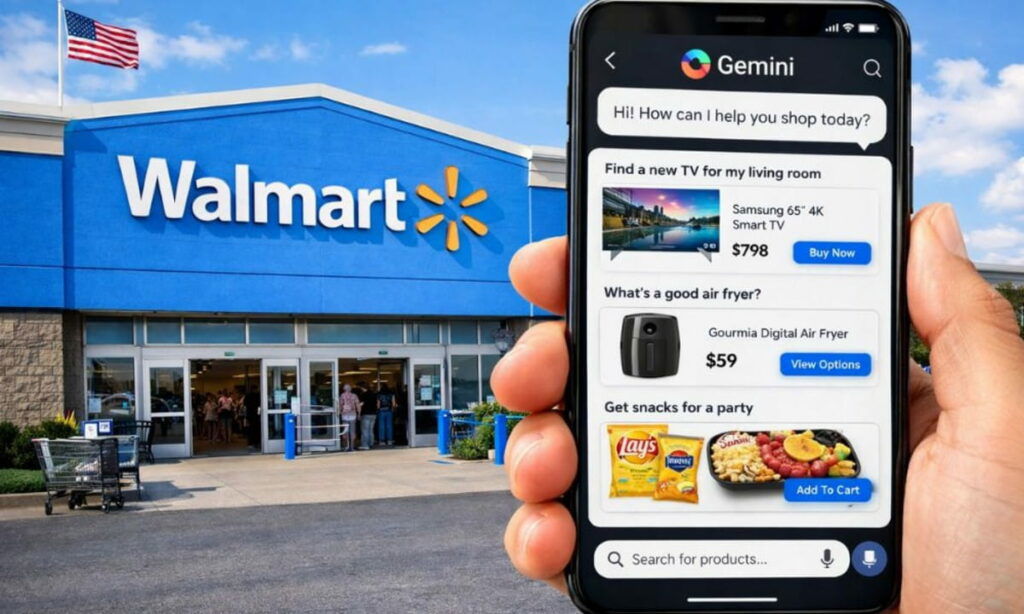
Walmart’s next CEO, John Furner, revealed the Google collaboration alongside Sundar Pichai, who leads Google and parent company Alphabet, during the National Retail Federation’s 2026 Big Show in New York City.
The announcement underscores how AI technology is transitioning from operational tools to direct customer interactions. Rather than providing website links, Gemini will display relevant products within conversational exchanges, eliminating steps between browsing and buying.
Pichai leveraged the platform to introduce additional AI solutions for retailers. Google is launching the Universal Commerce Protocol, an open framework designed to enable AI-agent commerce throughout the shopping experience, spanning initial discovery through purchase completion.
According to Pichai, Google has witnessed substantial AI adoption growth among retailers seeking to engage customers across various digital touchpoints.
“We want to use our full stack approach to help you shape this next chapter of retail,” Pichai stated.
Timing coincides with Walmart leadership change

For Walmart, this partnership arrives during a significant executive transition. Furner will assume the chief executive position as the company intensifies its technology investments. Outgoing CEO Doug McMillon has publicly stated his confidence in Furner’s ability to navigate Walmart through an AI-driven evolution.
Furner characterized the current moment as pivotal for retail. He emphasized Walmart’s openness to reimagining virtually every operational component to maintain competitiveness in a shifting marketplace.
“What won’t change … is our purpose, our values, the way we think about people leading,” Furner addressed attendees. “But everything else we are willing to change — what we sell, how we interact with customers, with our associates.”
This adaptability reflects how AI is compelling retailers to challenge established practices. Conventional search functions, fixed product listings, and manual comparisons are being replaced by conversational platforms capable of presenting options, verifying stock, and facilitating purchases instantly.
Furner’s career reflects retail’s transformation
Furner’s professional journey mirrors the industry’s evolution. He currently holds the position of president and CEO for Walmart’s U.S. operations and previously managed Sam’s Club U.S. He started his Walmart career three decades ago as a store employee in Bentonville, Arkansas.
“Retail was different,” Furner recalled regarding his early career. “In 1993, there was a playbook on how it worked and things seemed familiar at that time, but over the years, and just this last few years, we’re in a different period.”
Today’s retail landscape is being redefined by artificial intelligence, analytics, and automation. Walmart has integrated AI across inventory systems, pricing strategies, supply chain operations, and workforce tools. The Gemini collaboration extends these capabilities to consumers, transforming AI from a backend utility into a customer-facing interface.
Strategic response to evolving consumer behavior
Industry observers view this development as Walmart’s tactical answer to changing shopping patterns. Growing numbers of consumers initiate product research through AI-powered platforms rather than conventional search engines or retailer websites. By embedding itself within Gemini, Walmart positions itself at the beginning of the customer journey.
The agreement also demonstrates increasing collaboration between major retailers and technology companies. Rather than developing proprietary solutions exclusively, organizations are forming partnerships to accelerate innovation and deliver new experiences to massive user bases.
As Walmart enters its next leadership phase, Furner emphasized that artificial intelligence will define the company’s competitive approach. Transforming retail operations, he implied, has become necessary rather than optional.
For consumers, these developments could deliver quicker information, reduced navigation, and more intuitive paths from inquiry to transaction. For retailers, the changes intensify competition in an environment where discovery, data analysis, and decision-making increasingly depend on intelligent systems.
The partnership signals a fundamental shift in digital commerce, where conversational AI becomes the primary interface between retailers and shoppers seeking products and information.
What’s your take on AI-powered shopping? Share your thoughts on whether chatbot integration will improve or complicate your online shopping experience in the comments below.