

Speculation about overheated valuations has shaken technology shares in recent weeks. But the AI wave continues to push massive capital toward the sector’s dominant players, and major institutional investors dismiss the anxiety.
Shares of leading tech companies have experienced sharp volatility as analysts question whether the “Magnificent Seven” hold too much influence over benchmark indexes. Concerns about artificial intelligence pricing add another layer of uncertainty. Despite this turbulence, major markets hover near historic peaks.
The Nasdaq trades less than 5% off its record and maintains a position above its 200-day trend line. The index has surged over 245% since pandemic lows.
Big investors remain confident despite volatility
This conviction was evident at CNBC’s Delivering Alpha conference last week. Two fund managers controlling nearly $190 billion in assets explained their sustained optimism toward American technology companies and the unprecedented spending behind the AI wave.
Philippe Laffont, who founded and manages Coatue Management’s approximately $70 billion portfolio, identified a crucial distinction separating current conditions from the dot-com collapse. He calls it the “hyper-scaler advantage.” Laffont said investors should also understand critics who think the AI wave is inflating valuations.
He referenced giants like Alphabet, Microsoft, and Amazon, which analysts project could deploy over $500 billion toward AI infrastructure next year. That spending scale fundamentally reshapes the investment thesis, he argued.
Bill Ford, chairman and CEO of General Atlantic, which manages $118 billion, shared this perspective. For him, the staggering investment figures justify confidence rather than caution.
“The people driving change in AI are the large public companies and the incumbents; they have the advantage,” he said.
Private investors must track public market leaders

Ford noted his firm maintains intense focus on private investment opportunities and artificial intelligence deployment across portfolio companies. General Atlantic holds stakes in more than 200 businesses. Machine learning adoption spans all of them, he said, delivering “pretty high payback” already. Yet he emphasized that private investors must monitor public technology leaders closely.
“You can’t invest in the private market without an understanding of what Oracle, what Google, what Microsoft is doing,” Ford said. “You can’t make good decisions. We have to be fully aware of what they are doing even if we are not investing in them.”
Price swings require careful analysis
Laffont splits his capital between public and private opportunities. He acknowledged legitimate concerns about how the AI wave can accelerate price appreciation, creating tension with long-term investment discipline. He cited Oracle’s recent performance as an illustration. Shares climbed from $150 to nearly $350 over 12 months before retreating to the $220 range. He avoided direct criticism but suggested such movements demand careful evaluation.
Alphabet’s comeback story gains momentum
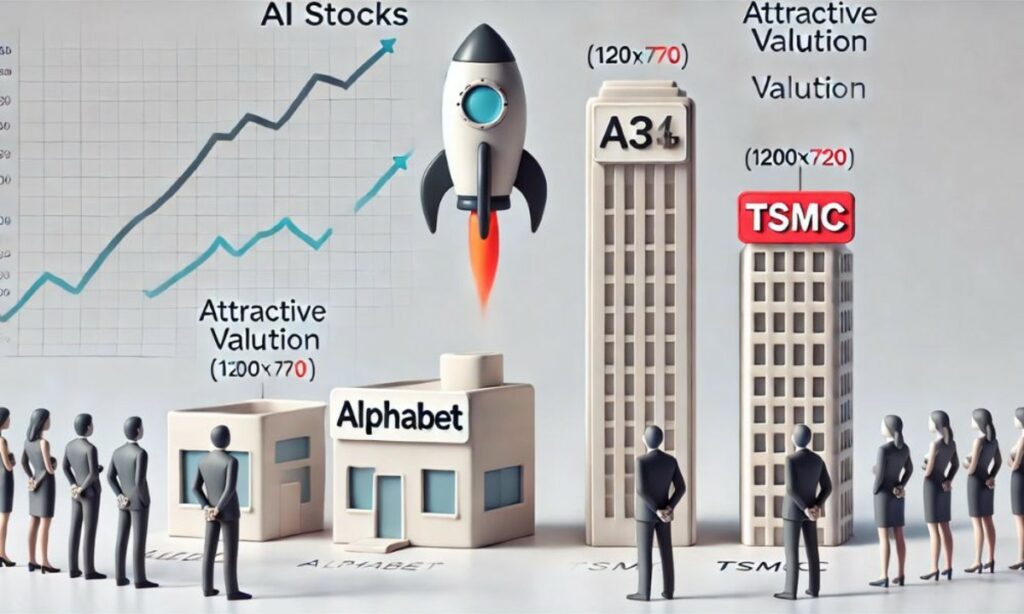
Alphabet presents the contrasting scenario. Not long ago, some market participants believed Google had fallen behind the AI race following ChatGPT’s launch and early difficulties with Google Gemini. Now Alphabet ranks as the year’s top-performing mega-cap technology stock. That momentum accelerated when Warren Buffett’s Berkshire Hathaway disclosed a new position. The purchase carries significance because Buffett previously acknowledged missing earlier opportunities.
At Berkshire’s 2019 shareholder meeting, Buffett and Charlie Munger admitted they had “screwed up” by avoiding Alphabet despite witnessing Google’s advertising dominance through their own business operations. Back then, shares traded around $59. Friday’s close exceeded $276. During the quarter when Berkshire accumulated its stake, the stock never dropped below $170.
Dot-com comparisons fall short
Laffont said investors should consider perspectives from those questioning whether the AI wave is inflating valuations. “Big Short” investor Michael Burry recently suggested that leading AI companies boost earnings through questionable methods. But Laffont rejected parallels to 2000.
During the dot-com mania, “all the capital was fueled by IPOs and new companies with fairly dubious business models,” he said.
Today, the largest publicly traded technology corporations generate nearly $1 trillion in annual free cash flow. They achieve this with minimal debt.
Most corporations, he observed, produce free cash flow while carrying “a ton of debt,” constraining investment capacity. The leading companies powering the AI wave face no such limitation.
“It’s investments made by companies with real boards and return on capital requirements, so I think the system is pretty healthy and the implied leverage in the system is small,” he said. “I’m watchful, but if you ask me, ‘Am I worried?’ I’m not yet,” he added.
Still, Wall Street analysts have expressed concern about Oracle’s balance sheet and debt usage for funding AI expansion. Laffont acknowledged investors should monitor that exposure.
Focus on opportunity over bubble debate
The bullish sentiment at Delivering Alpha extended beyond Ford and Laffont. Mary Callahan Erdoes, CEO of JPMorgan Asset and Wealth Management, urged investors to concentrate on emerging opportunities rather than debating whether excessive valuations already exist.
Circular economy shows industry confidence
Ford highlighted another encouraging trend: the circular AI economy. Major corporations invest aggressively in their own capabilities while simultaneously funding competitors. He interprets this as evidence that industry giants recognize “a real significant opportunity at the other end.”
“They are all fighting for a very big prize,” Ford said, “and need to invest now to win,” he added.
He also pointed to robust earnings growth.
“The amazing thing about valuation increases among the ‘Mag 7’ is the earnings follow-through,” he said. “This is not double to triple price-to-earnings ratio. The earnings are there.”
Lower compute costs fuel optimism
Laffont addressed concerns about computational economics. Some strategists worry that declining token costs could undermine revenue growth.
He disagreed. “It’s like gasoline to an engine,” he said. “It’s strange, because if I say as the price goes down, P times Q should go to zero, even if P goes to zero, P times Q can go to near infinity.”
He anticipates sharp drops in compute token pricing.
But he believes “elasticity of the things we can do with lower-priced tokens are almost infinite.”
He forecasts sustained growth across sectors.
“So many things can be done, not just with intelligence and software but in cars and humanoids and machines. I’m sort of fairly optimistic that for long period, a decade-plus, with any decrease in the price of a token, overall P times Q will still be growing strongly.”
Their position remains unambiguous. Despite market swings, concentration worries, and bubble fears, the AI wave continues to drive the sector’s largest players forward. And the investors controlling tens of billions remain convinced opportunities dwarf the risks.
What’s your investment outlook on AI stocks? Do you share the confidence of institutional investors or believe caution is warranted?
Please share your perspective in the comments below.