

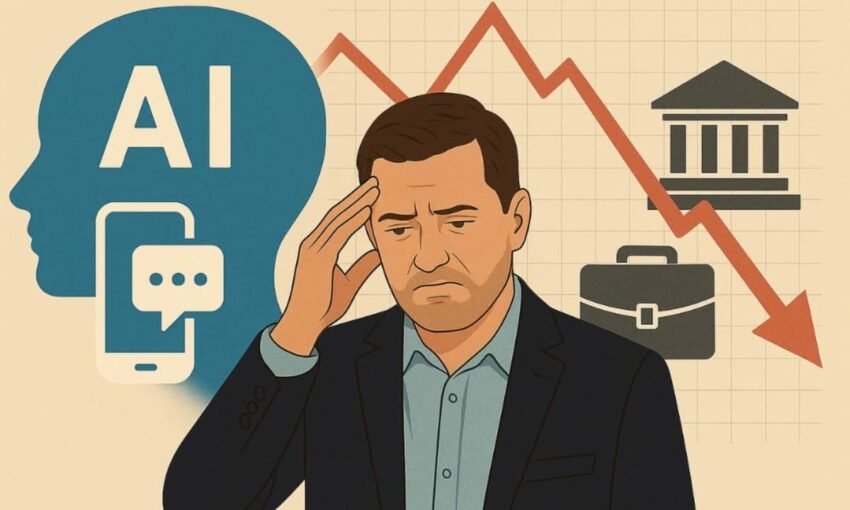
Artificial intelligence has captured the imagination of everyday users worldwide. Yet a troubling disconnect is widening between consumer enthusiasm and enterprise results. Investment analysts at Goldman Sachs warn that this imbalance could be fueling an emerging AI bubble, raising concerns about possible market instability in the future.
Popular platforms like ChatGPT and Claude have seamlessly integrated into daily digital routines. Millions rely on these tools for everything from drafting emails to answering complex questions. The consumer success story appears undeniable.
Corporate America tells a different tale. Analyst Kash Rangan captured the contradiction on Goldman’s podcast.
“Consumer applications are demonstrating AI’s genuine value,” he noted. “But enterprise adoption shows only modest progress. We’re nowhere near projected levels.”
The McKinsey & Company “State of AI 2025” survey reveals the scale of this gap. Nearly 88% of surveyed companies report using AI in some capacity. That sounds impressive until you examine the details. Only one-third of organizations have deployed AI. Just 39% can point to tangible financial benefits.
Behind the AI bubble: Why business adoption trails booming consumer use?
The disparity stems from fundamental differences in how consumers and businesses approach new technology. Individual users face minimal barriers to experimentation. Free trials and low-cost subscriptions make testing easy. Feedback arrives instantly. The “aha moment” comes quickly.
Businesses confront steeper challenges. Integrating AI into existing workflows demands careful planning. Leaders must justify substantial investments to skeptical stakeholders. Measuring concrete outcomes takes months or years. Cultural resistance slows implementation.
Goldman’s Eric Sheridan highlighted the infrastructure spending spree fueling AI development. Industry projections estimate global AI infrastructure investment will hit $3 trillion to $4 trillion by 2030. But he raised a critical concern.
“Most investors we speak with can’t rationalize returns on cumulative spending of that magnitude,” Sheridan explained. “Unless AI becomes the primary driver of enormous economic output across society, the math doesn’t work.”
Warning signs emerge from the dot-com era playbook

The explosive AI investment wave has triggered alarm bells among financial analysts. Goldman Sachs research identifies troubling parallels to conditions preceding the dot-com collapse. The bank emphasizes we haven’t reached “1999 territory yet.” However, strategic indicators from that period are flashing warnings.
Five specific red flags mirror late-1990s patterns. Infrastructure spending has accelerated dramatically. Company valuations have stretched beyond historical norms. Corporate debt levels continue rising. Profit margins show early signs of compression. Investor expectations may have detached from realistic outcomes.
Regulatory authorities are voicing concerns. The Bank of England issued its most forceful caution to date. Equity valuations for AI-focused technology companies “appear stretched,” the central bank stated. Market sentiment could reverse sharply if expectations aren’t met.
Why enterprise adoption lags behind the hype?
AI bubble expands as enterprises stumble despite consumer buzz.
Multiple obstacles prevent businesses from matching consumer AI adoption rates. Understanding these barriers helps explain the growing divide.
Integration complexity tops the list. Running pilot programs in isolated departments is manageable. Scaling AI models across entire organizations proves far more difficult. Legacy systems resist new technology. Data silos prevent seamless information flow. Technical debt accumulates.
Measuring return on investment creates another stumbling block. Many firms lack frameworks for quantifying AI benefits. Traditional financial metrics don’t capture productivity gains or improved decision-making quality. Without clear measurement tools, justifying continued investment becomes harder.
Infrastructure spending has outpaced actual business value creation. Companies pour billions into specialized chips, massive data centers, and model training capabilities. The anticipated returns remain theoretical.
User trust and organizational readiness present additional hurdles. Recent research shows public acceptance of AI is declining in certain regions. Demand for human oversight of automated decisions keeps rising. Employees worry about job security. Management struggles to articulate clear AI strategies.
Navigating the gap between promise and performance
Companies deploying AI shouldn’t interpret slow progress as failure. This moment demands strategic refinement rather than panic. Thoughtful scaling beats rushed implementation.
Setting precise key performance indicators separates successful AI initiatives from vanity projects. Aligning artificial intelligence deployments with measurable business objectives creates accountability. Winners will demonstrate concrete value rather than riding momentum.
Investors need to scrutinize fundamentals more carefully. Market prices may already reflect assumptions of flawless execution and explosive growth. Some valuations appear disconnected from near-term reality.
Smart investment strategies focus on several key areas.
Prioritize companies demonstrating proven AI monetization rather than theoretical potential. Look for diversified revenue streams that don’t depend entirely on AI success. Monitor infrastructure expenditures relative to realized business benefits, a crucial step as AI bubble warnings grow louder. Track enterprise adoption metrics instead of just consumer enthusiasm.
Assess whether companies can articulate clear paths from AI investment to profit growth. Examine whether pilot projects are actually scaling or simply generating positive press releases — a common red flag during AI bubble phases.
Question whether infrastructure buildout matches current revenue opportunities.
Separating sustainable transformation from market froth

Artificial intelligence is undeniably reshaping how consumers interact with technology. It’s changing business processes across industries. But transforming promise into a sustainable reality requires enterprise adoption to accelerate significantly.
Markets may continue rewarding potential in the short term. Eventually, investors will demand tangible proof. Companies that can’t demonstrate measurable returns will face valuation corrections.
The infrastructure already exists for AI to drive meaningful economic change. Consumer enthusiasm proves that technology works at the individual scale. The question now centers on whether businesses can translate that potential into organizational transformation.
Time will determine whether current AI investments represent visionary positioning or speculative excess. The gap between consumer wins and enterprise struggles holds the answer.
How is your organization approaching AI implementation? As the AI bubble grows while consumer success masks corporate struggles, what are your views?
Please share your experiences in the comments below.