

OpenAI’s financial transparency came under harsh scrutiny after CEO Sam Altman delivered a sharp rebuke to questions about the company’s revenue performance and expenditure strategy, revealing mounting stress from escalating operational costs and investor frustration.
During a recently recorded conversation with podcast host and OpenAI backer Brad Gerstner, the typically measured Altman displayed visible annoyance when challenged to clarify how OpenAI justifies its most ambitious spending agenda in the history of the AI sector.
Gerstner posed a direct question:
“How can a company with $13 billion in revenues make $1.4 trillion of spend commitments?”
Altman’s response was immediate and cutting.
“If you want to sell your shares, I’ll find you a buyer,” he stated bluntly. “Enough.”
The heated exchange caught Gerstner off guard, prompting nervous laughter as Altman pressed his position.
“I think there’s a lot of people who talk with a lot of breathless concern about our compute stuff or whatever that would be thrilled to buy shares,” Sam Altman declared. “We could sell your shares or anybody else’s to some of the people who are making the most noise on Twitter about this very quickly.”
This confrontation has amplified discussions already circulating through investment communities: Is OpenAI providing accurate information about its financial stability and income figures while maintaining unprecedented spending levels?
Historic expenditures clash with limited revenue — investors grow anxious
Despite commanding global leadership in AI technology, OpenAI’s financial reality presents a contrasting narrative. Recent financial disclosures from Microsoft indicated the company suffered $11.5 billion in losses during the previous quarter. This figure represents extraordinary cash burn even by Silicon Valley standards.
ChatGPT — OpenAI’s primary income generator — faces growth limitations. The company has encountered difficulty converting casual users into paying customers, with approximately five percent of its 800 million active ChatGPT users subscribing to paid tiers.
While income increases, operational scale carries steep costs. Each query processed demands computational resources. Computing resources consume capital. Greater user engagement with ChatGPT directly correlates with higher company expenditures.
OpenAI’s strategy extends beyond improving AI models. Sam Altman seeks to establish the fundamental infrastructure supporting artificial intelligence — a multi-year initiative involving semiconductor procurement, facility construction, and expanding worldwide computing capacity. Financial experts project the strategy may demand spending obligations surpassing $1.4 trillion cumulatively, incorporating collaborations with international manufacturers and government investment entities.
Currently, OpenAI’s annual revenue sits in the low billions range.
This substantial disconnect explains investor demands for financial clarity.
Uncommon lapse in Sam Altman’s professional demeanor
Altman typically characterizes expenditures as strategic investments toward market supremacy. However, Gerstner’s inquiry appears to have struck a sensitive point.
The video segment circulated rapidly through digital platforms, serving as documentation of mounting internal pressure. The interview simultaneously amplified concerns about an AI investment bubble, where capital deployment outpaces sustainable business development.
Altman himself has recognized that this speculation could produce negative outcomes.
Last August, he acknowledged:
We are in a “phase where investors as a whole are overexcited about AI,” potentially resulting in “someone” losing a “phenomenal amount of money.”
These statements now carry prophetic weight.
“The most valuable private company on Earth” — hemorrhaging capital
OpenAI’s market valuation has climbed so dramatically that industry observers now label it the most valuable private company globally. Yet incoming investment doesn’t guarantee outgoing profitability. Expenses associated with training sophisticated models, acquiring datasets, assembling processor clusters, and establishing infrastructure remain massive.
Bernstein Research analyst Stacy Rasgon captured the implications in a recent investor memo, stating that Altman “has the power to crash the global economy for a decade or take us all to the promised land.”
This observation underscores how deeply OpenAI’s trajectory influences the wider AI economic landscape. Should OpenAI falter, repercussions would extend far beyond a single organization.
Altman challenges revenue figures — provides no alternative data
Following the contentious exchange, Sam Altman sought to minimize the revenue figure mentioned during questioning. He contested the accuracy of the cited numbers without supplying corrected statistics.
He stated merely that “revenue is growing steeply” and OpenAI maintains an “open bet that it’s continuing to grow.”
Because OpenAI operates as a private entity, it faces no legal requirement for financial disclosure.
This status may shift soon. Reuters indicated the company is “laying the groundwork for an initial public offering that could value the company at up to $1 trillion.”
True to form, Altman responded with characteristic boldness. He expressed anticipation of watching short sellers “get burned” following a potential public listing.
Investors demand data, not aspirational messaging
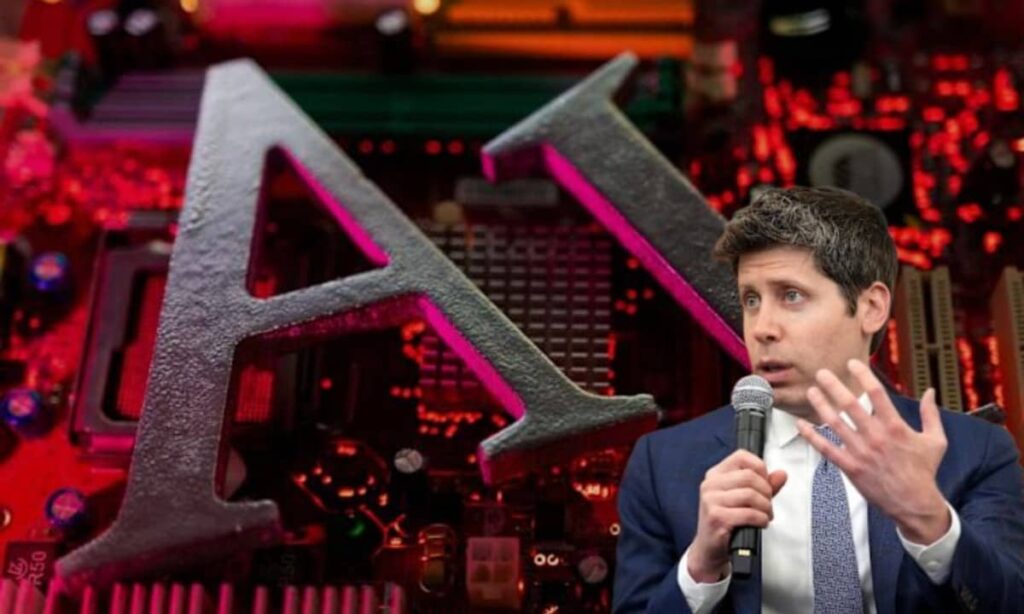
For years, OpenAI maintained its identity as a research-focused organization pursuing transformative goals. Today, it operates as a major infrastructure investor requesting unconditional stakeholder confidence during a period of heightened financial examination across the AI industry.
The confrontation with Gerstner exposed what numerous investors privately question:
- Why withhold revenue information if financial performance is solid?
- Why pursue trillion-dollar commitments if income remains modest?
- Is the organization concealing reliance on external funding sources?
The tense interaction suggests that defending OpenAI’s financial decisions is creating significant pressure for Altman.
Investors don’t question AI’s transformative potential.
They question whether existing business models can sustain current cost structures.
The path forward
As OpenAI advances toward extraordinary operational scale, the organization faces critical decisions.
It can maintain operational opacity, demanding investors’ trust leadership vision.
Or it can adopt transparency practices and disclose actual revenue growth trajectories.
Meanwhile, one question will dominate media coverage and stakeholder discussions:
Is Sam Altman protecting OpenAI’s competitive strategy — or avoiding financial disclosure?
Where do you stand on this debate? Should private AI companies provide detailed financial reporting to investors and the public, or is operational secrecy justified during rapid innovation cycles? Please share your thoughts in the comments section below.