

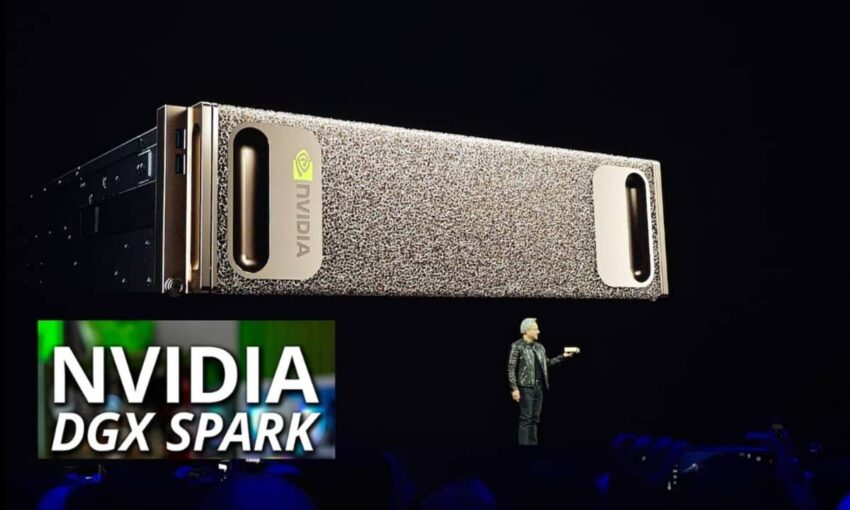
NVIDIA launches its compact DGX Spark mini PC on Wednesday, Oct. 15, bringing data-center-level artificial intelligence capabilities to developers’ desktops. The machine arrives after extensive preorder demand, with distribution through Nvidia.com and retail locations, such as Micro Center.
Redefining desktop computing for AI professionals
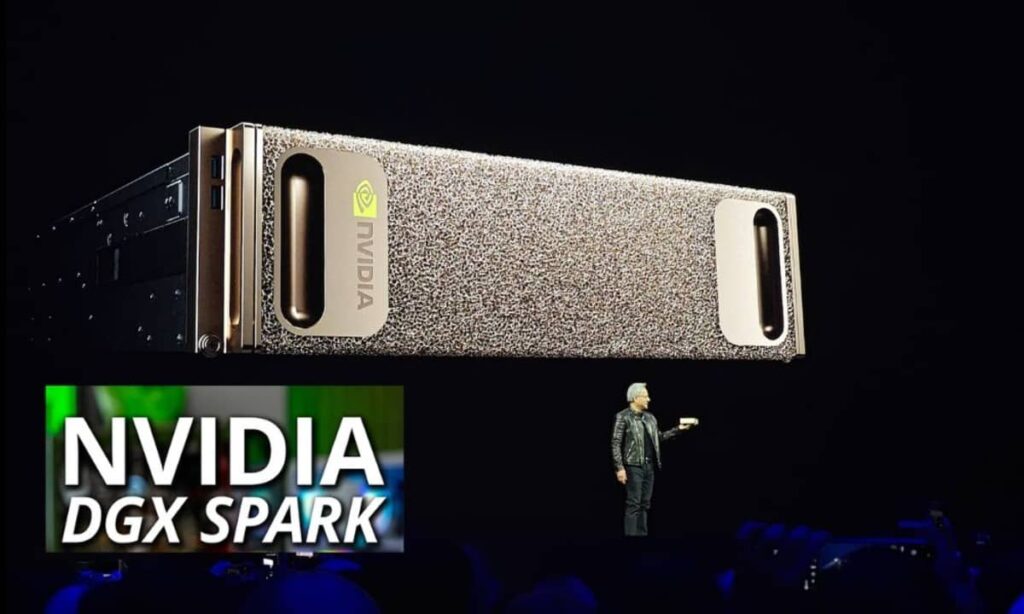
The DGX Spark challenges conventional desktop design. This 2.6-pound device delivers portability without sacrificing computational strength. The system targets a specialized audience: developers, researchers, and academics who need robust AI processing without cloud dependencies.
NVIDIA equipped the machine with DGX OS, a customized Ubuntu Linux distribution packed with pre-configured AI development tools. The company positions this as “the world’s smallest AI supercomputer,” promising enterprise-grade performance in an ultra-compact package that fits standard backpacks.
The GB10 superchip architecture explained
NVIDIA’s GB10 Grace Blackwell Superchip drives the DGX Spark’s capabilities. This innovative processor combines a 20-core Arm-based Grace CPU with Blackwell GPU technology, matching the RTX 5070’s CUDA core architecture. The unified design specifically addresses artificial intelligence workloads, letting users develop and deploy machine learning models on local hardware.
Performance metrics reveal that the GB10’s processing power reaches 1,000 trillion operations per second. Fifth-generation Tensor Cores enable this throughput, supported by FP4 precision capabilities.
The chip features NVLink-C2C interconnect technology, delivering five times greater bandwidth than PCIe Gen 5 connections. This architecture ensures rapid data exchange between processing units, critical for robotics applications, generative AI projects, and large-scale neural network inference.
Robust memory and storage solutions
NVIDIA allocated 128GB of LPDDR5x memory to the Spark, unified across both CPU and GPU components. This shared memory architecture accelerates performance on data-intensive deep learning tasks. Storage capacity reaches 4TB via NVMe drives, accommodating substantial datasets required for model training and evaluation.
The device features four USB-C ports, one HDMI output, and Wi-Fi 7 wireless networking capabilities. Standard electrical outlets power the system, maintaining portability despite its substantial computing capabilities. The connectivity suite supports multiple monitor configurations and peripheral devices essential for AI development workflows.
Empowering on-premises AI innovation
The DGX Spark addresses a growing need among AI professionals seeking alternatives to the ongoing expenses of continuous cloud computing and network latency issues. NVIDIA designed the system for compatibility with proprietary foundation models, including Cosmos Reason for world simulation and GR00T N1 for robotic systems development.
Local execution grants developers enhanced control over their artificial intelligence projects. Teams can prototype, refine, and test models directly on desktop hardware before migrating to NVIDIA’s DGX Cloud infrastructure for production scaling. The company’s integrated AI platform facilitates this transition with minimal code refactoring requirements.
Cost and market availability
NVIDIA set the DGX Spark’s base price at $3,999, excluding applicable taxes and import duties. The pricing reflects the system’s positioning as professional-grade AI infrastructure rather than consumer hardware. This investment targets organizations and individuals serious about machine learning development and edge computing applications.
The product will be available Oct. 15 through NVIDIA’s direct sales channel and authorized retail partners. Initial availability may vary by region based on demand and distribution logistics.
The broader AI hardware landscape
The DGX Spark enters a rapidly evolving market segment. Earlier this year at Computex, major manufacturers, including Asus, Dell, Gigabyte, HP, Lenovo, and MSI, demonstrated their own NVIDIA-powered AI workstations. Acer plans to ship its Veriton GN100 AI Mini Workstation in December, featuring similar local AI processing capabilities.
This hardware proliferation signals shifting priorities in artificial intelligence development. As cloud computing costs accumulate and data sovereignty concerns intensify, compact yet powerful systems like Spark address critical market demands. Organizations increasingly value the ability to process sensitive data on-premises while maintaining computational performance.
DGX station: The high-performance alternative
NVIDIA simultaneously develops the DGX Station, a tower workstation featuring the advanced GB300 Grace Blackwell Ultra processor. Pricing details remain undisclosed, but the company expects availability later this year through partners, including Asus, Boxx, Dell, HP, and Supermicro.
Both the Spark and Station exemplify NVIDIA’s strategic direction: delivering supercomputer-class AI performance in progressively smaller, more accessible formats. This approach lowers barriers to entry for advanced machine learning research and development.
Expanding access to AI computing resources
The DGX Spark won’t replace mainstream consumer PCs. However, it represents meaningful progress for research institutions, software developers, and academic programs. As cloud service expenses continue rising, these self-contained systems offer viable alternatives, balancing performance requirements with budget constraints.
NVIDIA’s push toward compact AI hardware may catalyze broader industry changes. The Spark demonstrates that powerful neural network training and inference capabilities need not require massive data center installations or continuous cloud subscriptions.
The future of decentralized AI development

This launch marks a pivotal moment in artificial intelligence infrastructure evolution. Developers gain new options for building and testing models without constant internet connectivity or recurring cloud fees. The ability to iterate rapidly on local hardware accelerates innovation cycles and reduces development costs.
As NVIDIA and competitors advance these technologies, expect more organizations to adopt hybrid approaches—prototyping locally, scaling in the cloud. The DGX Spark positions itself at the forefront of this transformation, offering a glimpse into how AI development might look in the coming years.
Are compact AI workstations like the DGX Spark the future of machine learning development, or do cloud platforms still hold the advantage?
Please share your views below about how local AI computing could transform your workflow.