

For nearly three years, seven technology titans, aka the Magnificent Seven, controlled Wall Street’s narrative. Today, the artificial intelligence revolution is creating fresh opportunities, pushing investors to look beyond the familiar names that once seemed invincible.
How the Magnificent Seven captured Wall Street?
The Magnificent Seven earned their name through sheer market dominance. Nvidia, Microsoft, Apple, Alphabet, Amazon, Meta, and Tesla turned artificial intelligence hype into stock market gold. These technology companies delivered more than half the S&P 500’s impressive 70-percent-plus climb since early 2023. Investors who bet big on this exclusive club celebrated extraordinary returns.
Their success story seemed unstoppable. Nvidia supplied the critical chips powering generative AI systems. Microsoft wove AI capabilities throughout its cloud computing and software products. Alphabet and Meta poured resources into AI-enhanced search engines and social media platforms. For many on Wall Street, betting against this group felt foolish.
However, even champions face challenges. The Magnificent Seven pushed major indexes to historic peaks, yet their unified strength is showing strain. Performance gaps are widening, and market analysts are questioning whether seven companies can truly represent the technological revolution.
Performance splits signal changing times
Market data reveals a growing divide within the group. Nvidia, Alphabet, Meta, and Microsoft have delivered impressive gains this year, climbing between 21 percent and 33 percent. Their leadership in the artificial intelligence race remains unchallenged. Meanwhile, Apple, Amazon, and Tesla struggle with slower momentum and mounting doubts about their AI strategies.
Chris Smith, who manages portfolios at Artisan Partners’ Antero Peak Group, sees the writing on the wall.
“The current Mag Seven hardly represents the best AI opportunities available,” Smith explained. “Tomorrow’s winners will tackle massive, open-ended markets using artificial intelligence. These companies will eventually surpass today’s Magnificent Seven in size and influence.”
Apple’s iPhone franchise maintains its consumer appeal, but the company lags in AI innovation compared to rivals. Tesla confronts intensifying competition in the electric vehicle sector. Amazon’s AI edge appears murky amid fierce battles in e-commerce and cloud infrastructure.
Rising stars challenge established order
Fresh competitors are capturing investor attention. Broadcom has climbed into America’s top-tier companies, fueled by surging demand for AI semiconductor technology. Oracle has skyrocketed more than 75 percent this year as its cloud computing division accelerates growth. Palantir Technologies has shocked markets with a stunning 135 percent gain in 2025, claiming the top spot in the Nasdaq 100 Index through explosive AI software demand.
Jurrien Timmer, who directs global macro strategy at Fidelity Investments, observes this transformation firsthand.
“Companies reach a point where markets cannot ignore them,” Timmer noted. “The artificial intelligence narrative evolves constantly. New champions emerge while previous leaders continue performing adequately.”
Wall Street searches for new labels
Market strategists are already experimenting with alternative groupings. Some analysts prefer a “Fab Four” consisting of Nvidia, Microsoft, Meta, and Amazon. Others advocate for a “Big Six” that drops Tesla from consideration. Melius Research proposed an “Elite Eight” adding Broadcom to the mix. Cboe Global Markets recently launched a “Magnificent 10 Index,” incorporating Broadcom, Palantir, and Advanced Micro Devices alongside the original seven members.
These competing indexes reveal shifting market perceptions. Oracle, despite its exceptional performance, missed inclusion in some lists. Nevertheless, few question its role in the AI transformation. Nick Schommer, managing portfolios at Janus Henderson, affirms this view: “Oracle absolutely belongs in this conversation now, and Broadcom does too.”
The artificial intelligence economy expands
The AI investment opportunity extends far beyond Silicon Valley’s household names. Taiwan Semiconductor Manufacturing Company remains indispensable for cutting-edge chip production. Arista Networks, Micron Technology, and Western Digital are capturing market share by building the infrastructure supporting widespread AI adoption. Even utility companies and power producers are attracting renewed interest as AI data centers consume enormous amounts of electricity.
Private companies add another layer of complexity. OpenAI, which sparked the current AI frenzy by launching ChatGPT in late 2022, carries an estimated valuation of $500 billion yet remains unavailable to typical investors. Anthropic and Elon Musk’s SpaceX also play significant roles in artificial intelligence development, though neither trades publicly.
Concentration dangers lurk beneath success
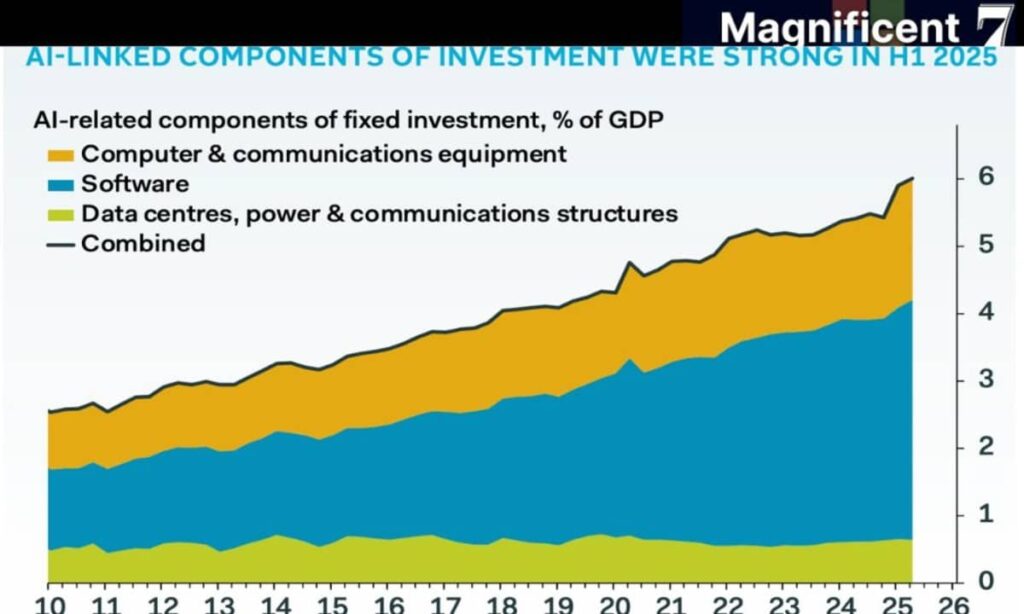
Heavy capital flows into AI-related stocks worry some market strategists. The Magnificent Seven still command roughly 35 percent of the S&P 500’s total value. Analysts project their earnings will jump more than 15 percent in 2026, driven by 13 percent revenue expansion. The remaining companies in the index face more modest forecasts: 13 percent earnings growth supported by just 5.5 percent revenue increases.
Market concentration rarely persists indefinitely. Timmer from Fidelity warns of potential turbulence ahead.
“Concentrated markets create vulnerability to disruptive shifts when leadership changes hands,” he explained. “Nobody can predict whether the Magnificent Seven era ends through gradual rotation into other stocks or a sudden market crash.”
Investment landscape transforms before our eyes
Investors face an unmistakable reality: artificial intelligence is fundamentally rewriting market dynamics. The Magnificent Seven may retain their power, but they no longer monopolize the AI opportunity. Aggressive competitors are surging forward, and the ultimate shape of the AI economy remains uncertain.
The beneficiaries span diverse sectors, including semiconductors, cloud computing, enterprise software, and power infrastructure. The list continues growing. Market history teaches harsh lessons through examples like the Nifty Fifty stocks of the 1970s and the FAANG companies of the 2010s. Today’s dominant players often become tomorrow’s forgotten memories.
The machine learning revolution, natural language processing advances, and deep learning breakthroughs are creating value across multiple industries. Companies providing AI training data, neural network infrastructure, and automation software are attracting serious investment capital. The technology sector faces a period of dramatic reshuffling as artificial intelligence capabilities mature and markets reward genuine innovation over hype.
What’s your take on Wall Street’s shifting AI landscape? Please share your thoughts in the comments below.