

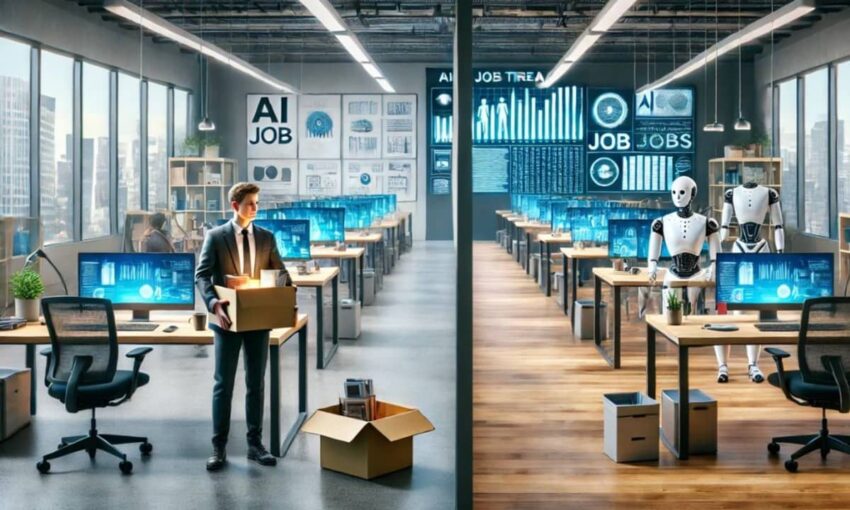
The automation wave powered by artificial intelligence is transforming how Americans find work. Traditional career pathways that once guaranteed employment for new graduates are disappearing faster than experts predicted. This technological shift threatens to eliminate the stepping stones millions have used to build successful careers. The AI job threat is real!
Entry-level positions face unprecedented decline
Recent data from workforce analytics company Revelio Labs reveals a stunning 35% drop in entry-level job postings nationwide since early 2023. Young Americans between 16 and 24 years old are experiencing their toughest employment landscape since the end of the COVID-19 era. Machine learning and AI automation drive much of this employment contraction.
Anthropic’s chief executive, Dario Amodei, recently projected that artificial intelligence could eliminate half of all beginner-level positions. These AI systems work around the clock without breaks or benefits. The prediction has sparked urgent discussions among educators, policymakers, and workforce development specialists.
AI job threat to corporate America’s traditional career ladder
America’s business mythology celebrates leaders who started at the bottom. HPE’s Antonio Neri answered customer service calls early in his career. Walmart’s Doug McMillon moved merchandise in warehouses. General Motors’ Mary Barra worked on factory floors as a teenager before becoming CEO.
These success stories inspired countless workers to start small and dream big. However, intelligent automation may destroy those foundational opportunities entirely. This goes on to speak loud and clear about the reality dawning upon us in the form of AI job threat!
“Entry-level work is vanishing before our eyes,” explains Heather Doshay from venture capital firm SignalFire. “This could potentially elevate everyone’s starting point.”
SignalFire’s research confirms this troubling pattern. Their analysis of technology companies and startup hiring showed a dramatic 50% reduction in workers with minimal professional experience between 2019 and 2024. This decline affected every department, including sales teams, software engineers, marketing specialists, talent recruiters, financial analysts, and creative designers.
Educational institutions and employers adapt strategies
Universities nationwide are partnering with AI companies like Anthropic and OpenAI to integrate machine learning training into the standard curriculum. Academic leaders want graduates to enter competitive job markets already proficient with intelligent automation tools.
“When email and internet became workplace necessities, students who learned them in school had clear advantages,” Doshay noted. “AI literacy will become equally essential for career success.” Students must now master these emerging technologies to remain employable in rapidly evolving industries.
Predictions of massive workforce displacement
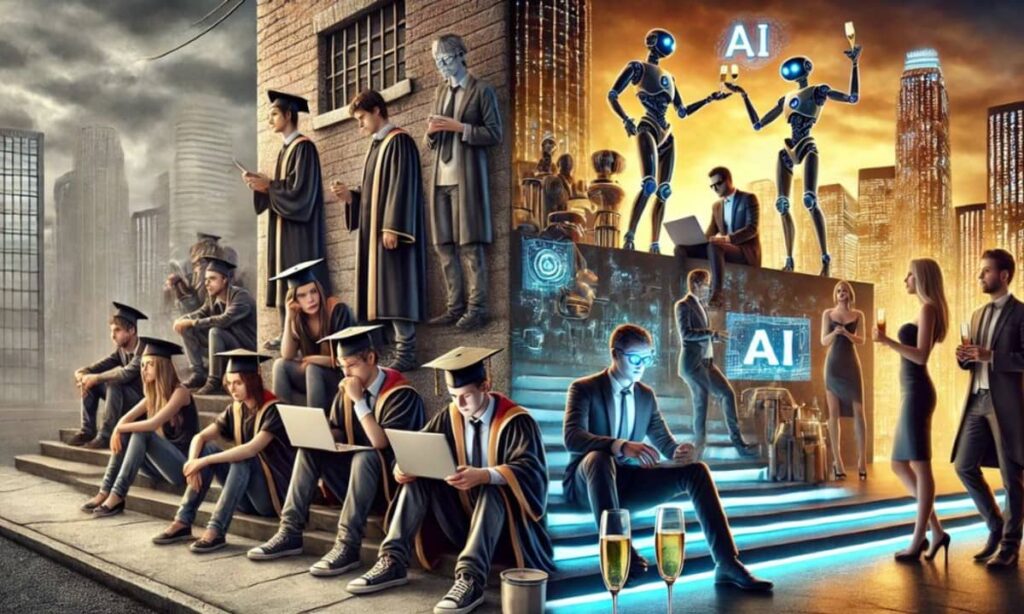
Some researchers paint much darker scenarios for American workers as AI job threat unleashes. University of Louisville computer science professor Roman Yampolskiy warns that AI and robotic systems could eliminate 99% of human jobs by the decade’s end.
“We’re approaching unemployment levels never seen in modern history,” Yampolskiy stated during a recent technology podcast. He believes artificial general intelligence will arrive by 2027, triggering widespread job losses within three years. Even highly skilled programmers and engineers face potential replacement by advanced algorithms.
Former Google executive Mo Gawdat shares similar concerns about white-collar professions. He predicts catastrophic disruption could begin as early as 2027 when AI capabilities surpass human performance in knowledge-based work.
Economic experts urge measured perspectives
However, other analysts counsel against premature panic about an employment apocalypse. University of Chicago economics professor Anders Humlum points to historical precedents showing that revolutionary technologies require decades to fundamentally alter labor markets.
“Generative AI has been widely available for two and half years without significantly impacting wages or employment across any occupation,” Humlum observed. He believes Amodei’s timeline underestimates the complexity of reorganizing business processes and retraining human workers.
Humlum’s studies reveal additional challenges, including unequal adoption rates. Women lag behind men in utilizing AI tools at work. Companies should address these disparities through comprehensive training programs rather than allowing digital divides to widen.
Corporate hierarchies flatten as automation spreads
Organizations are already restructuring as intelligent systems assume responsibilities previously handled by junior employees and middle managers. Traditional promotion pathways based on tenure and gradual skill development may become obsolete.
Modern corporations increasingly value specialized expertise over years of service. New employees must arrive with advanced capabilities that were once developed through on-the-job mentorship. This shift places enormous pressure on educational institutions, professional training programs, and individual learning initiatives.
Broader implications for American business culture
The transformation extends beyond unemployment statistics to threaten fundamental aspects of corporate development. Entry-level positions have traditionally fostered mentorship relationships, institutional knowledge transfer, and long-term employee loyalty. Eliminating these roles could undermine organizational continuity.
Without early career experiences, companies may struggle to develop future leadership pipelines. Max Tegmark from the Future of Life Institute suggests even executive positions face eventual automation. “Superintelligent systems can theoretically outperform humans in every professional capacity,” Tegmark cautioned.
Navigating the technological transition
Whether AI eliminates half of entry-level jobs or transforms them into more sophisticated roles, this shift will challenge businesses, government agencies, and individual workers. Success depends on effective training initiatives, adaptive strategies, and thoughtful regulation of emerging technologies.
Today’s job seekers face unprecedented uncertainty compared to previous generations. They cannot rely on traditional career progression models. Instead, they must create innovative pathways using artificial intelligence as both a competitive threat and a powerful ally.
The next few years will determine whether this technological revolution creates opportunity or devastation for American workers. Proactive preparation and strategic adaptation will separate those who thrive from those left behind.
Do you think AI will reshape your industry? Are you prepared for these changes, or do you believe the threat is overstated? Please comment below and share your views.