

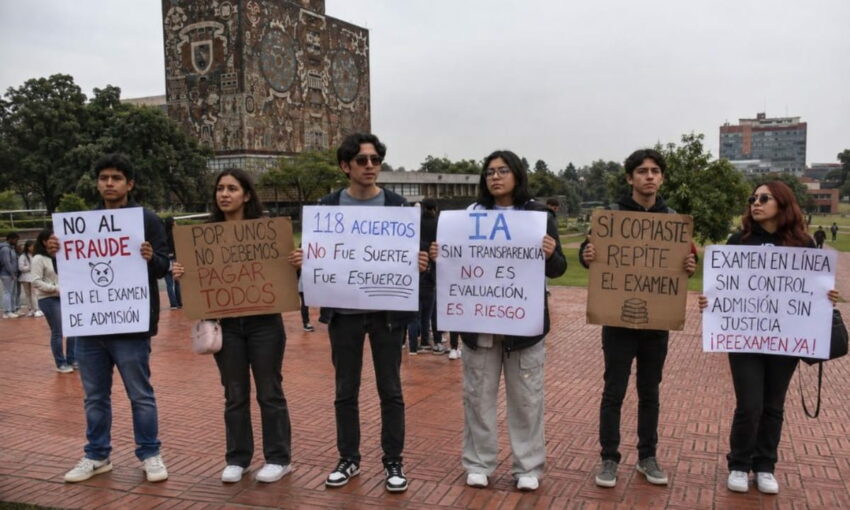
Mexico’s largest public university will make about 58,000 applicants retake its entrance exam in person, the sharpest step yet in the UNAM AI cheating scandal that upended its first online admissions test.
The National Autonomous University of Mexico, known as UNAM, ordered the makeup exam after remote testing produced scores it could not explain. Officials released the results on July 17, then suspended enrollment on July 25 while a 16-member commission reviewed the data.
The UNAM AI cheating scandal now threatens roughly 21,962 undergraduate seats, with classes set to begin Aug. 10. UNAM has not announced a date or a location for the retest. The commission asked it to move fast.
One of those affected is Daniel Fernando García Velázquez. He scored 94 out of 120 on the online test, enough for a place in Communication and Journalism at UNAM’s Aragón campus. Now he waits, his enrollment frozen with everyone else’s.
What did the numbers show?
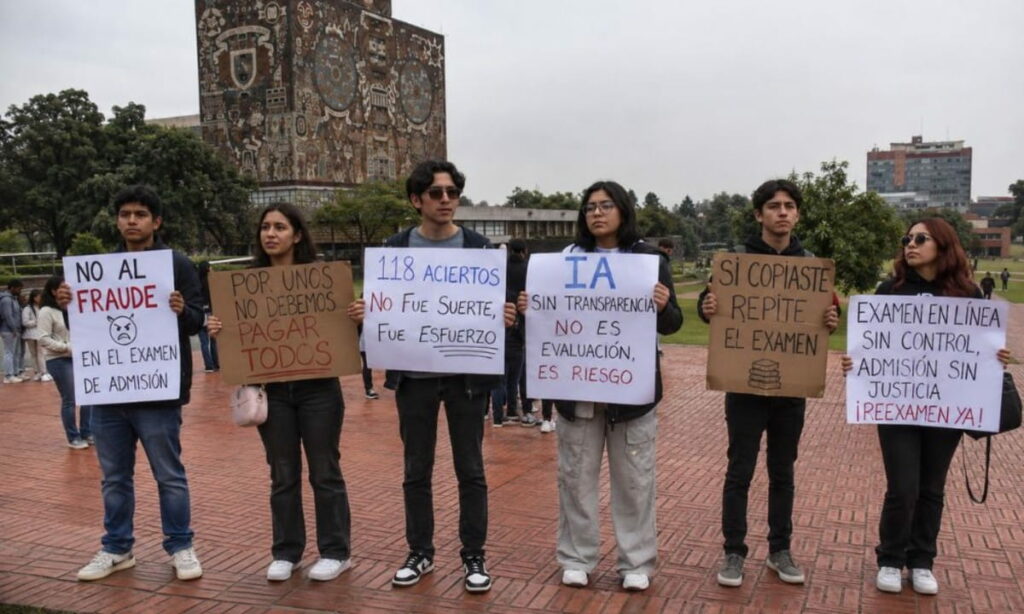
More than 158,000 people took the exam over three weekends in May and June. UNAM first voided about 2%, or roughly 3,000 tests, for rule-breaking.
The scores then raised wider alarm. From 2021 to 2025, about 3.5% of applicants scored 100% correct. In 2026, that share hit 16.3%. Top marks of 110 or more jumped from 0.9% to 5.5%, a sixfold rise.
Investigators tied the UNAM AI cheating scandal to phones, outside help, and identity fraud. Alma Maldonado, a commission member, said the spike stunned reviewers.
“It’s really shocking because of the number of students who got a perfect score on the exam, something we hadn’t seen before,” Maldonado said.
A market for answers
The fraud reached beyond individual test-takers. Videos on TikTok claimed to show how to beat the monitoring tools. Daniel Flores Miranda, an applicant, told CNN that an acquaintance offered software to solve the test for 2,500 pesos, about $150. He refused, but he knew others who bought it and passed.
Why did the AI proctoring fall short?
UNAM moved the exam online to widen access and cut travel to Mexico City. It paired human monitors with AI proctoring that logged behavior, checked identities, and captured activity.
Territorium Life, the company behind the platform, said the system “operated as planned.” It argued that integrity needs both technological security and academic security.
Still, the UNAM AI cheating scandal exposed clear gaps. Monitoring can flag a phone on camera. It cannot stop leaked questions, off-screen coaching, or answers shared across a 17-day window.
Who must test again
The retest covers two groups: roughly 22,000 admitted candidates, and applicants whose scores matched or beat the lowest qualifying marks from the past five years. Together they total about 58,000. The university’s fix for the UNAM AI cheating scandal is a pen-and-paper exam under supervision, with rotating versions to block leaks.
UNAM has filed a formal complaint with authorities. Rector Leonardo Lomelí backed the retest, even though it forces admitted students to prove themselves again.
“Plotting not only harms the institution, it harms society as a whole, it erodes the social fabric, it is a practice that we must eradicate,” Lomelí said.
The UNAM AI cheating scandal has also reached national politics. President Claudia Sheinbaum, a UNAM physics graduate, said the university should resolve it under its autonomy, and that federal prosecutors could help if UNAM requests a criminal case.
A warning for online exams
The UNAM AI cheating scandal now stands as a warning for schools weighing remote tests. Locked browsers, identity checks, and alerts all help. They fail when questions leak or help sits off-camera.
For students like García Velázquez, the UNAM AI cheating scandal means another exam and no fixed date. UNAM must act fast without losing the fairness its online exam was meant to deliver.
What do you think? Should universities keep online entrance exams with tougher safeguards or move high-stakes testing back to supervised classrooms? Please share your view in the comments.