

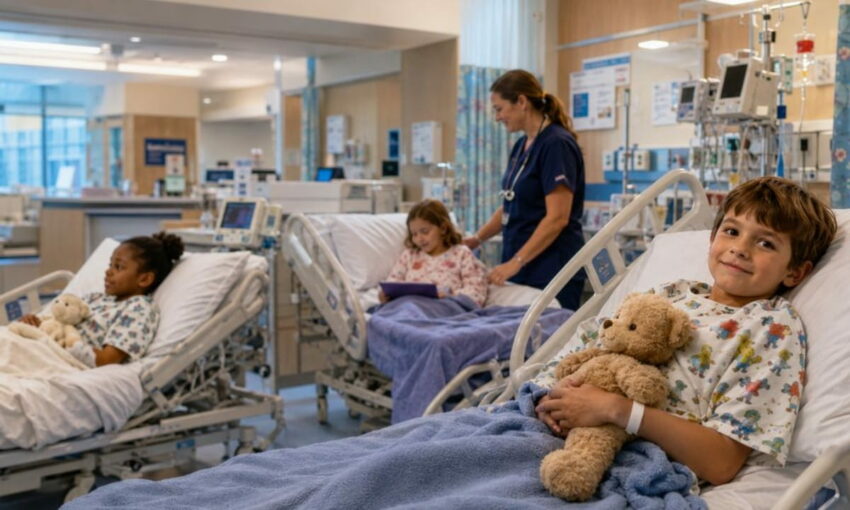
A reasoning model from OpenAI just handed 18 families an answer they had chased for years. Doctors at Boston Children’s Hospital used the company’s o3 system to reexamine rare pediatric cases that earlier reviews could not crack.
The work landed Thursday in NEJM AI, the journal’s outlet for studies on machine reasoning. It shows how AI rare disease diagnosis can pull fresh clues from old patient files.
The team reanalyzed 376 unsolved pediatric cases. Each child showed clear symptoms, yet standard testing and prior genome reviews returned no cause.
“It’s a total game changer,” said Catherine Brownstein, scientific director of the genetic investigations arm of the Manton Center for Orphan Disease Research at Boston Children’s Hospital.
Brownstein and her colleagues fed the o3 Deep Research model clinical notes, symptom descriptions, and a filtered list of candidate genes. Then the system hunted for links among each patient’s condition, genetic variants, and published research.
The payoff arrived fast. AI rare disease diagnosis flagged 18 answers that specialists had missed across repeated reviews.
“It got almost 5% new diagnoses, which doesn’t sound like a lot,” Brownstein said, “but considering how many times these had already been analyzed, that’s a huge number, and each one means an answer for a family.”
How did the system find buried clues?
Genome sequencing maps a child’s DNA. The hard part follows. Doctors must pick which genetic variant explains the illness, and that hunt can span thousands of genes, dense records, and brand-new studies.
“A researcher can only spend so much time on a single case,” said Suyash Shringarpure, a technical researcher at OpenAI who works on health. “Maybe a case remained unsolved when it came to them first, but a year later, a paper was published that clarifies the link between the gene and the disease.”
That timing gap is exactly where AI rare disease diagnosis earns its keep. The model never tires, and it reads faster than any human team.
“There’s pages upon pages of these genes that I have to get through for a case, while the LLM doesn’t get tired,” Brownstein said.
Still, the machine never made the final call. Human experts checked every output before any AI rare disease diagnosis became official.
What the study uncovered
The 18 answers fell into four groups. Ten involved rare neurodevelopmental conditions. Four covered neuromuscular disorders. Two centered on children who died suddenly without explanation. Two pointed to early childhood psychosis.
Seven results counted as “rediscoveries.” In those cases, a treatment team had already found the answer, yet that knowledge never reached outside researchers. Each AI rare disease diagnosis of that kind still carries weight.
“When new treatments do come online, we can find the patients right away and make sure that they’re first in line for any new technological development or any new therapy,” Brownstein said.
A 15-year wait ends

Kyra Benton knows the cost of that wait. Her symptoms surfaced at age 9. She began walking on her tiptoes, and she could not run with a normal gait.
A neuromuscular specialist in New York City came up empty. Boston Children’s Hospital also drew a blank at first. Her health then slid. She developed severe heart trouble, and she underwent a tracheotomy at 13.
Then the call came.
“Last summer, about a week before my 20th birthday, we got a call from one of the researchers at the lab,” Benton said. “She said, ‘Hi, we know it’s been about 15 years, but we have some news for you,’ and it kind of just blossomed from there.”
The AI rare disease diagnosis traced her case to myofibrillar myopathy, a disorder that breaks down muscle fibers over time. Benton admits the source surprised her.
“Quite frankly, I’m the type of person who’s not all that much favor of AI,” she said. Yet she sees the upside. “Such as in this case, where it can lead to massive breakthroughs that can really change people’s lives for the better.”
Experts urge caution
Outside doctors welcomed the results, though they flagged limits. Adam Rodman, an AI-in-medicine expert at Beth Israel Deaconess Medical Center, said the speed matters.
“A diagnostic yield of 5% is truly meaningful and could serve as a significant screening tool to help speed up the reanalysis of significant backlogs of cases,” Rodman said.
Chunhua Weng, a bioinformatics professor at Columbia University, praised the paper but pressed for scrutiny. “The appropriate use of LLMs in diagnosis requires careful attention to trustworthiness,” Weng said.
The team behind every AI rare disease diagnosis shares that restraint. Ashley Alexander, head of health at OpenAI, wants honest framing.
“We definitely don’t want to overhype this,” Alexander said. “But I also want to make sure that people don’t miss what’s happening and what’s possible with even just the version of ChatGPT that’s in their pocket today.”
Why does it matter for families?
A clear AI rare disease diagnosis does more than name an illness. It guides treatment and opens doors to clinical trials. It can hand a family a steadier future after years of dead ends.
The study does not promise an answer for every child. A diagnosis only starts the next chapter, and families still need specialists, therapies, and long-term care. But AI rare disease diagnosis gives hospitals a practical way to clear their backlogs.
For now, doctors can point tools like o3 at old data, test fresh gene links, and move quickly when research shifts. The promise of AI rare disease diagnosis sits in that simple loop, repeated case after case.
What do you think? Should hospitals lean on tools like OpenAI’s o3 to reopen unsolved rare disease cases, of course, under a doctor’s supervision? Please share your views below. Drop your take in the comments and tell us where you stand.