

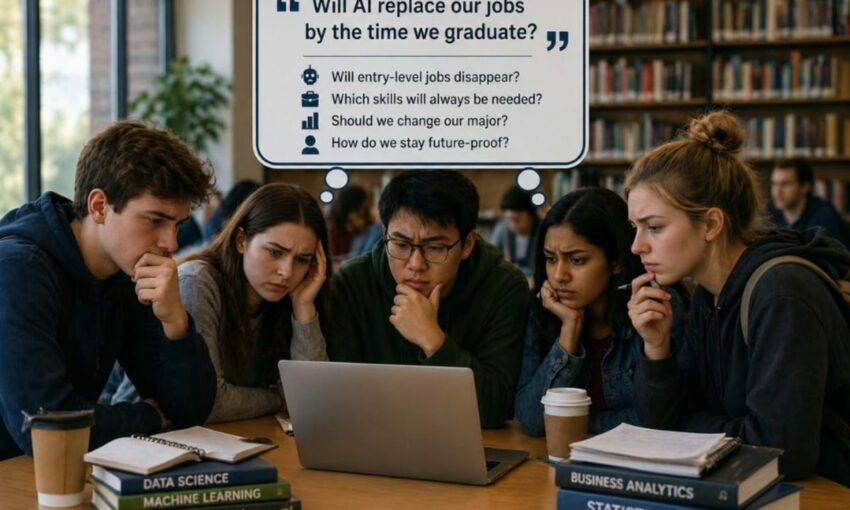
Josephine Timperman walked into Miami University in Ohio with a clear plan and without a doubt about the future of jobs. She declared business analytics as her major, betting that niche technical skills would make her stand out in a crowded job market. Two years later, she changed course entirely.
Automation had quietly made parts of her coursework redundant. Statistical analysis, basic coding, data tasks — machines now handle those faster and cheaper. So Timperman switched to marketing and started focusing on skills she believes technology cannot easily replicate.
“Everyone has a fear that entry-level jobs will be taken by AI,” said the 20-year-old. “You don’t just want to be able to code. You want to be able to have a conversation, form relationships and be able to think critically, because at the end of the day, that’s the thing that AI can’t replace.”
Her decision reflects a broader shift playing out at universities across the country.
Nearly half of all college students are rethinking their majors
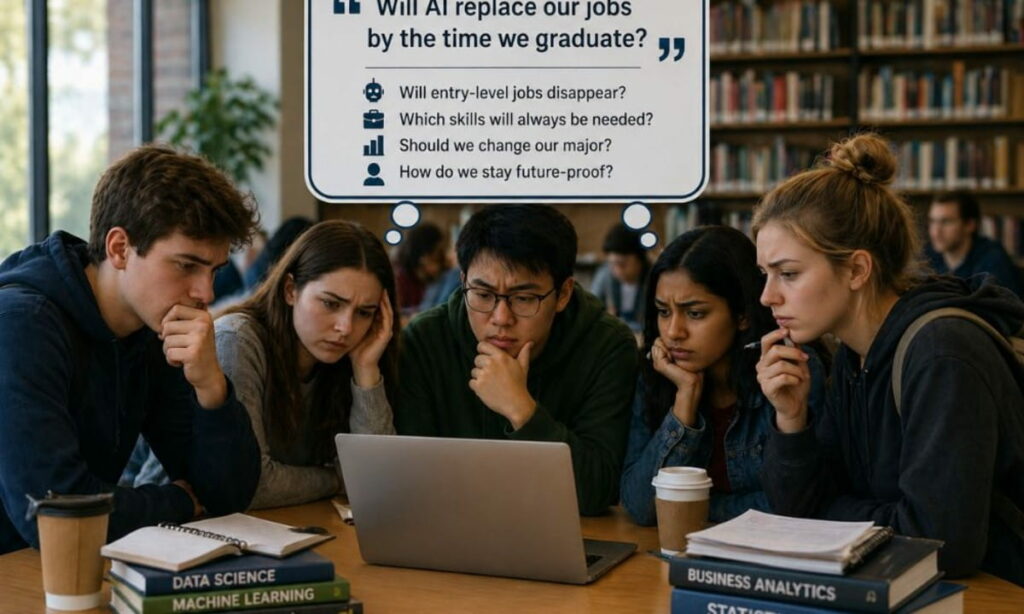
About 47% of currently enrolled college students have given at least a fair amount of consideration to switching their major because of AI’s growing impact on the future of job market, according to the Lumina Foundation-Gallup 2026 State of Higher Education Study. Furthermore, roughly one in six students — 16% — say they have already made that switch.
Between 2022 and 2025, early-career workers in AI-exposed roles, such as software development and clerical work, saw a relative employment decline by 16%, while more experienced workers in those same fields held steady. That data hit younger workers directly, and some are already doubting the future of jobs.
About 70% of college students now view AI as a genuine threat to their job prospects, according to a 2025 poll by the Institute of Politics at the Harvard Kennedy School. That number has reshaped how students weigh every major, every elective, every career conversation.
Courtney Brown, a vice president at Lumina Foundation, said the scale of the shift is jarring.
“The fact that so many students say it’s because of AI — that is startling,” she said.
Brown added that students typically change majors for a variety of reasons. But AI as a driving factor is something new entirely.
“Students are having to navigate this on their own, without a GPS,” she said. They are in doubt about the future of jobs.
Computer science no longer feels like a safe bet
Even students in traditionally bulletproof fields say the ground has shifted. The future of jobs is doubtful.
Ben Aybar, a 22-year-old University of Chicago graduate, sent out roughly 50 applications for software engineering roles without landing a single interview. He eventually enrolled in a master’s program and picked up part-time work in AI consulting.
“People who know how to use AI will be very valuable,” Aybar said. “Being able to talk to people and interact with people in a very human way I think is more valuable than ever.”
His pivot reflects a widening crack in the long-standing assumption that a computer science degree guarantees employment. Students in computer science, information technology, and data science are among those most likely to believe their fields have fewer jobs now because of AI, according to ZipRecruiter’s 2026 graduate report.
Some students feel trapped between their degree and doubts about the future of jobs

At the University of Virginia, data science major Ava Lawless questions whether her entire career path will survive long enough for her to use it.
“It makes me feel a bit hopeless for the future,” Lawless said. “What if by the time I graduate there’s not even a job market for this anymore?”
She now considers switching to studio art — a subject she once kept on the back burner.
“I’m at a point where I’m thinking if I can’t get a job being a data scientist, I might as well pursue art,” she said. “Because if I’m going to be unemployed, I might as well do something I love.”
Human skills are climbing in value
As automation takes over coding, data entry, and analysis, employers increasingly want what machines still struggle to deliver — empathy, creative judgment, and the ability to read a room.
Brown University President Christina Paxson made that case plainly at a recent university leadership forum.
“And none of us know. We don’t know the answer to that,” Paxson said. “I think it’s communication, it’s critical thought. The fundamentals of a liberal education are probably more important than learning how to code in Java right now.”
Alex Kotran, CEO of the AI Education Project, said the volume of students changing majors signals a failure by institutions to provide meaningful guidance.
“If students were adequately prepared, you wouldn’t see as many of them change their major, or you would see that happening in a way that schools are driving, but they’re not doing that,” he said.
Gen Z uses AI but increasingly fears the future of jobs

The uncertainty hits hardest among students pursuing technology and vocational degrees, who feel pressure both to master AI tools and to avoid being replaced by them. That push-pull dynamic creates real anxiety for a generation that grew up online and adopted new technology faster than any before it.
Men are more likely than women to report changing majors because of AI — 21% versus 12% — according to the Lumina-Gallup study. Meanwhile, students in health care and natural sciences appear less disrupted for now.
Just 29% of students finishing their degrees in 2026 said their school provided extensive AI training for their careers, according to ZipRecruiter. That gap between what campuses teach and what employers now demand leaves graduates exposed.
One expert said students need to start asking harder questions of the people already in their target industries.
“Have conversations with folks who are more senior to you, five, 10, 15 years, and sort of ask the question, ‘What is it that humans can do and need to be here for, and how do I sort of fill that role?'” said Stephen Aguilar, director of the University of Southern California’s Center for Generative AI and Society.
He added a warning for anyone tempted to cut entry-level roles entirely.
“We can’t just undercut all of the entry-level positions, because then there won’t be people who develop the experience to really understand what happens when AI fails,” Aguilar said.
The future of jobs
No clear roadmap exists for this generation about the future of jobs. Colleges scramble to update curricula. Students scramble to future-proof themselves. And artificial intelligence keeps evolving faster than either group can keep up.
There are some early bright spots. Internship postings are up 32% year-over-year, primarily in white-collar fields. Employers say they plan to hire nearly 4% more interns and 5.6% more new college graduates in 2026 compared with last year. Demand has not vanished. But the rules have changed.
Students who combine technical fluency with strong communication, critical thinking, and human judgment may hold the edge. Still, no one — not advisers, not professors, not industry veterans — can say exactly what the workforce will look like in four years.
What they can say is that doing nothing is not a strategy.
What do you think — should students double down on AI skills or pivot toward human-centered disciplines? Please drop your thoughts in the comments below about the future of jobs and share this story with anyone navigating the same question.