

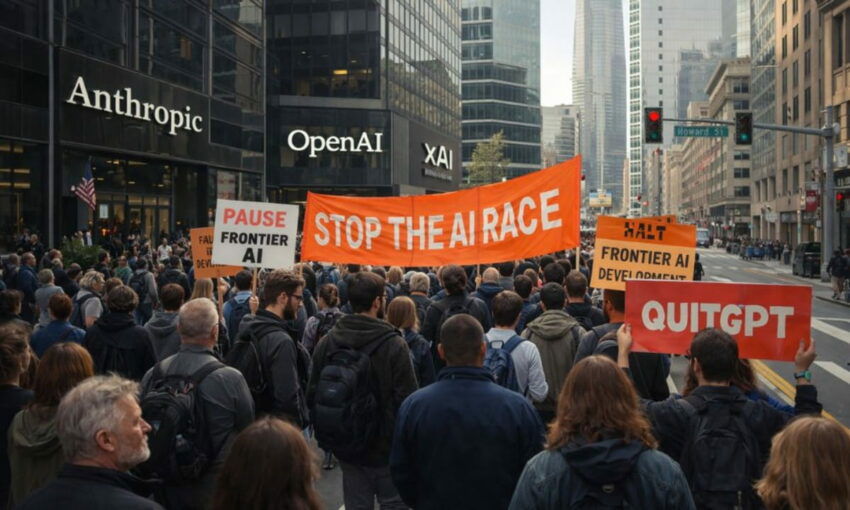
A protest march wound through San Francisco on March 21, 2026, targeting the rapid rise of frontier AI. It stopped at three addresses. Each one housed one of the most powerful artificial intelligence companies on the planet. The message was pointed — and deliberately conditional.
The group behind the action, Stop the AI Race, organized what it described as a peaceful demonstration. Marchers started outside Anthropic at 500 Howard St., moved to OpenAI at 1455 Third St., then continued to xAI at 3180 18th St., before concluding at Dolores Park. The route was not accidental. Every stop was chosen to land directly on the doorstep of AI’s most influential decision-makers.
Executive summary
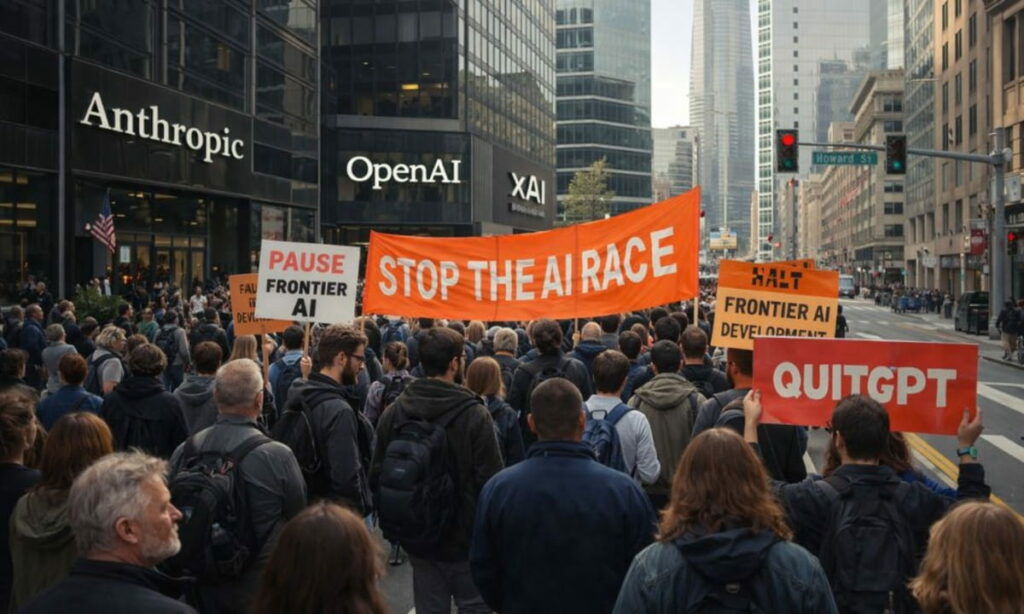
The march targeted three leading frontier AI laboratories with a single coordinated demand. Organizers called on the CEOs of each company to publicly commit to pausing frontier model development — but only if every other major lab worldwide agreed to do the same.
The protest drew added urgency from a recent policy update. On Feb. 24, 2026, Anthropic revised its Responsible Scaling Policy. Critics argued the update quietly dropped an earlier pledge to pause development under certain risk conditions. That controversy, combined with the rollout of California’s SB 53 transparency law and a wave of newly published safety frameworks from major labs, set the stage for the march.
The march and the demand
Organizers framed their goal carefully. This was not a call to shut AI down. It was a call to slow the race.
The single demand: every CEO must publicly commit to pausing frontier AI development if every other major lab commits to doing the same. The targeted executives were Anthropic’s Dario Amodei, OpenAI’s Sam Altman, and xAI’s Elon Musk.
Stop the AI Race was explicit about its intent. “We are not protesting the technology,” the group said. “We are protesting the reckless race to build it.” Reuters documented marchers moving between all three locations on the day of the event.
What counts as frontier AI?
The term “frontier AI” does not have a rigid technical definition. It functions as shorthand for the most capable, general-purpose AI models available at any given moment.
The Frontier Model Forum defines frontier AI broadly as state-of-the-art, general-purpose models. For membership qualification, it specifies that a frontier model must outperform all other widely deployed models — on conventional benchmarks or high-risk capability assessments — for at least 12 months.
That shifting definition is precisely what makes frontier AI such a focal point for policymakers and safety researchers. As these systems grow more capable, risk discussions move beyond everyday harms toward low-probability, high-consequence scenarios. Governance documents increasingly treat frontier model risk as a function of both raw capability and how widely the technology is deployed. That includes concerns tied to cyber operations, biosecurity threats, and autonomous decision-making systems.
Why are protests concentrating on pause the race?
The logic of a conditional pause is rooted in competitive dynamics. No single lab wants to slow down first. Doing so hands an advantage to every competitor still moving at full speed.
Organizers designed their demand to address that problem directly. A public, CEO-level commitment — structured as “if others pause, we will too” — is intended to neutralize the first-mover disadvantage that keeps labs locked in acceleration mode.
The group also argued that transparency measures, on their own, are not enough. Publishing safety reports and risk disclosures does not reduce development speed. Stop the AI Race framed public commitments as a necessary first step toward broader international coordination on AI governance.
That position sits alongside a growing set of governance tools that stop short of a full pause. These include independent safety evaluations, incident reporting protocols, and risk disclosures designed to make safety claims more verifiable and publicly accountable.
Why Anthropic, OpenAI, and xAI are in the spotlight?

Each of the three companies has made recent, visible policy moves — and each has drawn scrutiny for different reasons.
Anthropic updated its Responsible Scaling Policy on Feb. 24, 2026. The revised framework redesigns how the company governs catastrophic risk and introduces new public disclosure tools, including Frontier Safety Roadmaps and quantified Risk Reports covering deployed models. The update also distinguishes actions Anthropic will take unilaterally and heavier mitigations it believes should apply industry-wide.
Critics, citing reporting by TIME, focused on what the new policy removed. An earlier version contained a pledge that Anthropic would not train or release systems unless it could guarantee adequate risk mitigation in advance. That language is gone. Anthropic researcher Jared Kaplan explained the reasoning plainly: “We felt that it wouldn’t actually help anyone for us to stop training AI models.”
OpenAI has pointed to its governance structure as evidence of safety commitment. Its founding charter contains a race de-escalation clause, committing the company to stop competing with — and start assisting — any value-aligned effort that approaches artificial general intelligence first. The company also announced an updated corporate structure on Oct. 28, 2025, establishing a nonprofit foundation with controlling interest over a new public benefit corporation, OpenAI Group PBC. Separately, reporting by Fortune noted that OpenAI’s mission statement in IRS Form 990 filings changed multiple times, with the most recent version removing references to safety — a development that reignited debate about nonprofit accountability in the AI sector.
xAI has taken a compliance-forward approach. Its Frontier AI Framework, last updated Dec. 30, 2025, explicitly states that the document was built to satisfy requirements under California’s Transparency in Frontier Artificial Intelligence Act.
California SB 53 and the transparency turn

California’s SB 53 — the Transparency in Frontier Artificial Intelligence Act — took effect Jan. 1, 2026. The law imposes new disclosure and reporting obligations on what it designates as “large frontier developers.”
The California Department of Justice describes the law as a mechanism to increase transparency and safety around foundation models. Covered developers must publish a frontier AI framework detailing how they incorporate industry standards and best practices, define thresholds for catastrophic risk, apply risk mitigations, and respond to critical safety incidents.
The law also establishes protections for employees who disclose information about violations or catastrophic-risk dangers — a whistleblower provision that signals the state’s intent to enforce, not merely encourage, compliance.
The broader industry has taken note. Google DeepMind, for example, describes its own Frontier Safety Framework as a structured set of protocols for identifying future capabilities that could cause severe harm. That includes safeguards against what it characterizes as “exceptional agency” and “sophisticated cyber capabilities” in advanced AI systems.
What do you think — should AI labs agree to a conditional pause, or does slowing down create more risk than it prevents? Please feel free to share your views below.