

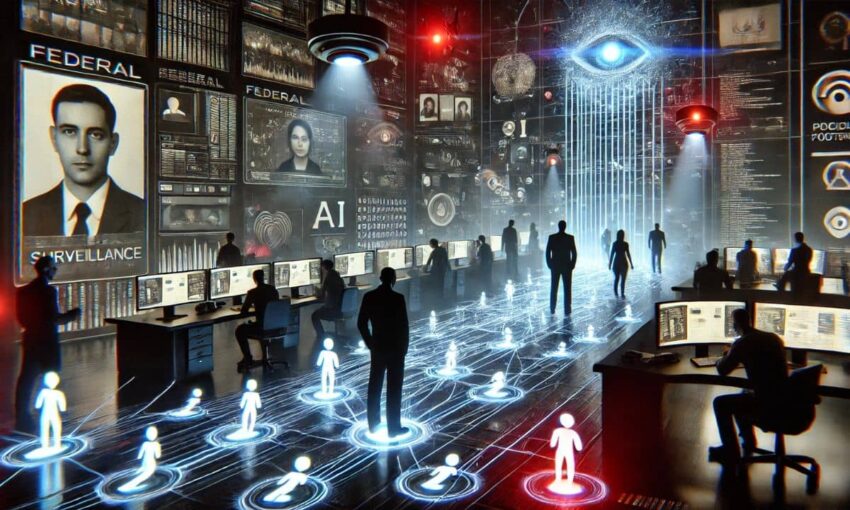
Federal agencies are rapidly deploying artificial intelligence to monitor online activity. This digital surveillance operation has grown from targeted visa screening to a comprehensive monitoring system. Civil liberties advocates now warn about serious implications for democratic freedoms and digital privacy rights.
What started as focused immigrant vetting has evolved into a sophisticated surveillance framework. Multiple federal departments under President Trump’s administration have embraced AI tools. These agencies now scan social platforms to identify potential threats through digital footprints.
Visa monitoring reaches new heights through algorithmic assessment
Since 2019, approximately 14 million visa applicants have submitted their social media handles for review. This scrutiny has intensified substantially. The State Department recently launched a program called Catch and Revoke. This initiative uses AI systems to analyze posts from student visa holders. Reports indicate individuals expressing pro-Palestinian views face increased scrutiny, sometimes resulting in visa cancellations.
A State Department representative confirmed the agency utilizes “all available tools to receive and review concerning information.” The spokesperson added that visa decisions may reflect criminal history or “conduct inconsistent with visa classification.” Details about specific technologies remain undisclosed.
“It is nearly — if not entirely — impossible for the government to focus only on non-citizens and not look at anyone else’s social media,” said Rachel Levinson-Waldman from the Brennan Center for Justice. Her statement reflects growing concerns that AI surveillance inevitably captures American citizens in its digital net.
USCIS policy shift signals expanded monitoring

The U.S. Citizenship and Immigration Services recently proposed collecting social media information from all immigration benefit applicants. This includes those seeking asylum and naturalization. The policy would extend to applicants’ family members, including spouses, parents, and children, many of whom hold U.S. citizenship.
USCIS has indicated that online activity considered “antisemitic” could become grounds for application denial. The public comment period for this policy concluded on May 5, 2025.
Critics argue this approach represents one of the most extensive digital surveillance programs ever applied to immigration processes.
Homeland Security confirms advanced AI deployment
In April 2025, Department of Homeland Security records confirmed that Customs and Border Protection uses Babel X. This AI-powered platform, developed by Babel Street, analyzes open-source and social media data. The system flags travelers for additional screening, though exact triggering criteria remain unspecified.
DHS officials did not respond to comment requests. Babel Street representatives likewise offered no statement.
Immigration enforcement leverages multiple monitoring platforms
Immigration and Customs Enforcement continues using SocialNet, developed by technology firm ShadowDragon. This tool aggregates information from over 200 online platforms. These include Facebook, X (formerly Twitter), Instagram, LinkedIn, dating applications, and even gaming platforms like Roblox.
ShadowDragon maintains distance from AI analysis capabilities. “Our tools simply automate the gathering of public information,” company representative Sandy MacKay stated. “We don’t believe in trusting machines to make decisions about what the data means.”
The company emphasizes its deliberate avoidance of artificial intelligence, machine learning, or analytics features. Nevertheless, the extensive data collection scope concerns privacy advocates.
ICE also maintains a contract with LexisNexis Risk Solutions for “screening, vetting, and targeting” in deportation operations. Reports indicate more than 11,000 ICE officers accessed these technologies in 2022. LexisNexis released a statement claiming these tools “support public safety efforts” rather than deterring legal immigration.
Rights advocates express deepening concerns
Critics see a dangerous blurring between security measures and civil liberties restrictions.
“We’re witnessing a real-time expansion of the use of social media monitoring technologies,” warned Paromita Shah, who leads Just Futures Law. “When you use social media monitoring to intimidate, harass, alienate, deport, incarcerate, arrest — when that becomes your standard to do those things — it’s antithetical to a lot of what democracy stands for.”
Online communication presents additional complexities. Social media often features humor, irony, slang, memes, and algospeak – coded language to bypass content filters.
“Now we’re layering on top of that the use of AI that is error-prone,” noted Becca Branum from the Center for Democracy & Technology. She cautioned that AI systems might misinterpret sarcasm or incorrectly identify threats. This creates serious consequences for individuals simply expressing opinions or sharing Internet content.
Limited transparency fuels growing demands for oversight
The federal agencies leading this digital monitoring effort have provided minimal transparency. The State Department, DHS, and ICE offer few details about their surveillance methods. Advocacy organizations demand increased oversight, clearer regulations, and limitations on what they describe as authoritarian-style surveillance expansion.
Levinson-Waldman warns, “Once you open the door to this kind of surveillance, it’s difficult to close.”
As Congress evaluates privacy and AI regulation proposals in 2025, the government’s application of artificial intelligence for internal monitoring could become central to national debates. These discussions will shape policy on digital rights, public safety protocols, and democratic principles.
How might expanding AI surveillance affect your online expression?
Please share your thoughts about balancing national security with digital privacy rights below.