

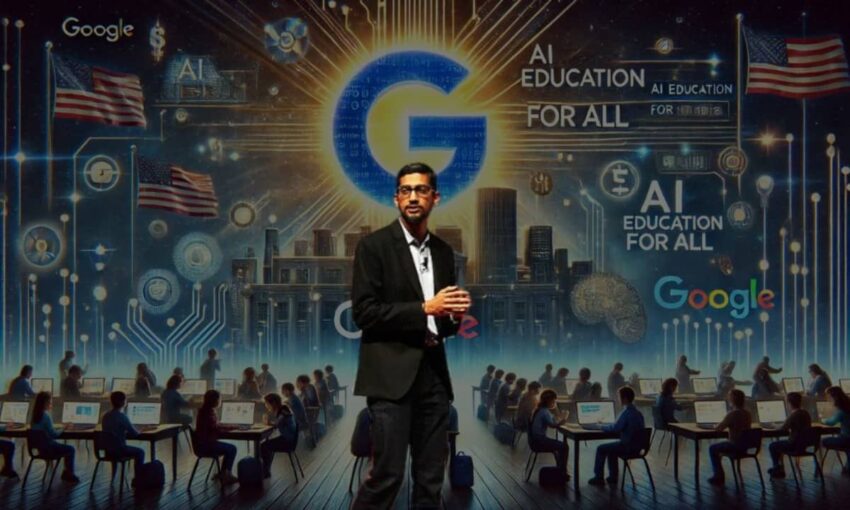
Google announced a groundbreaking $1 billion investment spanning three years to transform AI education across colleges and universities in the United States. The comprehensive program provides students with cost-free AI training resources, positioning them for success in an increasingly automated job market.
The initiative, announced on August 6, encompasses cutting-edge training platforms, access to premium AI technology, and professional certification programs. Students at more than 100 accredited institutions, including prestigious universities such as Texas A&M and the University of Michigan, can access these resources without charge.
“Understanding artificial intelligence technology will be crucial for students entering today’s competitive workforce,” stated Sundar Pichai, chief executive officer of Google and Alphabet Inc.
Comprehensive platform access and advanced technologies
The program centers around Google’s AI for Education Accelerator, providing students with 12 months of premium access to the Google AI Pro subscription service. This extensive package delivers industry-leading artificial intelligence tools, including:
Gemini 2.5 Pro: Google’s flagship AI model offering sophisticated contextual support for academic writing and complex problem-solving tasks.
NotebookLM: An intelligent study companion designed to help students systematically organize research materials and comprehend challenging academic concepts.
Deep Research: An automated report generation system that synthesizes real-time internet information into comprehensive academic resources.
Veo 3: A multimedia creation platform capable of transforming written content and static images into dynamic video presentations.
Jules: A specialized AI programming instructor tailored for students pursuing technology and computer science careers.
These advanced tools extend beyond traditional academic support, preparing students for professional environments where artificial intelligence proficiency represents a fundamental career requirement.
Data protection and educational-first design
Google stressed its unwavering dedication to student privacy protection throughout the educational program. AI tools implemented in academic settings, including the specialized Gemini for Education platform, operate under stringent data security protocols. The company guarantees that no student information undergoes human review or contributes to future AI model development.
“Our Guided Learning approach promotes active student engagement through thoughtful questioning and open-ended exploration… It functions as a personalized educational mentor,” explained Maureen Heymans, Google’s Vice President of Learning and Development.
Heymans highlighted that the technology adapts explanations to match individual student learning preferences while emphasizing conceptual mastery over simple answer delivery.
Scaling artificial intelligence education nationwide
This announcement represents Google’s largest educational commitment in company history. Beyond direct student support, the program establishes partnerships with educational nonprofits and provides universities with substantial cloud computing resources for AI-focused research initiatives.
Senior Vice President James Manyika outlined the company’s global expansion strategy. “We anticipate collaborative learning experiences with these academic institutions,” Manyika noted, explaining that university feedback will drive continuous improvement of Google’s educational AI technologies.
Competing technology companies have launched parallel educational efforts. Microsoft’s newest Copilot platforms deliver customized AI learning experiences for high school students, while Amazon’s “AI Ready” program exceeded its target of training 2 million individuals worldwide by summer 2024.
Bridging workforce preparedness and skills development
Google’s educational investment addresses mounting concerns about American workforce readiness for widespread AI adoption. Recent Handshake employment data reveals a 15% decline in entry-level job opportunities over the past year. Additionally, research from Challenger, Gray & Christmas documented over 10,000 job eliminations in 2025 attributed to AI-driven workplace automation.
Amazon’s workforce analysis suggests that artificial intelligence competencies can enhance employee productivity by approximately 40% and increase salaries by 30%. However, the company warns of significant knowledge gaps across multiple industries requiring immediate attention.
Pichai reinforced this perspective in his announcement: “Tomorrow’s professionals must develop AI fluency to achieve meaningful career success.”
Emerging AI-first student demographics
Google identifies current university students as the inaugural generation developing alongside artificial intelligence as a fundamental educational tool. From academic research and essay composition to software development and multimedia production, students increasingly incorporate these technologies into standard coursework activities.
The integration of AI capabilities within established platforms like Google Classroom demonstrates this educational evolution. Educators now access time-efficient features, including automated vocabulary generation, while students receive individualized, immediate academic assistance.
Market competition and regulatory considerations
As major technology corporations compete for dominance in educational AI markets, institutional concerns persist. Questions surrounding academic honesty and excessive dependence on AI-generated responses have prompted some universities to implement usage restrictions on certain tools.
Google reports minimal resistance from educational administrators thus far. Nevertheless, Manyika acknowledged that “numerous additional considerations” require examination as institutions and technology companies collaboratively shape the future of AI-enhanced learning environments.
Strategic investment in future talent development

By integrating its technological ecosystem into educational environments that train future professionals, Google pursues a long-term strategic advantage. Students gaining proficiency with Google’s AI platforms during their academic careers may maintain these preferences throughout their professional lives—potentially providing the company with competitive advantages in future enterprise markets.
With participation from over 100 American universities and aggressive expansion plans, this billion-dollar AI education investment represents both philanthropic commitment and calculated positioning in the evolving artificial intelligence landscape.
What are your thoughts on Google’s massive AI education initiative? Do you believe this AI education program will adequately prepare students for an AI-driven job market? Share your perspective on how universities should balance artificial intelligence integration with traditional learning methods in the comments below.