

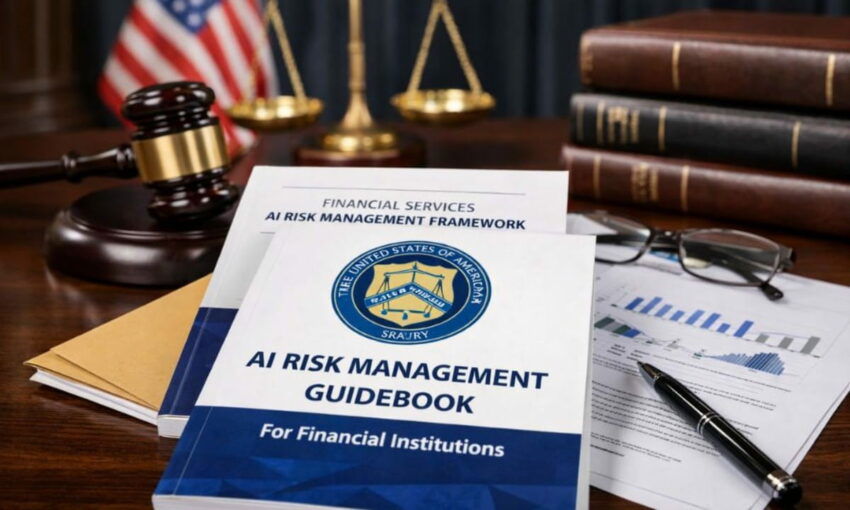
The U.S. Treasury has stepped in with a structured playbook for financial institutions navigating the fast-moving world of artificial intelligence. A newly released AI risk management guide gives banks and financial firms a concrete roadmap for adopting AI responsibly — without stalling innovation in the process.
At the center of the effort is the Financial Services AI Risk Management Framework, known as the FS AI RMF, along with a companion Guidebook. More than 100 financial institutions, industry groups, technical bodies, and regulators contributed to building it. The result is one of the most comprehensive sector-specific AI governance efforts the industry has seen.
Sector-specific approach fills a real gap
Traditional governance frameworks were not built with AI in mind. That gap has become harder to ignore.
AI introduces risks that older systems simply were not designed to catch. Algorithmic bias, opaque decision-making, cybersecurity exposure, and tangled interdependencies between datasets and platforms are just a few. Large language models make the problem sharper. Their outputs shift with context and resist straightforward interpretation.
Financial firms already operate under layers of regulatory pressure. Many have leaned on broad standards like the NIST AI Risk Management Framework.
But applying general guidance to AI-specific problems has proven clunky in practice. The FS AI RMF fills that space directly, offering sector-tailored controls and implementation guidance built for financial services.
Framework built on governance and risk integration
The Guidebook explains how institutions can fold AI governance into their existing compliance, risk, and operational processes.
The framework rests on four core components: an AI adoption stage questionnaire, a risk and control matrix, a detailed implementation Guidebook, and a control objective reference guide. Together, they define 230 control objectives organized under four functions drawn from NIST standards — govern, map, measure, and manage.
These categories cover AI systems across their full lifecycle, from initial development through deployment and ongoing monitoring.
AI adoption stages determine control requirements

One of the framework’s defining features is how it evaluates a firm’s actual stance on AI.
The adoption stage questionnaire examines how deeply AI is embedded in business operations. It looks at governance structures, business impact, deployment models, third-party dependencies, and data sensitivity. Based on those findings, firms are sorted into one of four stages.
The initial stage covers organizations where AI is not yet operational. The minimal stage applies where AI handles limited, low-risk tasks. The evolving stage fits firms where AI touches more complex or sensitive workflows. The embedded stage describes organizations where AI drives core decision-making.
The staging system matters because it calibrates expectations. Firms in early stages are not expected to implement every control at once. But as AI use deepens, so do the requirements.
Focus on operational risk and accountability
The framework gets specific about what responsible AI management looks like on the ground.
Controls address data quality, bias monitoring, fairness, cybersecurity hardening, and operational resilience. Transparency in AI-driven decisions gets particular attention — especially in areas where customers or regulators are directly affected.
The Guidebook also calls for dedicated incident response procedures for AI failures and centralized tracking of AI-related incidents across the organization. Firms must match controls to their risk profile and keep evidence ready to demonstrate compliance.
Emphasis on trustworthy AI principles

The FS AI RMF draws on widely accepted principles for responsible AI development. Reliability, safety, security, accountability, transparency, privacy, and fairness all feature prominently.
The guidance is clear: AI systems must produce consistent, secure, and interpretable outcomes. When AI makes decisions that affect customers or draw regulatory attention, firms must be able to explain how and why.
Strategic implications for financial leaders
The U.S. Treasury’s move sends a direct signal to the C-suite. AI governance is no longer a back-office concern. It belongs on the leadership agenda.
The framework calls for coordination across business lines. Technology teams, risk managers, compliance officers, and executives all share responsibility for overseeing AI systems. The U.S. Treasury warns that using AI without strong governance can lead to system failures, regulatory fines, and reputational harm. Conversely, institutions that build disciplined governance may scale AI faster and with greater confidence.
Evolving landscape for AI regulation
The U.S. Treasury frames AI risk management as a living process, not a checklist to file away.
Regulatory expectations will keep moving. AI capabilities will keep expanding. Financial institutions will need to revisit governance practices and risk assessments on a rolling basis. The FS AI RMF gives the industry a shared language and structure for ongoing work. It also signals that regulators are getting specific — and serious — about AI oversight in high-stakes sectors.
For banks and financial firms, the takeaway is straightforward. AI is no longer peripheral. It is becoming infrastructure. And infrastructure carries responsibility.
How is your organization approaching AI governance? Please share your perspective in the comments below.