

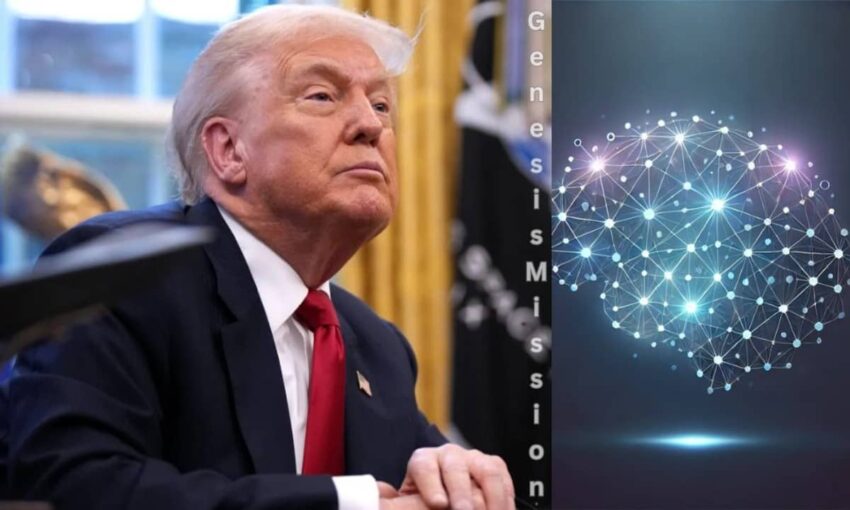
President Donald Trump unveiled a sweeping artificial intelligence initiative Monday, directing federal agencies to construct a massive AI platform powered by decades of government research data as the United States intensifies its battle for global technology leadership. The executive order establishes the Genesis Mission, a coordinated effort across multiple agencies designed to convert enormous federal scientific databases into resources for advanced machine learning systems and automated research capabilities.
According to the order, the Genesis Mission aims to advance scientific discovery rapidly, bolster national security, secure energy independence, boost workforce efficiency, and maximize returns on taxpayer-funded research investments.
Federal datasets become the foundation for AI advancement
The Department of Energy’s national laboratory network will serve as the cornerstone of this artificial intelligence initiative under the new directive. These facilities will provide carefully vetted data and computing resources to researchers developing cutting-edge scientific foundation models.
White House officials characterize the initiative as carrying the same urgency and scope as the Manhattan Project. The administration seeks to establish an American Science and Security Platform that consolidates data, supercomputing capabilities, and software resources currently dispersed throughout government agencies.
The executive order states the Genesis Mission will construct an integrated AI platform leveraging federal scientific datasets—the world’s most extensive collection developed through decades of federal funding—to train scientific foundation models and develop AI agents capable of testing hypotheses, automating research processes, and accelerating scientific achievements.
Michael Kratsios, serving as assistant to the president for science and technology and director of the Office of Science and Technology Policy, will oversee the program.
Kratsios explained that the initiative will compress discovery timelines from years to days or hours, enabling scientists to pursue ambitious hypotheses and achieve breakthroughs previously beyond reach.
Initially, federal researchers will utilize existing supercomputers distributed among the nation’s 17 national laboratories. The government intends to expand infrastructure gradually, creating an AI foundation supporting energy research, biotechnology, climate modeling, and national security applications.
Infrastructure expansion has already begun. Last October, the Energy Department revealed a $1 billion collaboration with AMD to construct two AI-focused supercomputers, Lux and Discovery, at Tennessee’s Oak Ridge National Laboratory. Lux, described as an AI factory for scientific research, should launch in 2026, with Discovery following later this decade.
Additional partnerships with Nvidia and Hewlett Packard Enterprise will deliver more high-performance computing systems and quantum-ready accelerators to Oak Ridge and other facilities, contributing to a broader federal supercomputer acquisition campaign supporting AI-driven research.
Portions of the Genesis Mission’s data and computing capabilities will become accessible to private sector partners. Technology companies, including Nvidia, AMD, Hewlett Packard Enterprise, and Dell, have committed to establishing facilities within national laboratories, according to White House officials.
Authorities emphasize that only authorized datasets will reach external artificial intelligence companies. Information involving national security concerns and personal privacy will remain protected by rigorous safeguards.
Energy Secretary Chris Wright faces a 90-day deadline to identify systems and data supporting the program, including resources available through industry collaborators. Within 270 days, agencies must begin applying artificial intelligence to significant science and technology challenges, spanning fusion energy, advanced manufacturing, robotics, and nuclear technologies.
The initiative expands upon the National Artificial Intelligence Research Resource, a pilot research network launched under 2020 legislation, providing universities and laboratories with improved access to computing power and datasets for AI development.
Lynne Parker, who previously led the NAIRR task force during President Joe Biden’s administration and currently teaches at the University of Tennessee, Knoxville, previously noted that government backing for AI research establishes groundwork for breakthroughs while keeping innovation aligned with public priorities. She warned that without sustained investment, America risks surrendering leadership in technologies shaping the economy, security, and daily life.
Major initiative sparks division within conservative movement

Trump’s directive represents his most recent effort to position artificial intelligence as central to American economic and security objectives. Since returning to office, he has embraced Silicon Valley’s AI sector while cautioning that excessive regulation could handicap the country against China.
During a recent investment summit, Trump declared he had eliminated what he called “absurd” Biden-era restrictions and pledged to construct the largest, most powerful, and most innovative AI ecosystem globally.
Administration allies reinforce this messaging. David Sacks, Trump’s AI and crypto czar, has likened the current AI competition to the 1960s space race, contending that artificial intelligence dominance will determine global influence for decades.
Sacks stated that continued American leadership in AI will preserve the nation’s superpower status, but falling behind competitors like China could prove catastrophic. He credited Trump with outlining a winning strategy for this AI competition.
However, the technology the White House deems essential has triggered intense opposition within Trump’s political coalition.
Steve Bannon, a longtime Trump confidant, has made artificial intelligence a primary focus on his War Room broadcast. He labels it potentially the most hazardous technology humanity has encountered. Despite identifying as a capitalist, Bannon denounces the AI push as corporatism and crony capitalism rather than genuine free enterprise.
For Bannon and numerous prominent right-wing commentators, rapid AI deployment threatens mass job elimination, concentrated corporate control, and social upheaval. Conservative podcaster Matt Walsh characterized AI as possibly the greatest crisis facing humanity currently, criticizing both industry and government for sleepwalking toward a dystopian reality without addressing the threat urgently.
Some MAGA commentators frame artificial intelligence as presenting spiritual and cultural dangers. Joe Allen, Bannon’s regular AI analyst, warns of an inverse singularity—a future where human intelligence diminishes as society grows dependent on machines for determining truth.
Allen argues that people are being conditioned to accept AI as the ultimate authority on reality. He contends emerging transhumanism concepts, including proposals for human-machine cognitive integration, are fundamentally anti-human and risk eroding humanity’s essence.
Technology companies accelerate despite congressional uncertainty
While grassroots conservatives grow increasingly skeptical, major technology corporations are racing to match the federal momentum.
Elon Musk, whose enterprises develop sophisticated robots and large-scale models, recently told staff that AI will eventually control everything rather than humans. He stressed the importance of ensuring AI remains beneficial to humanity.
Within Washington, debates over artificial intelligence guardrails remain unresolved. Senators Josh Hawley and Marsha Blackburn have introduced proposals restricting automated decision systems in lending, healthcare, and other critical domains, arguing that unchecked deployment could consolidate power among a few corporations while devastating workers.
Simultaneously, the Energy Department and peer agencies continue signing public-private agreements for AI-centered supercomputers, and maintaining shared systems like Lux, Discovery, Solstice, and Equinox will accelerate progress in clean energy, medicine, and national security.
For now, the Genesis Mission provides Trump a flagship program, demonstrating American determination to outpace Beijing in artificial intelligence and next-generation computing.
The initiative also highlights a fundamental tension within his coalition. The White House believes connecting federal science to powerful AI platforms will deliver economic growth and strategic advantages. Many of Trump’s staunchest supporters remain unconvinced—and are positioning artificial intelligence as a defining political battleground for the coming election cycles.
What’s your take on the Genesis Mission? Should the government prioritize AI advancement or stronger safeguards? Please share your perspective in the comments below.