

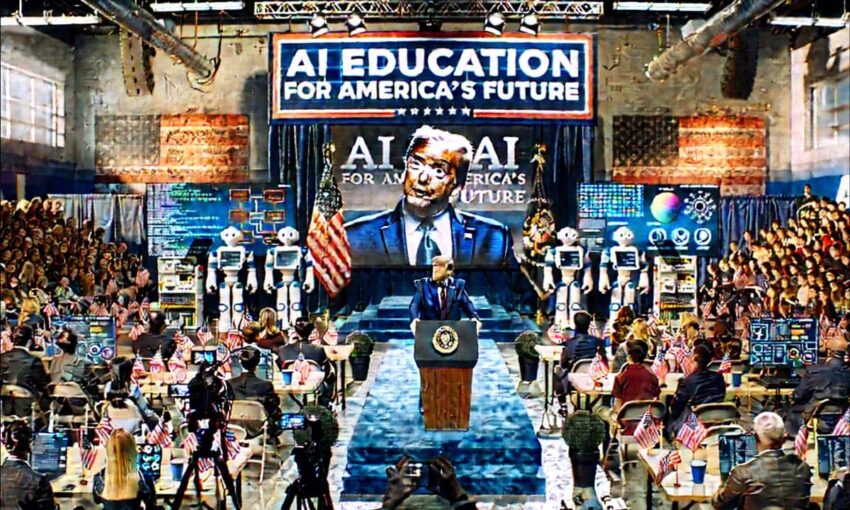
President Donald Trump signed a far-reaching executive order on April 23, 2025, mandating the integration of artificial intelligence into K-12 education across the United States. The directive aims to prepare students for an increasingly automated workforce while strengthening America’s technological competitiveness against global rivals.
The order by the Trump administration directs the Education Department and National Science Foundation to prioritize artificial intelligence through grants and research initiatives. It also instructs the Labor Department to expand AI-focused apprenticeship programs, reinforcing the administration’s emphasis on alternatives to traditional college pathways.
Reshaping American education through technology
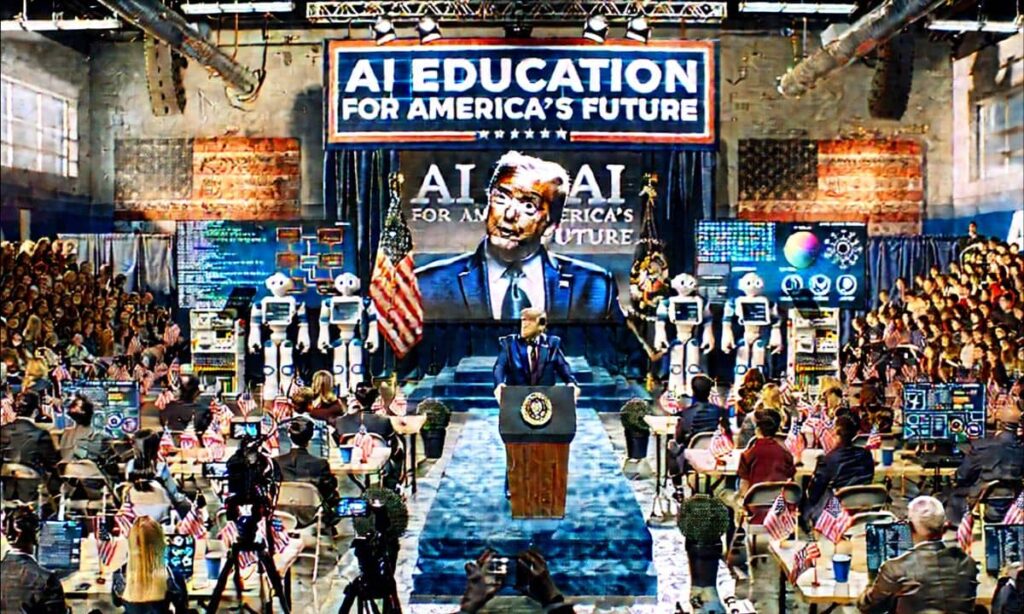
“This is a big deal, because AI seems to be where it’s at,” Trump said during the Oval Office signing ceremony. The directive represents one of seven education-focused actions taken by the administration on the same day, reflecting growing bipartisan concern about maintaining American leadership in technological education.
Under the order, the Education Department must develop pathways enabling high school students to access AI courses and certification programs. The department will partner with states to scale these educational initiatives nationwide. Additionally, teacher training grants will now prioritize projects incorporating artificial intelligence, while the NSF will redirect its research agenda toward effective AI classroom integration.
Central to the initiative is the formation of a White House Task Force on AI Education, headed by Michael Kratsios, who leads the Office of Science and Technology Policy. Education Secretary Linda McMahon and Labor Secretary Lori Chavez-DeRemer will serve on the task force, which will launch a Presidential AI Challenge – a national campaign promoting classroom AI adoption. The group will also develop public-private partnerships to fund and expand AI education programs throughout the country.
Economic investment and cross-party interest
Trump highlighted the global significance of AI development, noting “trillions of dollars being invested in AI” worldwide. “Somebody today, a very smart person, said that AI is the way to the future. I don’t know if that’s right or not, but certainly very smart people are investing in it,” he remarked.
The push for technological education reform has drawn interest from both major political parties, with shared concerns that American students may fall behind international competitors, particularly in countries like China, where AI education receives substantial government support. A bipartisan congressional report released in December 2024 emphasized that K-12 educators need significant resources to build AI literacy, while cautioning that implementation must comply with labor and anti-discrimination regulations.
Despite agreement on AI’s importance, ideological differences persist. A recent Republican-led committee concluded, “AI will likely revolutionize the way students learn, but the federal government doesn’t need to be involved,” indicating resistance to federal oversight even as states seek implementation guidance.
Evolving AI policy direction
The executive order marks a shift in Trump’s approach to artificial intelligence policy. Earlier in his current term, he repealed regulatory frameworks established by former President Joe Biden that sought to expand AI with federal oversight. Instead, Trump has championed private sector investment, including securing a $500 billion commitment from three major technology companies to develop AI data centers.
This latest directive further emphasizes apprenticeship programs, aligning with broader Republican efforts to promote workforce alternatives to four-year college degrees. The Labor Department has been instructed to create incentives for businesses to offer AI-centered apprenticeships, a strategy that has garnered support across party lines.
Challenges and controversies
The rollout of the initiative has faced several complications. Secretary McMahon, who holds a key position on the task force, recently became the subject of widespread online mockery after mistakenly referring to AI as “A.1. steak sauce” during a public event in San Diego on April 8. Though she initially used the term correctly, her verbal slip quickly went viral, with the sauce brand itself capitalizing on the gaffe in social media posts.
Further complicating implementation, Trump’s broader education reform agenda has encountered legal obstacles. In March, he signed an order aimed at dismantling the Department of Education—a move that has reduced the agency’s staff by half.
A coalition of states has filed suit against the administration, arguing that these mass layoffs violated federal law. A court hearing scheduled for April 25 will determine whether the staffing reductions should be temporarily halted.
Additional educational directives
Alongside the AI initiative, Trump signed several other contentious education-related orders. These include measures targeting what the administration describes as “woke ideology” in university accreditation processes, strengthening requirements for colleges to disclose foreign financial gifts, and establishing a new White House initiative supporting Historically Black Colleges and Universities (HBCUs).
These directives emerge during a period of significant upheaval in federal education policy, as Trump attempts to balance his commitment to decentralization with efforts to shape national education priorities through executive action.
The future of AI in American classrooms
As artificial intelligence technologies become increasingly embedded in daily life, their role in education appears inevitable to many policy experts. Trump’s executive order represents a substantial escalation in federal efforts to influence that integration, even as debates continue over appropriate regulation, funding mechanisms, and student privacy protections.
The White House Task Force is expected to publish its initial recommendations within 90 days, with preliminary pilot programs in selected states projected to launch by late 2025.
What do you think about integrating AI education into K-12 schools? Should the federal government play a leading role, or should these decisions remain at the state and local levels?
Share your perspective on how this executive order might affect students in your community, and whether you believe AI literacy should be a priority in American education.