

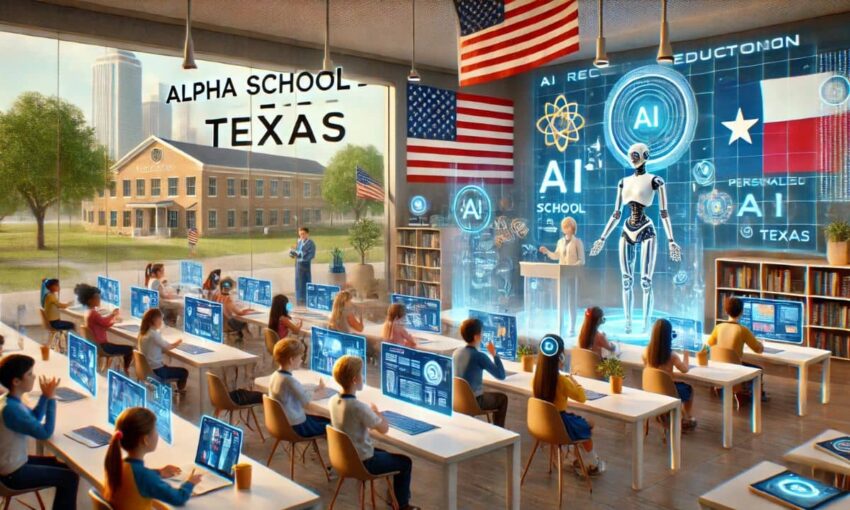
In Brownsville, Texas, a quiet educational revolution is changing how students learn. Alpha School has replaced traditional teaching methods with artificial intelligence tools. The results? Students who rank in the nation’s top 2% on standardized tests after spending just two hours daily on core academics.
Streamlining education, unlocking student potential
Alpha School condenses conventional learning into two-hour sessions using custom AI tutors and adaptive technology. Students then participate in practical workshops covering everything from public speaking to bicycle riding. The program allows children to progress at their own pace.
“Our personalized AI learning systems help students learn faster and more effectively,” explains MacKenzie Price, who co-founded the school.
Academic assessments validate this approach. Alpha students consistently perform in the top percentiles nationwide on NWEA MAP and other standardized measurements.
Frustration fuels innovation
Price’s educational journey began when her children returned from school uninspired despite attending one of Texas’s highest-rated districts. As a Stanford-educated psychologist, she recognized that traditional education was suppressing their natural curiosity.
“After just two and a half years in school, my daughters’ love for learning had disappeared,” Price notes. “The problem wasn’t the teachers themselves but rather the outdated educational model.”
This realization prompted her to launch Alpha in Austin (2016), pioneering a new educational framework: brief AI-guided academic sessions combined with supportive adult mentors who foster independence and motivation.
AI: From classroom disruptor to learning equalizer
Alpha Brownsville opened in 2022, becoming a testing ground for AI-enhanced education. Pre-K through eighth-grade students use specialized applications for 30-minute sessions in each core academic subject daily.
Six-year-old Sarah Schipper enthusiastically describes her experience: “Our school is different because we use computers to learn. Maybe all schools should try this?”
Already developing critical thinking skills alongside traditional academics, Sarah dreams of pursuing science—with a confidence that stems directly from Alpha’s innovative approach.
The school’s impact extends beyond theory. High school junior Elle Kristine, an Alpha student since second grade, has developed an AI dating coach for teenagers that gained Wall Street Journal recognition.
“Most 16-year-olds don’t have time for such projects, but our educational model makes it possible,” she explains.
Nationwide expansion plans
Alpha currently operates in Austin, Brownsville, and Miami, with enrollment carefully limited to maintain educational quality. However, rapid growth is underway. The organization plans to open seven new campuses in fall 2025, including locations in Houston, Fort Worth, Orlando, Tampa, Palm Beach, Phoenix, Santa Barbara, and New York City. Tuition varies significantly by location—from $10,000 in subsidized Brownsville to over $65,000 in Manhattan—yet Price maintains the model works across socioeconomic backgrounds.
“Our approach scales infinitely and remains accessible,” she says. “It benefits struggling students and those bored by conventional teaching methods.”
Half of Alpha Brownsville’s students are children of SpaceX employees working at Elon Musk’s nearby Starbase facility. The surrounding community ranks among Texas’s most economically challenged regions, with one-fourth of residents living below poverty thresholds.
“AI technology serves as education’s great equalizer,” Price emphasizes. “We’re demonstrating its effectiveness across diverse backgrounds.”
National policy shift toward AI education

Alpha’s emergence coincides with broader policy changes. In April, President Trump signed an executive order promoting AI-powered K-12 education nationwide. This directive establishes a White House Task Force on AI Education and redirects federal funding toward AI integration in schools.
The order states: “AI is rapidly transforming our world. To maintain America’s global leadership, we must equip young people with skills to use and create next-generation AI technologies.”
The policy also creates a “Presidential Artificial Intelligence Challenge” modeled after the Presidential Physical Fitness Challenge, designed to encourage innovation among students and educators.
Education Secretary Linda McMahon called the initiative “groundbreaking,” noting it “returns educational control to states” while expanding parental choices, including AI-based learning options.
Screen time concerns and solutions
Despite positive outcomes, Alpha’s laptop-centered approach raises questions about excessive screen exposure.
Mo Swain, who leads Alpha’s Brownsville campus, acknowledges these concerns. “Very few parents worry about screen time because most learning happens during school hours,” she explains. Younger students cannot take laptops home, while older ones may use them only for specific projects.
National statistics show American K-12 students average 98 minutes daily on school-issued devices, peaking at 144 minutes in middle school. Alpha’s structured two-hour format seems reasonable by comparison.
Swain emphasizes that motivation drives student engagement. “Children work late because they want to, not because they’re required to.”
Redefining educator roles
Alpha replaces traditional teachers with “guides” who provide coaching and emotional support rather than lectures or grades. These mentors focus on building student confidence.
Robin Lake, who directs the Center on Reinventing Public Education, believes public schools should reconsider traditional teaching models.
“We need to examine whether educators’ time is optimally utilized,” Lake suggests. “Students might benefit more when teachers focus on mentorship while AI delivers core content.”
As public education faces budget constraints and performance challenges, Lake views AI tools as increasingly essential. “The conventional one-teacher-per-30-students model may no longer be sustainable.”
Students shape their educational future
The strongest endorsement comes from Alpha students themselves. Seventh-grader Savannah Marrero wants to establish a Brownsville high school to continue her AI-powered education journey.
“Returning to traditional schooling makes no sense,” she states.
Savannah actively researches regulations and funding options while exploring Alpha’s Austin high school campus.
“Even after school hours, I’m eager to continue learning. Everyone here feels passionate about education.”
This enthusiasm exemplifies Alpha’s core mission. As Price notes, “Students spend 13 years in school—they should enjoy the experience. AI enables faster, more effective learning while maximizing human potential.”
Education at a turning point
As artificial intelligence transforms various industries, Alpha School offers a glimpse into education’s future, where personalized learning, intrinsic motivation, and emotional mentorship replace outdated instruction models.
While critics question whether AI can preserve education’s human element, Alpha’s success suggests the opposite: Artificial intelligence may restore joy, curiosity, and purpose to American classrooms.
As AI continues to reshape education across America, we want to hear from you. Are AI tutors the solution to our educational challenges? How might this technology impact your local schools?
Please share your views.