

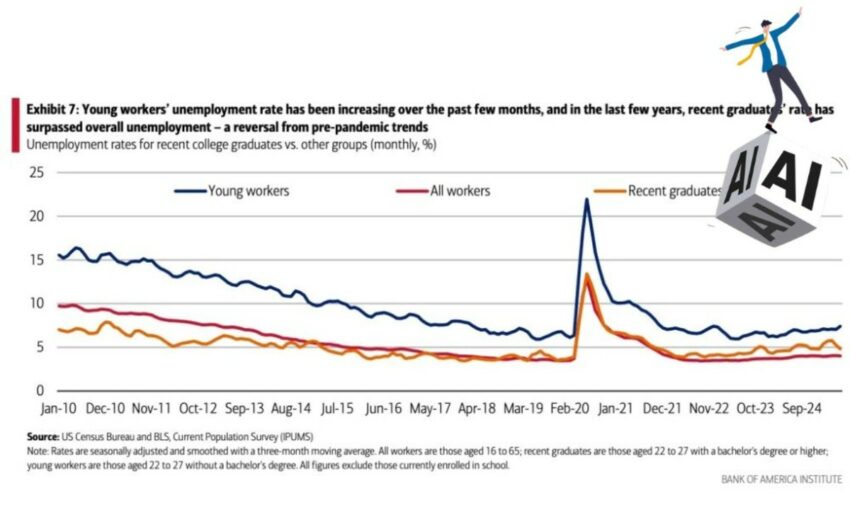
Fresh research from Stanford University reveals that artificial intelligence deployment is creating a generational divide in the American job market. The study finds that recent graduates are experiencing the steepest employment losses due to AI impact.
The comprehensive analysis, published Tuesday, demonstrates that AI integration has generated “substantial and uneven consequences” for workers between 22 and 25 years of age in technology-intensive roles, including software development and customer support. Economist Erik Brynjolfsson’s research team examined millions of real-time payroll data points from ADP, America’s premier payroll management company.
Their analysis reveals a 13% comparative employment decrease among early-career professionals in AI-affected sectors since late 2022, even when accounting for broader economic disruptions.
Meanwhile, seasoned employees in identical professions have experienced consistent job market expansion, highlighting how workplace expertise serves as crucial protection against technological displacement.
Young professionals face the biggest AI impact
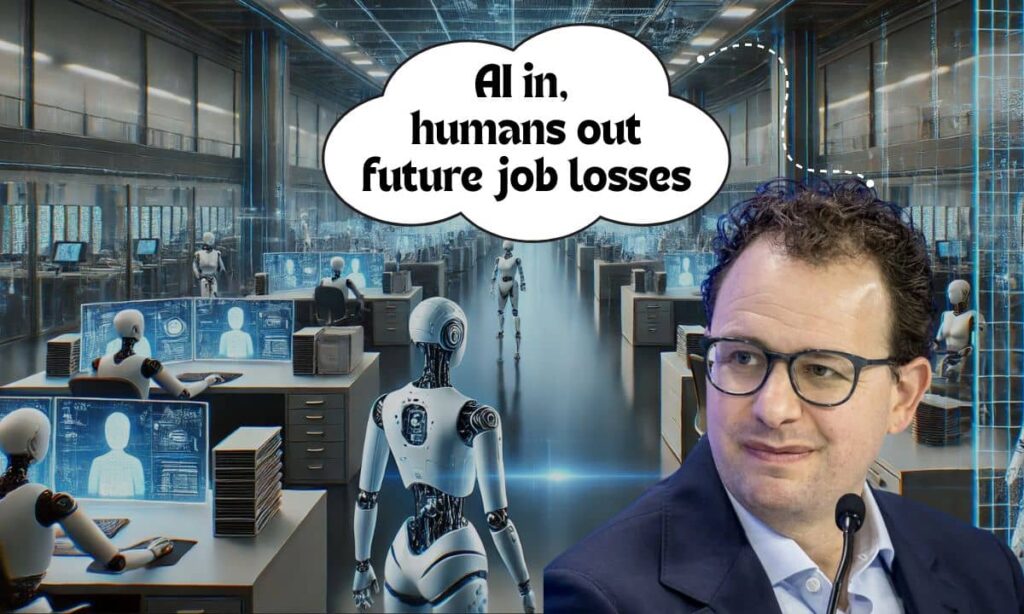
Stanford’s research demonstrates that employment disruption affects different age groups unequally. Recent college graduates struggle most severely, particularly those establishing careers in information-based industries. Standardized activities, including basic programming tasks, routine customer interactions, and regular report generation, are increasingly transferred to AI platforms.
“Professional experience and implicit knowledge provide essential protection against job displacement,” the research emphasizes. It notes that, while AI can duplicate academic learning, it fails to substitute complex skills developed through practical workplace experience.
These findings align with escalating warnings from financial sector analysts. Goldman Sachs has cautioned that college degree wage premiums are declining, while Bank of America Global Research recently observed that recent graduate unemployment rates have exceeded national averages for the first time in years.
Recruitment patterns have shifted dramatically since 2022
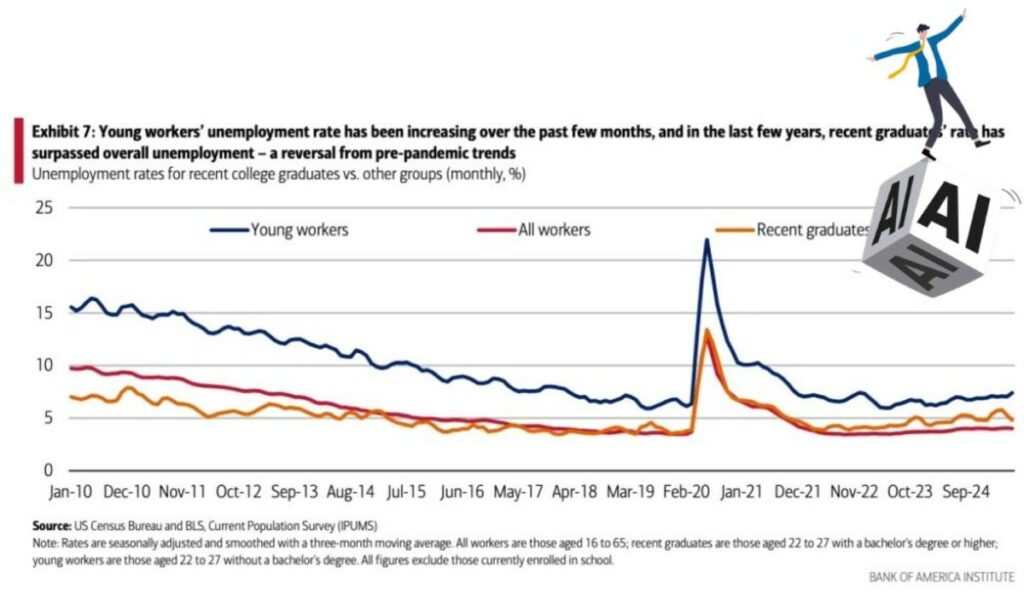
The investigation also reveals that employment practices for younger professionals have transformed significantly since late 2022, coinciding with widespread generative AI system adoption. Job creation for workers under 25 in AI-intensive fields has stagnated or contracted, while older employees in comparable positions have achieved 6% to 9% gains.
Conversely, sectors with minimal AI exposure show no such generational disparities, with younger and older workers experiencing comparable growth trajectories. Stanford researchers interpret this divergence as definitive proof that AI transformation is already redirecting opportunities away from entry-level positions.
Technology replacement versus enhancement

A fundamental question in AI discussions centers on whether emerging tools eliminate jobs or improve worker performance. Stanford’s investigation highlights AI impact.
Positions where AI primarily substitutes human labor demonstrate employment reductions. However, roles where AI supplements human capabilities through enhanced tools maintain more stable entry-level hiring patterns.
Joshua Wöhle, Mindstone CEO specializing in AI skills development programs, advocates for the augmentation approach. “We’re approaching the threshold where artificial intelligence surpasses most knowledge workers’ capabilities. This is precisely why enhancement strategies outperform replacement approaches,” he recently stated.
The report references cautionary examples like IgniteTech, where CEO Eric Vaughan eliminated nearly 80% of personnel in 2023, attributing the cuts to unsuccessful AI tool integration into operational workflows.
Eliminating alternative explanations
Researchers systematically excluded other potential causes, including pandemic-related disruptions and monetary policy changes. They determined the employment pattern emerged exclusively following the late-2022 AI surge. Additionally, the trend extends beyond technology-focused positions, affecting broader occupational categories where routine functions can be automated through software systems.
For younger workers in the highest AI-exposure job categories, the relative employment decline is “substantial and statistically significant,” according to the study. Among older age demographics, the impact remained minimal or statistically negligible.
Employment decreases without wage reductions
The workforce transformation has not involved salary adjustments. Despite concerns about income collapse, Stanford’s examination finds minimal pay changes across age groups or exposure levels. The adjustment has occurred through hiring freezes and position eliminations rather than compensation cuts.
The researchers suggest this reflects “wage inflexibility,” where employers reduce workforce size more readily than salaries. If accurate, early AI effects focus more on lost employment opportunities than reduced earnings.
Consistent trends across data sets
The study confirms these patterns appear consistently across multiple information sources. The most significant changes began in late 2022, corresponding with the launch of generative AI platforms.
While Brynjolfsson and colleagues acknowledge their research captures only initial phases of the AI revolution, they contend that these represent the first large-scale, immediate indicators of technology’s labor market impact.
For Generation Z, frequently celebrated as the most technology-fluent generation, the situation presents bitter irony: the digital tools they mastered may exclude them from careers before they establish professional identities.
Consequences for society and economy
The discoveries raise critical concerns for government officials, business leaders, and educational institutions. Academic institutions may need to modify curricula, emphasizing skills that artificial intelligence cannot readily duplicate. Companies might increase investment in retraining and skill development programs, helping young workers adapt to technological changes. Entry-level positions may require fundamental restructuring when AI systems rapidly master routine responsibilities.
Stanford’s information suggests these challenges have moved beyond theoretical discussion. For many young adults in their early twenties, AI effects are already apparent through reduced employment opportunities, indicating a job market potentially experiencing fundamental generational restructuring.
Current data reveals that technological advancement creates immediate, measurable impacts on career prospects for America’s newest workers, fundamentally altering traditional employment pathways and professional development trajectories.
Have you or someone experienced AI-related job changes in your industry? Please share your thoughts on whether companies should prioritize protecting entry-level opportunities or embrace efficiency gains from artificial intelligence automation.