

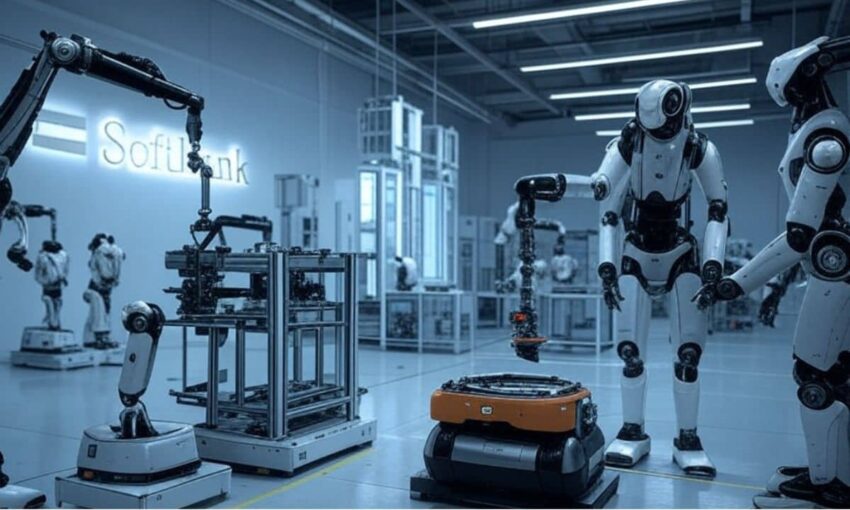
SoftBank Group Corp. plans to invest more than $1 trillion to create artificial intelligence-powered industrial parks across the United States, potentially revolutionizing American manufacturing. Under CEO Masayoshi Son’s leadership, the Japanese conglomerate aims to build factories operated almost entirely by AI-equipped robots, addressing persistent labor shortages while fundamentally changing how products are made.
A vision for AI-driven manufacturing
The planned industrial parks would function as manufacturing centers where robots handle production with minimal human supervision. These autonomous systems would manage everything from raw materials to finished products, making operational decisions traditionally handled by human managers.
This approach directly addresses America’s manufacturing labor gap, which has left approximately 600,000 factory positions unfilled. Nearly 70% of manufacturers report difficulty finding workers, limiting production capacity, and contributing to supply chain vulnerabilities exposed during the pandemic.
SoftBank’s AI-powered facilities would operate continuously without shift changes or staffing fluctuations, potentially tripling output compared to conventional factories while maintaining consistent quality. The systems would also enable rapid reconfiguration to produce different products, allowing manufacturers to respond quickly to market changes.
Strategic collaborations and previous commitments
This trillion-dollar initiative builds on SoftBank’s growing technology investments in the United States. In January 2025, Son partnered with OpenAI, Oracle, and Abu Dhabi-based MGX to form Stargate LLC, committing up to $500 billion over four years for AI infrastructure, including massive data centers.
In December 2024, Son announced a separate $100 billion investment aimed at creating 100,000 AI-focused jobs across America. During that announcement, he emphasized that the United States offers ideal conditions for next-generation technology development.
These investments represent a strategic pivot for SoftBank following several challenging years in its investment portfolio. After substantial losses from investments in companies like WeWork, Son appears to be refocusing on industrial applications of artificial intelligence rather than consumer-facing technology startups.
Economic implications and job creation
While traditional manufacturing positions would be limited in these new facilities, the initiative would generate significant employment in supporting fields. These include robotics engineering, AI development, predictive maintenance, and systems integration.
Economic analysts suggest each AI-powered factory could create between 300 and 500 high-skilled technical positions, though these require different qualifications than traditional manufacturing jobs. The initiative could generate up to 300,000 new positions across various technical disciplines nationwide
Beyond direct employment, the construction and operation of these facilities would stimulate local economies through increased service sector demand and tax revenue. Communities hosting these industrial parks could see substantial economic benefits, particularly in regions that have experienced manufacturing decline.
The initiative promises to strengthen American manufacturing competitiveness globally by reducing production costs and improving quality control. This could potentially reverse decades of manufacturing outsourcing by making domestic production economically viable for products currently manufactured overseas.
Addressing labor challenges with AI
The fundamental premise behind SoftBank’s initiative addresses one of American manufacturing’s most persistent problems: worker shortages that limit production capacity.
Manufacturing employment has never recovered to pre-2000 levels, with many companies unable to find qualified workers despite offering competitive wages. The skills gap has widened as manufacturing processes become more technical, requiring specialized training that many workers lack.
SoftBank’s autonomous factories would operate without the staffing challenges affecting traditional manufacturing. This consistency could increase production reliability while potentially reducing costs by 30-40% compared to conventional factories.
The technology would also allow manufacturing to thrive in regions with declining working-age populations, a growing concern as demographic trends show continued workforce contraction in many manufacturing-intensive states.
Technological and ethical considerations
Implementing factory-scale autonomous systems presents significant technological challenges beyond those faced in smaller automated production lines.
These facilities require advanced machine learning systems capable of adapting to manufacturing variables in real time, sophisticated sensor networks to monitor production quality, and highly reliable robotic systems that can operate for extended periods without failure.
Security concerns are substantial, as these facilities would represent critical infrastructure vulnerable to cyber threats. Protecting manufacturing AI systems from tampering or disruption requires sophisticated cybersecurity measures integrated throughout the production environment.
The ethical dimensions extend beyond technical considerations to the societal impact of advanced automation. While SoftBank’s initiative addresses labor shortages, it accelerates the transition away from traditional manufacturing employment that has historically provided middle-class livelihoods for millions of Americans.
Policy experts emphasize the need for comprehensive transition programs to help workers develop skills relevant to the new manufacturing paradigm. Without adequate support systems, communities could face significant disruption despite the economic benefits these facilities might bring.
Political and social reactions
News of SoftBank’s proposed investment has generated varied reactions. Economic development officials have generally welcomed the potential investment, while labor advocates express concerns about long-term employment implications.
Some Congressional representatives have called for investment incentives to ensure these facilities are built in regions most affected by manufacturing decline. Others have proposed that SoftBank establish training programs in communities where industrial parks are located.
Public opinion is divided, with 62% of Americans believing AI-powered manufacturing will benefit the economy overall, while 57% express concern about potential job displacement. Younger Americans tend to view the development more positively than older generations, particularly those with manufacturing experience.
Business leaders have largely praised the initiative, seeing it as strengthening America’s competitive position in global manufacturing. The U.S. Chamber of Commerce called it “a vote of confidence in America’s industrial future” that could reverse decades of manufacturing decline.
Long-term implications for the U.S. economy
SoftBank’s initiative could fundamentally reshape American manufacturing, potentially reversing the sector’s long decline as a percentage of GDP.
By addressing labor constraints through advanced automation, the initiative could expand manufacturing capacity while improving productivity. Economic analysts project that full implementation could increase American manufacturing output by 15-20% while reducing production costs significantly.
The initiative also positions the United States to lead in developing manufacturing technologies that could be exported globally. As other industrialized nations face similar demographic challenges, demand for autonomous manufacturing systems will likely grow worldwide.
As SoftBank plans to invest $1 trillion in AI-powered factories across America, we want to hear from you. How do you think these autonomous manufacturing facilities will affect your community and the future of work? Will they create new opportunities or pose challenges for American workers?
Please share your thoughts below on this transformative investment that could reshape U.S. manufacturing.