

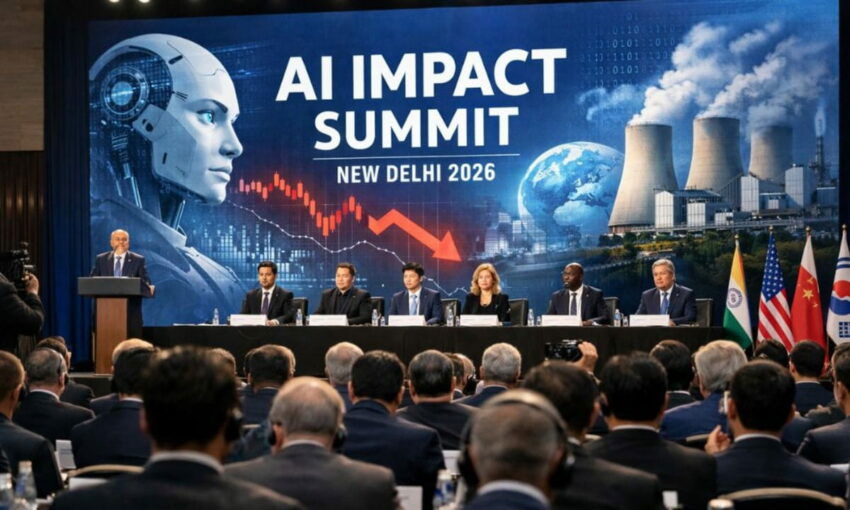
Artificial intelligence has shifted from theory to reality, fundamentally altering how the world works, governs, and operates. This transformation sets the stage for the India AI Impact Summit beginning Monday in New Delhi, where global leaders, policymakers, tech executives, and scientists will tackle the artificial intelligence challenges.
The Delhi gathering marks the fourth major international conference on AI governance since 2023. Previous meetings emphasized safety protocols. This year’s focus extends further. Discussions will cover workforce displacement, system failures, infrastructure demands, market instability, governance frameworks, and potential catastrophic risks.
Six critical issues are shaping the conversation.
Job displacement threatens multiple sectors worldwide
One of the most concerning artificial intelligence challenges is job displacement.
Automated systems now handle tasks once reserved for human workers. These tools generate computer programs, prepare legal documents, create advertising content, and manage customer service interactions. Their expanding capabilities are causing anxiety across global industries.
Economies heavily dependent on service sectors face mounting pressure. Stock prices for numerous companies in outsourcing, technical support, and business processing have declined recently. Market analysts worry that AI assistants could eliminate significant portions of call center, administrative, and back-office positions across continents.
The summit’s workforce panel cautioned that machine learning, intelligent platforms, and information-based operations are progressively assuming routine and repetitive functions, transforming conventional employment patterns. These advances may boost productivity and spark innovation, but they simultaneously threaten to displace substantial workforce segments worldwide.
Financial markets globally have experienced turbulence. Major U.S. indexes posted losses during the week ending Feb. 13. The Nasdaq dropped 2%. The S&P 500 fell 1.4%. The Dow Jones declined 1.2%.
The Tech-Software Sector ETF, featuring giants like Microsoft and Palantir, has tumbled 22% since January. Investors fear automation might erode revenue streams for established enterprise software companies.
Tim Urbanowicz from Innovator Capital Management characterized the market swings as AI’s negative consequences. He stressed the importance of monitoring these patterns, noting that additional sectors will face disruption and genuine threats.
However, not every expert predicts disaster as a fallout of the artificial intelligence challenges. Amanda Agati of PNC Asset Management called the downturn temporary, highlighting robust market performance in most other areas.
Dangerous systems cause tangible damage

Security concerns remain paramount globally. U.S. families have filed lawsuits against OpenAI, claiming its chatbot played a role in suicide deaths. The company reports it has enhanced protective measures and oversight mechanisms.
Controversy also surrounds xAI and its Grok platform. The application triggered worldwide backlash after users created sexualized fake images of actual people, including children. Multiple nations moved to block access.
Another of the artificial intelligence challenges is that fraudulent activity is escalating internationally. Criminals exploit generative technology to produce convincing, deceptive messages and duplicate human voices. Intellectual property battles are mounting as creators accuse AI companies of unauthorized use of artistic works.
These incidents reveal an ongoing disconnect between technological advancement and regulatory control across borders.
Power and resource consumption surge globally

Machine learning demands enormous computational capacity. That capacity requires electricity at historic levels.
The International Energy Agency forecasts that data center electricity usage will double by 2030. In 2024, these facilities consumed approximately 1.5% of worldwide electricity.
Technology corporations are pouring hundreds of billions into AI systems globally. Some are examining nuclear power partnerships to guarantee steady energy supplies. Meanwhile, communities worldwide are voicing concerns about water requirements for server cooling, particularly during extreme heat periods.
Environmental organizations caution that uncontrolled growth might jeopardize climate reduction goals internationally.
Competing regulatory approaches emerge worldwide

Nations are scrambling to establish new frameworks to meet the artificial intelligence challenges.
South Korea passed comprehensive AI legislation in January. It makes it mandatory for companies to reveal the use of automation to power their products and services.
The European Union’s AI regulations authorize officials to prohibit systems presenting unacceptable dangers. This encompasses live biometric monitoring in public areas or crime prediction tools relying exclusively on physical data.
American officials have advocated restraint. Vice President JD Vance previously warned against overregulation that might hinder progress and diminish competitive advantage.
This division highlights a worldwide dilemma. Leaders must find an equilibrium between economic development and citizen safety.
Market volatility spreads beyond tech globally
Companies outside technology sectors are experiencing losses. Logistics and financial advisory stocks have suffered. C.H. Robinson dropped 11% last week. Universal Logistics fell 9%. Charles Schwab declined 10%. Raymond James slipped 8%.
Markets responded after firms introduced AI-powered shipping and financial planning tools designed to expand operations without increasing headcount. The concern is straightforward. If machines complete more assignments, service-based revenue models may weaken.
Some strategists maintain optimism. Urbanowicz projects the S&P 500 could hit 7,600 by December, citing favorable tax measures and investment shifts toward energy, raw materials, and consumer goods.
The discussion reflects a fundamental question affecting markets worldwide. Is AI a speculative bubble or a permanent transformation rewarding flexible organizations?
Long-term catastrophic risks debated
A dedicated group of specialists concentrates on distant artificial intelligence challenges.
Leaders and programmers have departed from Anthropic and OpenAI over ethical disputes. Anthropic recently warned its newest models might be manipulated toward knowingly assisting efforts related to chemical weapons and other serious crimes.
Researcher Eliezer Yudkowsky offered more dramatic comparisons in his 2025 publication, suggesting superintelligent AI could match nuclear arsenals in destructive capability.
Such predictions spark debate internationally. Many researchers maintain that current systems fall short of human-level cognition. Others contend that development is advancing more rapidly than anticipated.
Critical decisions ahead
The New Delhi summit occurs at a decisive juncture. Machine intelligence offers productivity improvements and research advances. It simultaneously creates unprecedented risks for societies worldwide.
Participants face difficult choices. What level of danger is tolerable? Who absorbs disruption costs? Who establishes governing standards?
These determinations will influence markets and businesses globally, while fundamentally reshaping labor and political systems.
Please share your perspective on the AI impact in the comments below. Which of the artificial intelligence challenges concerns you most, and how should leaders respond?