

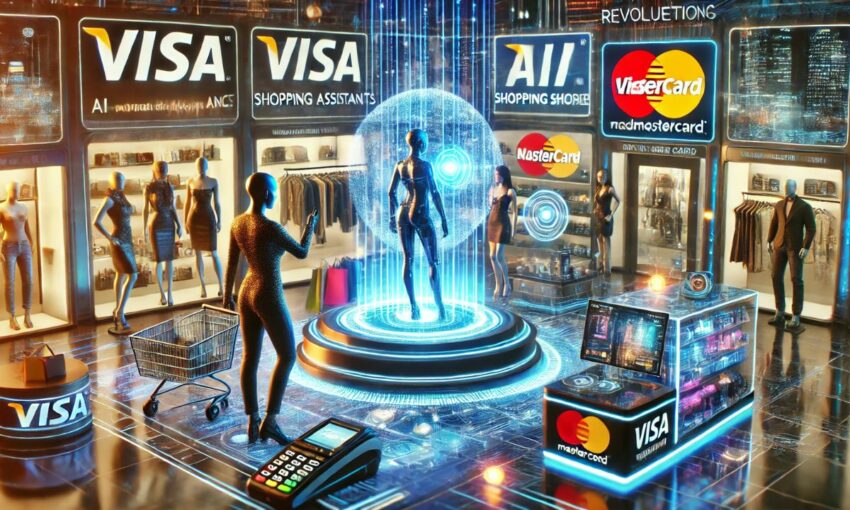
Visa and Mastercard set to introduce AI assistants for smarter shopping experience.
Payment industry titans Visa and Mastercard have officially entered the AI shopping arena. Both companies unveiled groundbreaking initiatives this week that integrate artificial intelligence directly into the purchasing process. These new platforms promise to transform how consumers discover and buy products by eliminating traditional shopping steps.
Visa introduced its new venture Wednesday, branded as “Intelligent Commerce.” The concept appears straightforward, but represents a fundamental shift: AI agents will “find and buy” products based on user-defined preferences. These digital assistants can complete personalized purchases without human intervention after initial setup.
Jack Forestell, Visa’s Chief Product and Strategy Officer, explained the vision: “Each consumer sets the limits, and Visa helps manage the rest.” This approach gives shoppers control over parameters while delegating repetitive tasks like searching, comparing, and payment processing to AI. Forestell positioned the technology as consumer empowerment—establish preferences once and let AI handle tedious shopping tasks.
Visa’s initiative relies on partnerships with leading tech innovators. The company has assembled an impressive network, including OpenAI, Anthropic, Microsoft, IBM, Mistral AI, Perplexity, Samsung, and Stripe. Together, they aim to create seamless, secure shopping experiences that operate continuously in the background.
Mastercard advances “agentic commerce” capabilities
A day before Visa’s announcement, Mastercard revealed its parallel AI shopping ecosystem. The company’s Agent Pay system embeds payment functionality directly into generative AI interactions. This effectively transforms conversational AI into retail platforms.
Mastercard’s vision showcases practical applications: a woman planning her 30th birthday celebration can simply describe her event details, style preferences, budget constraints, and even expected weather conditions to an AI assistant. The system then recommends appropriate clothing and accessories from relevant retailers, processes payment, and suggests optimal payment methods like Mastercard One Credential.
In their announcement, Mastercard stated: “This means that for a soon-to-be-30-year-old planning her milestone birthday party, she can now chat with an AI agent to proactively curate a selection of outfits and accessories… Based on her preferences and feedback, the intelligent agent can make the purchase, and also recommend the best way to pay.”
To develop Agent Pay’s infrastructure, Mastercard partnered with Microsoft, IBM, Braintree, and Checkout.com. Their collaborative goal: building a robust autonomous shopping ecosystem that seamlessly integrates across digital platforms.
“Agentic Commerce” — The next retail evolution
Both financial leaders’ announcements highlight an emerging retail technology trend: agentic commerce. This term describes shopping experiences powered by autonomous AI that interprets user requests, explores multiple retailers, and completes transactions without traditional human actions like website navigation or payment detail entry.
This represents a significant departure from conventional e-commerce. Rather than simply accelerating existing shopping patterns, agentic commerce potentially removes active shopping altogether for many routine purchases. With minimal instruction, AI can now accomplish what previously required extensive browsing, filtering, and decision-making.
Industry-wide movement toward AI shopping solutions

Visa and Mastercard’s entrance into AI-powered commerce follows similar moves from other major financial and technology players.
PayPal unveiled its own AI shopping assistant Tuesday, though specific capabilities remain under wraps. Given PayPal’s extensive merchant network and payment processing infrastructure, this signals its determination to maintain relevance as AI reshapes digital commerce.
Amazon recently began testing “Buy for Me,” an AI shopping assistant available to select users. This feature suggests a fundamental shift in Amazon’s customer interaction model. Rather than browsing product pages, users may increasingly delegate shopping tasks to AI assistants.
OpenAI recently enhanced its web search capabilities in ChatGPT, emphasizing improved shopping assistance features like product comparisons, checkout navigation, and purchase recommendations.
Other technology companies, including Google and Perplexity AI, have demonstrated similar shopping agents capable of website navigation and purchase execution, indicating the increasing convergence of search and commerce functions.
Strategic partnerships driving innovation
The success of autonomous shopping systems depends on seamless integration, enhanced security, and personalization capabilities. This explains the strategic importance of partnership announcements. Visa’s collaboration with Stripe, Samsung, OpenAI, and additional partners suggests future AI shopping assistants embedded across payment apps, smart devices, and conversational interfaces.
Mastercard’s alliance with Checkout.com and Braintree (PayPal’s subsidiary) extends its merchant reach, while partnerships with Microsoft and IBM provide technological infrastructure for developing secure, scalable AI payment systems.
Balancing security, privacy, and user control
Both financial leaders emphasize consumer control in their announcements. These systems aren’t designed as unsupervised purchasing agents. Users will establish preferences and spending boundaries, with AI operating within these parameters. Additional safeguards include fraud monitoring, transaction verification, and secure authentication through systems like Mastercard One Credential.
Privacy advocates note that effective personalization requires extensive data sharing. AI shopping assistants need details about preferences, sizes, location, and mood. This raises important questions regarding data storage, protection, and cross-platform information sharing.
Retail and consumer impact
For retailers, adaptation will require restructuring digital storefronts, APIs, and inventory systems to accommodate AI shoppers. Optimizing for human visual browsing will become insufficient—merchants must now consider how their products appear to automated shopping algorithms that prioritize efficiency and preference matching over traditional visual merchandising.
For shoppers, this technology could eliminate routine purchase frustrations and decision fatigue. Rather than browsing dozens of options, consumers may instruct ChatGPT or a Visa assistant: “Find a hiking-related birthday gift for my father under $100,” and receive appropriate recommendations with minimal effort.
Future developments
Agentic commerce is gaining momentum rapidly. The competition extends beyond Visa and Mastercard to encompass AI developers, payment processors, e-commerce platforms, and search providers. The prize: defining the next generation of global digital commerce.
As technology leaders, including OpenAI, Google, Amazon, and payment networks, converge in this space, traditional boundaries between shopping, search, and conversation continue dissolving. Shopping journeys that once began with search queries may soon start and finish with simple conversational requests.
Please share your views on how AI-powered shopping might transform your purchasing habits.