


Artificial intelligence continues to reshape the global workforce in unexpected ways. A comprehensive new study reveals that AI implementation drives significant job creation and wage increases, even within sectors traditionally viewed as vulnerable to automation.
PwC’s latest 2025 Global AI Jobs Barometer, published this week, demonstrates how AI-integrated industries experience remarkable growth trajectories. The research indicates that sectors embracing artificial intelligence technologies witness productivity improvements nearly four times greater than those with limited AI adoption since 2022.
Workers possessing AI-related competencies now command salary premiums averaging 56% above their non-AI-skilled counterparts.
This represents a dramatic increase from the 25% premium recorded just twelve months ago, highlighting the rapidly evolving value proposition of AI literacy in today’s employment market.
“The velocity of technological advancement creates uncertainty among workforce communities,” explained Joe Atkinson, PwC’s Global Chief AI Officer, during a recent CNBC interview. “However, our findings consistently demonstrate that artificial intelligence generates employment opportunities rather than eliminating them.”
The comprehensive analysis examined nearly one billion job advertisements alongside thousands of corporate financial statements spanning six continents. Researchers measured “AI exposure” as an indicator of organizational readiness for AI deployment, regardless of actual implementation levels.
Industries positioned for optimal AI utilization, particularly software development and publishing sectors, achieve revenue-per-employee growth rates of 27%. This substantially outpaces the 9% growth observed in sectors with minimal AI exposure, such as traditional logging operations.
Since 2022, productivity advancement in AI-ready industries has accelerated dramatically, while sectors with limited artificial intelligence adoption show marginal productivity declines.
Carol Stubbings, PwC UK’s Global Chief Commercial Officer, emphasized historical precedents supporting current trends. “Previous industrial revolutions consistently created more employment opportunities than they eliminated,” Stubbings noted. “The primary challenge involves ensuring workers acquire appropriate skills for emerging roles.”
The transformation requires strategic workforce preparation initiatives. “Our concern isn’t job scarcity,” Stubbings continued. “Instead, we must ensure workers receive adequate training for available positions.”
Debunking common AI workplace misconceptions
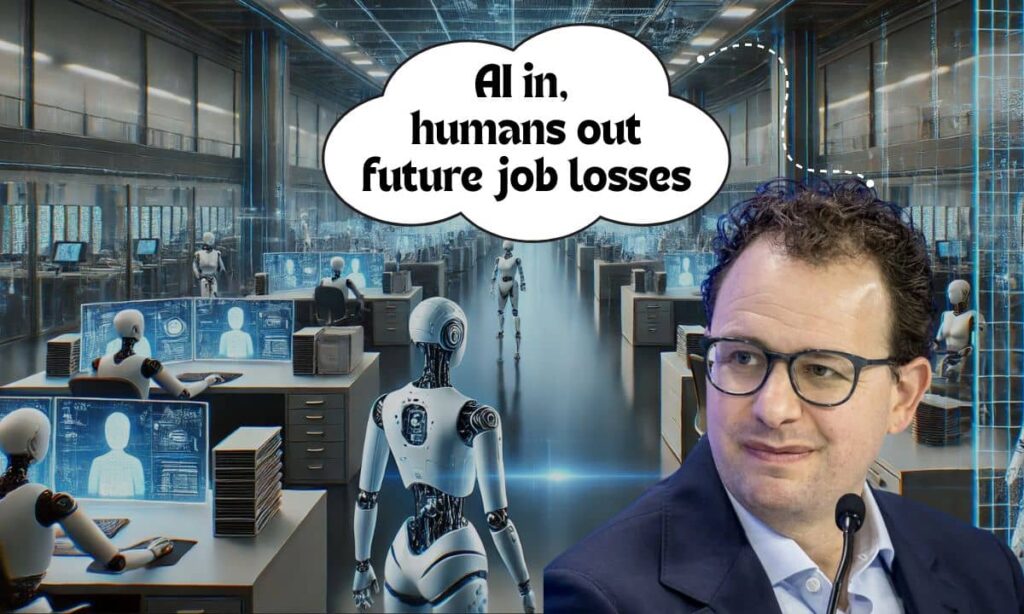
The comprehensive report addresses six prevalent myths surrounding artificial intelligence’s workforce impact:
Productivity impact
Common Belief: AI hasn’t significantly influenced workplace productivity.
Reality: Industries with substantial AI exposure demonstrate 27% productivity growth since 2022, nearly quadrupling rates in less-exposed sectors. Traditional industries like mining and construction increasingly adopt AI technologies, showcasing the technology’s expanding influence.
Wage effects
Common Belief: AI implementation reduces worker compensation and negotiating power.
Reality: Employees with artificial intelligence skills earn 56% higher wages than similarly-positioned workers lacking these capabilities. This premium doubled from last year’s figures. Overall compensation in AI-integrated industries rises twice as rapidly as in traditional sectors.
Employment levels
Common Belief: AI adoption leads to widespread job losses.
Reality: Occupations with minimal AI exposure experienced 65% employment growth between 2019 and 2024. Even roles with substantial AI integration grew 38%, contradicting widespread unemployment fears.
Workplace Equity
Common Belief: AI increases employment and wage disparities.
Reality: Both augmentable and automatable positions show rising wages and employment rates. Notably, AI-exposed roles increasingly de-emphasize formal degree requirements, creating opportunities for workers without traditional credentials.
Skill Development
Common Belief: AI “dumbs down” automated job functions.
Reality: Artificial intelligence enhances job quality by eliminating routine tasks, enabling workers to focus on complex decision-making processes. Data entry personnel evolve into analytical roles, utilizing freed time for higher-value activities.
Job Valuation
Common Belief: AI devalues highly automated positions.
Reality: Even in heavily automatable roles, compensation continues to rise. AI reshapes these positions to require enhanced creativity and sophisticated skills, increasing human worker value.
Economic implications and future outlook
The research suggests that moderate employment growth in AI-exposed occupations benefits economies facing workforce shortages. Slower job creation rates, combined with AI-driven productivity gains, address labor gaps without overwhelming employment markets.
Atkinson highlighted AI’s multiplicative effect on workforce capacity. “Artificial intelligence creates expansion opportunities that help companies fill positions they previously couldn’t staff,” he explained.
Moving forward, PwC encourages business leaders to approach AI strategically rather than merely as cost-cutting tools. Organizations deploying artificial intelligence solely for headcount reduction risk missing innovation opportunities, market expansion possibilities, and revenue diversification potential.
“We must avoid limiting our vision to automating existing processes,” the report concludes. “Instead, focus on creating tomorrow’s jobs and industries.”
The 2025 Global AI Jobs Barometer emphasizes that two-thirds of current occupations didn’t exist in 1940, representing technological advancement outcomes. As artificial intelligence continues evolving, it promises to generate fresh employment waves and business model innovations.
Successful AI integration requires strategic planning and skills development investment. Companies and policymakers must prioritize AI-related training programs, worker transition support, and continuous learning cultures. These efforts ensure organizations harness AI’s transformative capabilities for sustainable growth rather than being disrupted by technological change.
Ultimately, artificial intelligence emerges not as a threat to human employment but as a catalyst enhancing worker value and creating unprecedented opportunities in the modern economy.
What’s your take on AI’s impact on the job market? Share your thoughts and experiences with AI in your workplace in the comments below.