


As artificial intelligence reshapes global industries at breakneck speed, three technology powerhouses have emerged as central architects of this transformation. Micron Technology, Oracle Corporation, and Meta Platforms are making unprecedented investments and strategic pivots, accelerating AI development while raising expectations and concerns about the technology’s trajectory. Each company represents a distinct but essential layer of the AI ecosystem – from the fundamental memory components to cloud infrastructure and consumer applications.
Micron Technology: Leading AI memory solutions
The AI revolution has catapulted Micron Technology from a conventional memory manufacturer to a mission-critical supplier whose products determine the capabilities and limitations of modern AI systems. The company’s specialized high-bandwidth memory (HBM) chips have become the cornerstone of advanced AI processing, enabling the massive parallel calculations required for training sophisticated models.
Demand for these specialized components has reached extraordinary levels. Industry sources confirm that Micron’s entire production capacity for HBM chips through 2025 has already been secured through advance orders, creating an unprecedented backlog that highlights the explosive growth in AI development and Micron’s central position in this ecosystem.
“We’re witnessing computing’s most significant architectural shift in decades,” explained Raj Narasimhan, who leads Micron’s Compute and Networking Business Unit as Senior Vice President and General Manager. “HBM and low-power memory solutions are fundamental enablers that unlock enhanced computational capabilities for graphics processing units that power today’s AI breakthroughs.”
The company’s strategic partnership with NVIDIA has proven particularly valuable as AI development accelerates. Micron’s HBM technologies are being integrated into NVIDIA’s next-generation processors, creating a symbiotic relationship that drives innovation in both memory performance and AI processing capabilities. This collaboration positions Micron at the heart of the hardware ecosystem underpinning generative AI and other advanced applications.
However, industry analysts note that Micron must navigate the inherently cyclical nature of the semiconductor industry, where surges in demand often lead to aggressive capacity expansion followed by periods of oversupply and price compression. The company’s increasing specialization in AI-optimized memory products represents a strategic attempt to smooth these cycles by focusing on high-value segments with more sustainable demand patterns.
The memory giant has committed to significant manufacturing expansion, with plans for new fabrication facilities that will increase production capacity for HBM and other specialized AI components. These investments reflect confidence that AI development will drive sustained demand for high-performance memory solutions beyond market cycles.
Market analysts project that Micron’s strategic positioning could deliver compound annual growth rates exceeding 20% for its AI-specific product lines over the next three years, potentially transforming the company’s financial profile and valuation metrics. This trajectory depends heavily on continued AI adoption across enterprise and consumer applications, and Micron’s ability to maintain technological leadership in an increasingly competitive memory landscape.
Oracle Corporation: Expanding AI cloud infrastructure
While Micron builds the components that power AI systems, Oracle Corporation is constructing the industrial-scale infrastructure required to deploy these technologies at enterprise scale. The company has pivoted decisively toward becoming a premier provider of AI-optimized cloud services, a strategy that delivered 24% year-over-year growth in cloud revenue, reaching $5.9 billion for the quarter ending November 30, 2024.

Oracle’s cloud transformation represents one of the most successful strategic pivots in enterprise technology, transitioning from a traditional database and business applications provider to a leading infrastructure platform for next-generation AI workloads. This evolution has attracted major customers seeking scalable, high-performance computing resources for developing and deploying AI applications.
The company’s commitment to AI infrastructure is evidenced by a landmark agreement with Advanced Micro Devices (AMD) to develop a massive cluster powered by 30,000 MI355X AI accelerators. This multi-billion-dollar initiative will create one of the world’s largest dedicated AI computing environments, providing Oracle customers with unprecedented processing capacity for training and inference tasks.
“The computational demands of advanced AI require a complete rethinking of cloud architecture,” said Larry Ellison, Oracle’s chairman and CTO, during the company’s recent earnings call. “We’re building infrastructure specifically optimized for AI workloads rather than retrofitting existing systems, giving our customers a significant performance advantage.”
Oracle’s international expansion further underscores its AI ambitions. A recently announced $5 billion investment will expand the company’s cloud infrastructure across the United Kingdom over the next five years. This initiative aims to meet growing regional demand for AI and cloud services while addressing data sovereignty requirements that are becoming increasingly important for AI applications handling sensitive information.
The company’s strategic positioning between hardware manufacturers and enterprise customers allows Oracle to deliver integrated AI solutions that combine optimized infrastructure with pre-configured applications and development tools. This approach simplifies AI adoption for organizations that lack specialized expertise, potentially accelerating deployment across industries from healthcare to financial services.
Industry experts project that Oracle’s AI-focused cloud services could grow at twice the rate of its overall cloud business over the next three years, potentially reaching $20 billion in annual revenue by 2027. This growth trajectory depends on Oracle’s ability to differentiate its offerings in an increasingly competitive cloud market while demonstrating measurable business value from AI implementations.
Meta Platforms: Investing heavily in AI infrastructure
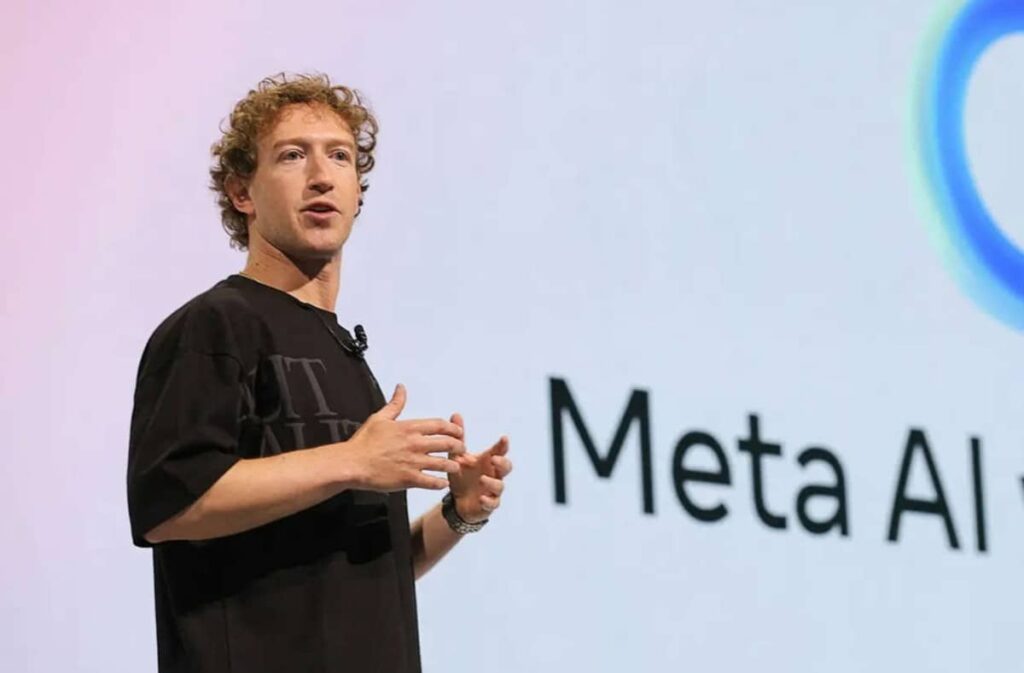
At the consumer-facing end of the AI spectrum, Meta Platforms is making extraordinary investments to build infrastructure that will power next-generation AI experiences across its family of applications. The company has allocated between $60 billion and $65 billion for capital expenditures in 2025, representing one of the largest technology infrastructure investments in history.
This massive spending increase reflects CEO Mark Zuckerberg’s conviction that AI will fundamentally transform social media, communications, and digital experiences. During a recent earnings call, Zuckerberg articulated an ambitious vision where AI assistants become ubiquitous digital companions, predicting that 2025 could mark a time when a single AI assistant reaches one billion users. He expressed determination for Meta AI to achieve this milestone ahead of competitors.
“We’re at the beginning of a new computing paradigm,” Zuckerberg told investors. “The companies that build the most capable AI systems and successfully integrate them into products used by billions of people will define the next generation of technology platforms.”
To realize this vision, Meta is reportedly planning a new data center campus dedicated exclusively to AI development and deployment. Industry sources indicate this initiative could ultimately cost more than $200 billion, representing an unprecedented commitment to building proprietary AI infrastructure. This approach contrasts with competitors who rely more heavily on third-party cloud providers, giving Meta greater control over its AI technology stack.
The company’s substantial investments reflect a strategic bet that AI capabilities will become a primary differentiator in consumer-facing applications. Meta is developing AI assistants, content generation tools, and recommendation systems that will be integrated across Facebook, Instagram, WhatsApp, and its Reality Labs products, creating a unified AI experience spanning the company’s entire ecosystem.
These investments also position Meta to potentially license its AI technologies to other companies or developers, creating new revenue streams beyond its traditional advertising business. The company’s massive user base provides valuable training data for developing AI systems, giving Meta a potential advantage in creating contextually relevant and personalized experiences.
However, the scale of Meta’s AI investments has raised questions about capital efficiency and return expectations. The company must demonstrate that these massive expenditures will translate into enhanced user engagement, new product opportunities, or increased advertising effectiveness to justify the unprecedented allocation of resources.
Navigating the AI investment landscape
As enthusiasm for AI reaches fever pitch, industry veterans are beginning to sound notes of caution about the sustainability of current investment levels. Joe Tsai, Chairman of Alibaba, recently expressed concerns about a potential bubble in AI data center investments, noting the extraordinary pace of capital deployment and capacity expansion across the sector.
“We’re seeing an unprecedented concentration of investment in AI infrastructure,” Tsai noted at a recent industry conference. “The question is whether current demand projections justify this level of capacity expansion, or if we’re building ahead of actual needs.”
Despite these cautions, companies like Micron, Oracle, and Meta continue making strategic bets on AI’s transformative potential. These investments reflect confidence that artificial intelligence represents a fundamental technological shift comparable to the internet or mobile computing, justifying substantial capital commitments despite near-term uncertainty.
For investors and industry stakeholders, these divergent perspectives highlight the importance of distinguishing between hype and sustainable business models in the AI sector. While the technology’s disruptive potential seems clear, questions remain about which companies and approaches will ultimately deliver the greatest value.
The massive investments by Micron, Oracle, and Meta illustrate different approaches to capturing AI’s potential – from specialized components to enterprise infrastructure to consumer applications. Each represents a distinct bet on how the AI ecosystem will evolve and where value will concentrate as the technology matures.
As this technological transformation accelerates, these companies will help determine the capabilities of next-generation AI systems, the business models, governance frameworks, and user experiences that shape AI’s impact on business and society. Their strategic decisions will influence the trajectory of artificial intelligence in the future, too, making them central players in one of technology’s most consequential developments.
As Micron, Oracle, and Meta make unprecedented investments in AI infrastructure, which company do you believe is best positioned to capture long-term value from artificial intelligence? Please share your thoughts below.