

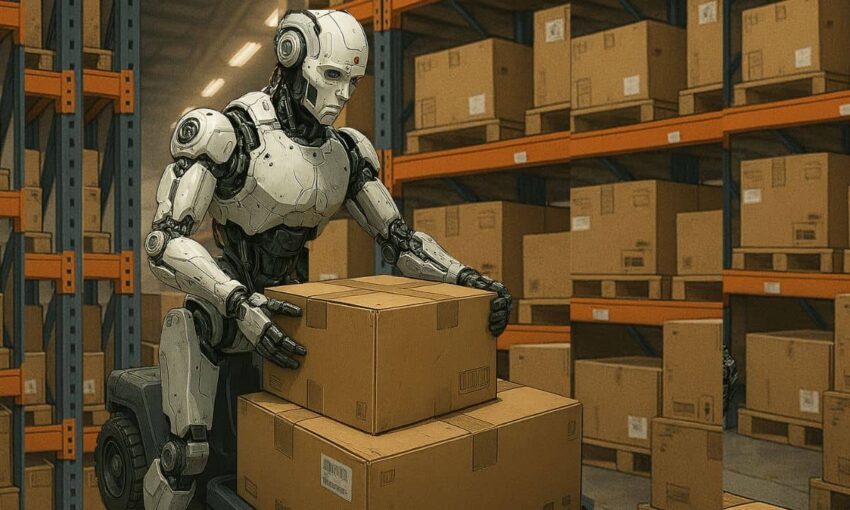
Dexterity, a California-based technology company specializing in robotics and artificial intelligence, has revealed a new industrial robot called Mech that could significantly alter how warehouses and factories operate. The machine, described as an “industrial super-humanoid,” combines advanced AI systems with mechanical capabilities designed specifically for commercial applications.
Mech: Engineering meets artificial intelligence
The newly unveiled Mech system features dual robotic arms mounted on a mobile platform, giving it flexibility to move throughout industrial spaces and perform complex tasks. The robot’s arms extend to an impressive 17.7 feet and can handle objects weighing up to 132 pounds. These specifications allow Mech to take over physically demanding responsibilities that typically cause strain injuries among warehouse workers.
“We designed Mech to address the most challenging aspects of material handling,” said a Dexterity spokesperson during the unveiling demonstration. “By automating these difficult tasks, we’re creating safer workplaces while increasing operational efficiency.”
Physical AI: The core technology
Mech’s performance relies on Dexterity’s custom-developed “Physical AI” system, which enables the robot to adapt to changing conditions in real time. Unlike conventional industrial robots programmed for specific repetitive motions, Mech uses multiple onboard artificial intelligence models running simultaneously on its integrated supercomputer.
This technological approach allows the robot to handle situations requiring nuanced movements, such as organizing boxes of different shapes, operating in tight quarters, or carefully managing delicate items. The system continuously learns from experiences, gradually improving its performance across various tasks.
Key features and capabilities
Lifting capacity and reach
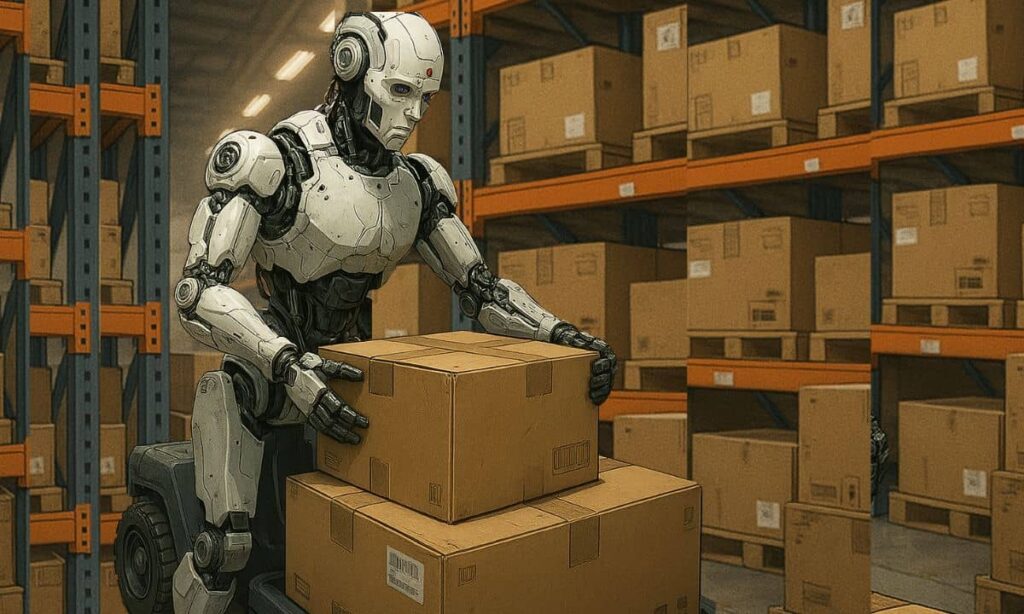
Mech can safely lift items weighing up to 132 pounds and place them on shelves or racks as high as 8 feet above floor level, making it ideal for warehouse stacking operations.
Temperature tolerance
Engineers have designed the system to function reliably in environments ranging from freezing point (32°F) to extreme heat (122°F), ensuring consistent performance across various industrial settings.
Visual processing
With up to 16 strategically positioned cameras, Mech maintains comprehensive awareness of its surroundings, allowing it to identify objects, avoid obstacles, and complete assignments with minimal human intervention.
Task versatility
The robot’s programming supports multiple warehouse functions, including loading delivery vehicles, building and breaking down pallets, and fulfilling individual orders from inventory systems.
Workforce productivity enhancement
Mech offers substantial operational advantages through its supervised autonomy model. A single human operator can monitor and manage up to ten Mech units simultaneously, creating a significant multiplier effect for workforce productivity.
This supervision ratio addresses critical labor challenges facing the logistics industry while reducing workplace injuries associated with repetitive motions and heavy lifting. Companies implementing Mech systems could potentially reorganize their operations to focus human workers on skills requiring judgment and decision-making while delegating physical tasks to robotic assistants.
“The innovation isn’t just about replacing human effort—it’s about redirecting it toward higher-value activities,” noted an industry analyst following the demonstration. “Workers who previously spent their shifts lifting boxes can be trained for supervisory roles managing multiple robots.”
Adaptable design for evolving requirements
Dexterity has constructed Mech with long-term versatility as a central design principle. The robot’s software architecture supports regular updates and new application installations, allowing customers to expand its capabilities as operational needs change. This approach protects the initial investment by ensuring the system remains relevant through evolving business requirements.
“Tomorrow’s warehouse might have completely different requirements than today’s,” explained a company engineer during the technical briefing. “We’ve built Mech to grow with those changing needs rather than becoming obsolete when conditions shift.”
The robot’s learning capabilities also contribute to this adaptability, as each unit improves its performance over time based on operational experiences. This continuous improvement model distinguishes Mech from traditional automation equipment with fixed capabilities.
Market response and industry implications
The introduction of Mech has generated significant interest across logistics and manufacturing sectors, particularly among companies facing labor shortages and increasing throughput demands. Major logistics provider FedEx has already expressed interest in the technology.
Rebecca Yeung, Corporate Vice President of Operations Science and Advanced Technologies at FedEx, commented on the potential applications: “Dexterity’s advances in AI and robotics offer meaningful support for our operations teams while helping us meet growing customer expectations.”
Despite enthusiasm from operations executives, the emergence of such capable robotics systems prompts important discussions about workforce impacts. While Mech is positioned as a collaborative technology that works alongside human employees, its introduction will likely accelerate changes in industrial employment patterns.
Companies adopting these systems will face strategic decisions about retraining existing employees, creating new positions focused on robot supervision, and developing transition plans for workers whose physical roles might be automated. Industry observers suggest that organizations embracing these technologies should develop comprehensive implementation strategies that address both operational and human resources considerations.
“The question isn’t whether this technology will transform industrial operations—it’s how companies will manage that transformation to benefit both their business and their workforce,” noted a labor economist specializing in automation impacts.
Future industrial landscape
Mech represents a significant step toward more sophisticated human-machine collaboration in industrial environments. By combining physical capabilities exceeding human limitations with artificial intelligence that enables contextual decision-making, the system bridges the gap between simple automation and truly adaptive robotics.
As deployment expands beyond initial customers, Mech could establish new operational standards for warehousing and manufacturing facilities. Companies that successfully integrate these technologies may gain competitive advantages through increased throughput, reduced error rates, and improved safety metrics.
The technology also signals potential convergence between warehouse robotics and autonomous vehicle development, as both fields rely on similar sensing, processing, and decision-making capabilities. Future iterations might incorporate additional innovations from related technological domains.
For industrial operations facing persistent labor challenges and increasing cost pressures, Mech offers a glimpse of how technology might reshape workplace dynamics over the coming decade. The question facing operations leaders is no longer whether robotics will transform their industry, but how quickly they should adopt these emerging capabilities to remain competitive.
As one industry veteran observed during the demonstration, “We’re watching the future of industrial operations take shape right before our eyes.”
For those interested in seeing Mech in action, Dexterity has released demonstration videos showcasing the robot’s capabilities across various warehouse scenarios.
How do you think robots like Mech will affect industrial workplaces?
Share your thoughts below with your perspective on the future of human-robot collaboration.