

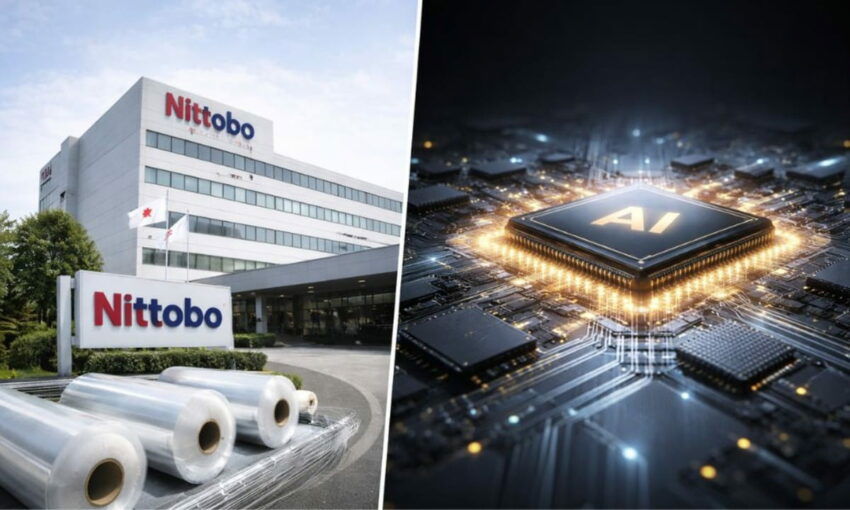
Nittobo, an obscure Japanese textile company, has become an unexpected kingmaker in the artificial intelligence revolution. The Japanese glassmaker controls virtually all global production of a hair-thin glass material that advanced semiconductors cannot survive without.
The substance, called T-glass, consists of microscopic glass fibers woven into sheets thinner than human hair. Its sole purpose is to prevent semiconductor packages from buckling under intense thermal stress. As AI hardware requirements explode worldwide, technology executives worry that this bottleneck could stall innovation across multiple industries.
Major tech players like Apple and Nvidia face mounting pressure as T-glass scarcity threatens production timelines for cutting-edge processors that power machine learning systems and generative AI platforms.
“Producing T-glass requires specialized knowledge and infrastructure that competitors cannot replicate quickly,” said Noritsugu Hirakawa, who analyzes semiconductor markets at Daiwa Securities. “Nittobo holds a commanding advantage that will persist for years.”
AI expansion creates unexpected material bottlenecks
The worldwide push toward artificial intelligence deployment has sparked unprecedented demand for memory modules, graphics processors, and related hardware components. Companies now scramble for obscure raw materials buried deep within semiconductor supply chains.
Industry observers note that well-funded technology giants frequently secure preferential treatment when allocating scarce components. This leaves consumer electronics manufacturers competing for whatever capacity remains available.
Yuta Nishiyama, who tracks chip markets for Citigroup, predicts consumer device makers will bear the brunt of coming shortages. “High-priority AI infrastructure projects are absorbing materials that would normally support smartphone and laptop production,” he explained.
Standing at this chokepoint is the Japanese glassmaker, Nittobo, officially named Nitto Boseki, a 100-year-old enterprise that started by spinning cotton and silk before transitioning to glass fiber innovation. The company now manufactures approximately 100% of the planet’s T-glass supply.
Despite mounting urgency from customers, Nittobo cannot substantially expand output until late 2025 at the earliest.
“Additional manufacturing capacity scheduled to activate this year will still fall short of bridging the widening gap between available supply and accelerating demand,” company representatives stated.
Semiconductor packaging costs surge amid scarcity
Material constraints are already driving significant cost increases throughout the chip production ecosystem.
Resonac, a Japanese chemical supplier serving the semiconductor industry, recently implemented price hikes exceeding 30% for select packaging materials. The Japanese glassmaker has similarly signaled intentions to raise T-glass pricing in 2025, with Citigroup projections suggesting increases of 25% or higher.
These upstream cost pressures will inevitably trickle down to end consumers, potentially elevating retail prices for smartphones, notebook computers, and consumer electronics devices.
Such price inflation underscores a fundamental truth about modern AI development. Breakthrough computational capabilities depend not merely on chip architecture innovation but equally on niche materials that only a handful of manufacturers can produce at a commercial scale.
Understanding T-glass and thermal management challenges
Modern high-performance processors generate extraordinary heat levels, sometimes approaching 100 degrees Celsius during peak operation. Even nanometer-scale warping can degrade chip performance or trigger complete failures.
Engineers integrate T-glass into reinforcement layers positioned beneath or surrounding silicon dies. These layers maintain dimensional stability and structural integrity when components undergo dramatic temperature fluctuations during normal operation.
While glass fiber technology principles are publicly known, manufacturing ultrathin variants demands proprietary chemical formulations and production methods refined across decades. Many potential competitors avoided entering this market historically because profit margins remained modest.
That conservative investment approach created a concentrated supplier base, with the Japanese glassmaker holding a monopoly. It struggles to meet the explosive demand for artificial intelligence.
Unlikely industries power AI infrastructure
T-glass represents just one example among numerous critical yet underappreciated technologies enabling contemporary computing breakthroughs.
Ajinomoto, globally recognized for popularizing MSG seasoning, applied its chemical processing expertise to develop specialized insulating films used alongside T-glass in advanced chip substrates. Meanwhile, Nvidia’s premium AI server systems rely on a Taiwanese company originally manufacturing furniture hardware to produce precision drawer slide mechanisms.
These unexpected connections highlight how artificial intelligence infrastructure frequently depends on industries completely disconnected from traditional technology hubs like Silicon Valley.
Apple pursues direct supplier relationships
Supply chain constraints have forced technology companies to fundamentally rethink procurement strategies and supplier relationships.
Consumer electronics brands traditionally maintained arm’s length relationships with materials providers located several tiers upstream from finished semiconductor products. That paradigm is shifting rapidly.
Sources familiar with T-glass procurement indicate Apple has deployed additional personnel to Japan for direct negotiations with materials manufacturers, seeking to lock in guaranteed long-term supply commitments.
The Japanese glassmaker acknowledged this changing dynamic in official statements.
“We view it as encouraging that electronics and chip manufacturers finally recognize glass cloth as strategically important material,” company officials noted.
The Japanese glassmaker reported operating profits approaching $104 million during its most recent fiscal year, establishing new company records.
Capacity expansion timeline raises concerns
Nittobo plans to triple its current production capacity by 2028, with gradual increases beginning in late 2025. However, customers facing immediate shortages question whether this expansion schedule adequately addresses their needs.
Japanese suppliers dominate numerous upstream semiconductor materials categories, yet their characteristically cautious planning culture sometimes hampers rapid responses to sudden demand surges.
“Many Japanese manufacturers fear overly aggressive expansion based on optimistic projections that could eventually produce overcapacity,” explained Shih Fang Chiu, senior researcher at Taiwan Institute of Economic Research.
Nittobo executives cited previous industry cycles when customers provided bullish demand forecasts before abruptly scaling back orders once market conditions cooled.
“Artificial intelligence is driving meteoric demand growth currently, but we remain skeptical this extraordinary growth rate will continue indefinitely,” stated the Japanese glassmaker.
Supply vulnerabilities threaten AI momentum
The emerging T-glass shortage reveals a critical weakness within the artificial intelligence economy. Rapid technological innovation can outstrip the specialized infrastructure required to support widespread deployment.
As technology corporations race to implement increasingly powerful AI systems, even obscure niche materials become strategic assets. Control over these inputs will influence pricing dynamics, production schedules, and competitive positioning across the entire technology sector.
For now, a single Japanese glassmaker occupies the center of this strategic equation, demonstrating that the AI future depends not solely on algorithmic breakthroughs but equally on the resilience of highly specialized global supply chains.
What are your thoughts on supply chain vulnerabilities in AI development? Please share your views below.