


Four decades ago, economist Robert Solow noticed something strange.
In 1987, the Nobel laureate observed that computers had become ubiquitous in American workplaces. Yet productivity statistics told a different story.
“You can see the computer age everywhere but in the productivity statistics,” he wrote.
The disconnect was jarring. Transistors had arrived. Microprocessors powered new machines. Personal computers sat on desks across the country. Executives had anticipated a wave of efficiency gains.
Instead, productivity growth collapsed. In the United States, annual productivity increases fell from 2.9% between 1948 and 1973 to just 1.1% in the years that followed. Economists called it Solow’s productivity paradox.
Today, as artificial intelligence spreads across industries, the same puzzle has resurfaced.
Corporate leaders champion AI, but data shows limited impact

Artificial intelligence dominates corporate messaging. Between September 2024 and 2025, 374 companies in the S&P 500 mentioned artificial intelligence during earnings discussions. Most spoke optimistically about implementation and future potential.
Broader economic indicators, however, tell a different story.
A National Bureau of Economic Research study published this month surveyed 6,000 chief executives, chief financial officers, and senior leaders across the United States, the United Kingdom, Germany, and Australia. The results revealed a sharp gap between perception and reality.
Nearly 90% of surveyed firms reported that AI produced no measurable change in employment levels or productivity over the past three years. Roughly two-thirds said their companies use AI tools. But average weekly usage per employee totaled only 1.5 hours. One-quarter of respondents said they do not use AI at work in any capacity.
Despite current performance, expectations remain elevated. Executives predict that AI will boost productivity by 1.4% and lift output by 0.8% over the next three years. Companies forecast a 0.7% drop in employment. Workers, meanwhile, expect employment to rise by 0.5%.
The gap between confidence and evidence has reignited debates about whether artificial intelligence is overhyped, underused, or simply in its early adoption phase.
Economists search for AI in economic data—and come up empty
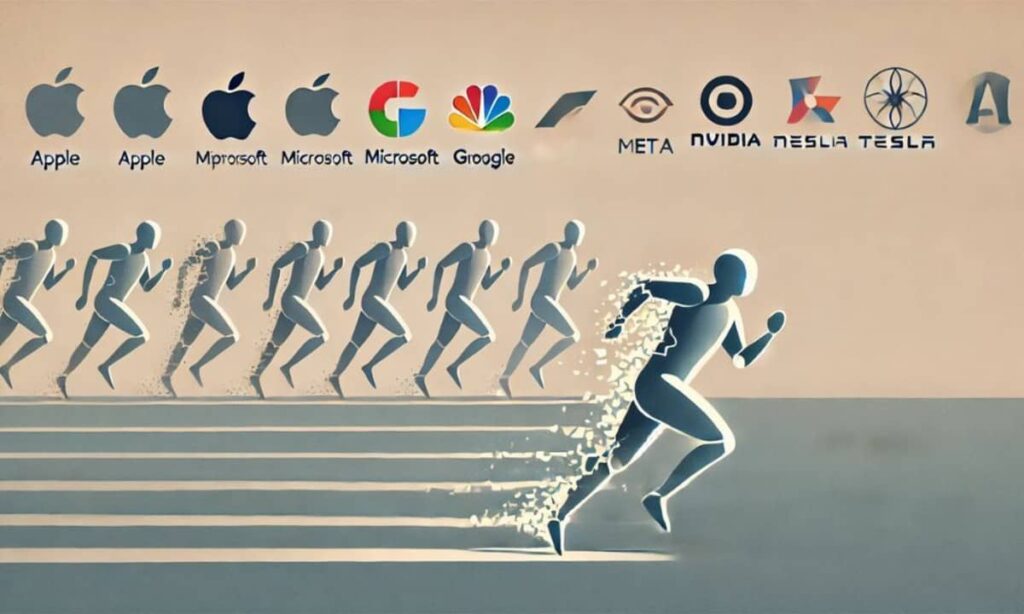
Leading economists have begun questioning when AI’s promised benefits will materialize.
“AI is everywhere except in the incoming macroeconomic data,” wrote Apollo chief economist Torsten Slok, echoing Solow’s decades-old observation. “Today, you don’t see AI in the employment data, productivity data, or inflation data.”
Slok added that outside of the Magnificent Seven tech giants, there are “no signs of AI in profit margins or earnings expectations.”
Corporate capital allocation, however, tells a different story. Global spending on artificial intelligence surpassed $250 billion in 2024. Money flowed into data centers, language model development, enterprise software platforms, and automation infrastructure.
But investment alone does not produce productivity growth. Implementation determines results.
Academic research offers conflicting signals
Studies on AI’s economic impact have produced widely varying conclusions.
In 2023, MIT researchers found that AI tools could increase individual worker performance by nearly 40% compared to employees who did not use the technology. The findings suggested significant potential for workplace transformation.
Other projections have been far more modest. A separate 2024 MIT study estimated only a 0.5% increase in productivity over the next decade.
Nobel laureate Daron Acemoglu, one of the study’s authors, defended the projection while acknowledging its modesty.
“I don’t think we should belittle 0.5% in 10 years. That’s better than zero,” he said. “But it’s just disappointing relative to the promises that people in the industry and in tech journalism are making.”
Meanwhile, the Federal Reserve Bank of St. Louis reported a 1.9% increase in cumulative excess productivity growth since ChatGPT launched in late 2022.
The data point in multiple directions. That uncertainty deepens the paradox.
Workers increase AI use while confidence declines

Workplace sentiment adds complexity to the picture.
ManpowerGroup’s 2026 Global Talent Barometer surveyed nearly 14,000 workers across 19 countries. Regular AI usage rose 13% in 2025. At the same time, confidence in the technology fell 18%.
Employees appear willing to experiment but remain cautious. Many use AI for drafting messages, conducting research, and analyzing data. Fewer trust the tools for high-stakes decisions or critical tasks.
Corporate leaders share similar hesitation about wholesale workforce changes. IBM Chief Human Resources Officer Nickle LaMoreaux announced last week that the company plans to triple its number of young hires. Her reasoning was strategic. If entry-level roles disappear entirely, the pipeline of future middle managers could dry up.
The comment reflects broader corporate thinking. Companies want efficiency improvements. They do not want long-term talent shortages that could cripple operations.
Historical patterns suggest delayed payoffs are normal
Technology revolutions rarely produce immediate results.
The information technology boom of the 1970s and 1980s did not deliver instant productivity gains. But between 1995 and 2005, productivity growth surged 1.5% annually after decades of stagnation.
Stanford economist Erik Brynjolfsson believes a similar pattern may be emerging. He recently pointed to fourth-quarter GDP tracking near 3.7% even as job growth slowed to 181,000 positions. That divergence suggests rising output per worker.
Brynjolfsson’s analysis indicated U.S. productivity jumped 2.7% last year. He attributed the increase to firms shifting from AI experimentation to practical deployment.
Former Pimco CEO Mohamed El-Erian also noted that GDP growth and employment growth appear to be decoupling, mirroring patterns from the office automation wave of the 1990s.
Slok described the potential trajectory as a “J-curve.” Early investment can temporarily depress performance measures. Gains arrive later, sometimes suddenly.
However, artificial intelligence differs from earlier technology waves in important ways. In the 1980s, innovators often enjoyed monopoly pricing power. Today, intense competition among large language model developers keeps prices low and access widespread.
That changes the economic structure entirely.
“The value creation is not the product,” Slok said, “but how generative AI is used and implemented in different sectors in the economy.”
The paradox intensifies as clarity remains elusive

Artificial intelligence now sits at the center of corporate strategy discussions worldwide. Yet hiring patterns have not shifted dramatically. Productivity data remains mixed. Macroeconomic indicators show only modest changes.
The paradox has sharpened. Leaders describe artificial intelligence as transformative. At the same time, they resist replacing workers and hesitate to restructure operations completely.
For now, artificial intelligence may be following Solow’s pattern from four decades ago. It dominates headlines, investor calls, and marketing materials.
Whether it will soon appear convincingly in productivity statistics remains the defining economic question of this decade.
What’s your take on the AI productivity puzzle? Do you believe the technology will eventually deliver transformative gains, or are current expectations overblown? Please share your perspective in the comments.