

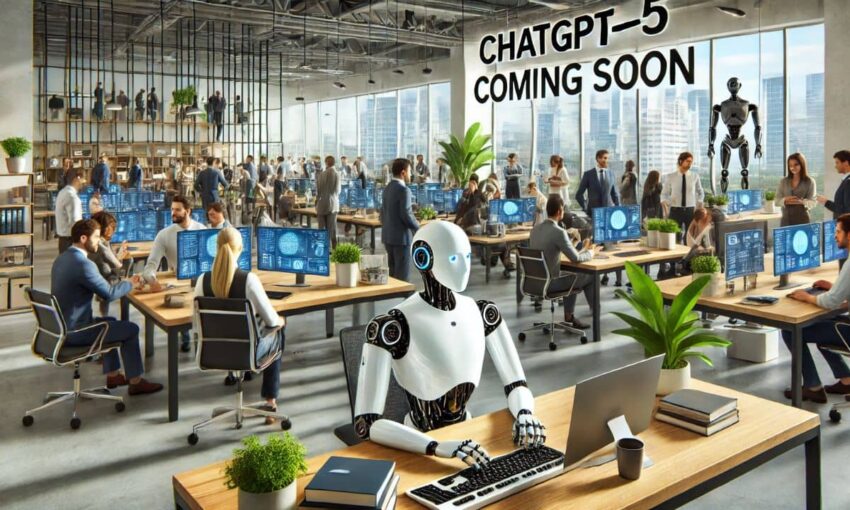
The artificial intelligence landscape stands on the brink of a seismic shift. OpenAI’s highly anticipated GPT-5 appears destined for a July 2025 launch, according to multiple industry sources and strategic hints from company leadership.
This development has sent ripples through the tech community, particularly among eCommerce professionals and Shopify store owners. The implications extend far beyond simple software upgrades.
OpenAI CEO Sam Altman recently offered cryptic insights about the timeline, stating: “I don’t know exactly when… We go back and forth on how much we turn up the big number.”
His measured approach reflects the careful orchestration behind what many consider the most significant AI advancement since ChatGPT’s initial debut.
GPT-5 represents more than incremental progress. It signals a fundamental transformation in human-AI collaboration.
Revolutionary features define GPT-5’s advanced capabilities
The upcoming model promises to shatter existing limitations through groundbreaking enhancements. GPT-5 will seamlessly integrate text processing, image recognition, voice interaction, and video analysis within unified conversations.
Technical specifications suggest a massive 256,000+ token context window, enabling the system to maintain coherent dialogue across extensive interactions. This expanded memory capacity addresses one of the most persistent challenges facing GPT-4.
Enhanced factual accuracy and autonomous task management represent core improvements. The model will significantly reduce hallucinations while demonstrating sophisticated reasoning capabilities.
Divya Parekh, a recognized authority in digital transformation, captured the moment’s significance: “GPT-5 feels like the moment we stop just using AI and start working with it.”
Shopify merchants gain an unprecedented competitive edge
The release holds particular promise for Shopify entrepreneurs leveraging AI-powered solutions. Several transformative applications emerge:
Advanced Customer Personalization: GPT-5’s enhanced memory will retain detailed customer interactions, purchase histories, and individual preferences across multiple touchpoints.
Intelligent Product Discovery: The system will generate recommendations based on voice queries, uploaded images, and contextual shopping behavior rather than simple browsing patterns.
Comprehensive Task Automation: Everything from processing returns to managing inventory updates and crafting follow-up communications can operate independently.
Accelerated Support Resolution: Customer service response times may plummet from the current 38-hour average to under 6 minutes through intelligent automation.
This evolution transforms AI from a reactive tool into a proactive business partner. The technology will anticipate needs and execute solutions autonomously.
Industry leaders praise pre-release performance

Early testing phases have generated overwhelmingly positive feedback. Business Insider’s sources describe GPT-5 as “materially superior” to its predecessor, GPT-4.
Altman himself expressed confidence in the model’s potential: “We can make GPT-5 much better than originally planned.”
Jim Liddle, Chief Innovation Officer at Nasuni, provided strategic context: “This represents the evolution from question-answering to an autonomous agent that plans and executes.” Such capabilities promise to streamline business operations while reducing manual oversight requirements.
The lookfor AI Agent, already recognized for automating Shopify customer interactions, will gain sophisticated personalization abilities. The integration will enable dynamic tone adjustment and strategic adaptation based on individual customer profiles.
Comprehensive feature comparison reveals major advances
The technological leap becomes apparent through direct comparison:
Reasoning Capabilities: GPT-4.5 lacks chain-of-thought processing, while GPT-5 offers complete multi-step logical reasoning.
Multimodal Integration: Limited functionality evolves into native cross-platform capabilities.
Memory Retention: Basic recall expands to long-term memory, exceeding 1 million tokens.
Error Reduction: Logical inconsistencies decrease through improved structured problem-solving.
Customization Options: General-purpose functionality transforms into brand-specific voice tuning.
Emotional Intelligence: Basic sentiment recognition advances to emotion-aware adaptive responses.
These improvements represent fundamental architectural changes rather than surface-level enhancements.
Strategic preparation guidelines for business success
Forward-thinking merchants are already positioning themselves for maximum advantage. Essential preparation steps include:
Data Organization: Ensure product catalogs and customer databases reflect current, accurate information.
Multimedia Integration: GPT-5’s multimodal strength requires businesses to incorporate images, voice recordings, and video content strategically.
Team Development: Prompt engineering and data literacy skills become essential competencies across organizations.
Gradual Implementation:
Alex Pilon, Senior Developer at Shopify, recommends: “Start testing with smaller data batches to find what works.”
His philosophy emphasizes measured experimentation: “Game-changing technologies are built out of small incremental steps of experimentation.”
Responsible AI implementation builds consumer trust
OpenAI maintains an unwavering commitment to ethical AI deployment. Responsible implementation becomes crucial as automation capabilities expand.
Organizations must establish clear governance frameworks and transparent AI usage policies. Recent McKinsey research demonstrates that companies with robust AI ethics protocols achieve double the performance in customer satisfaction and trust metrics compared to competitors.
Cross-industry transformation extends beyond commerce
While eCommerce applications capture immediate attention, GPT-5’s influence spans multiple sectors. Healthcare diagnostics, educational personalization, legal research, and customer service operations all stand to benefit from enhanced understanding of nuance, emotion, and intent.
Egbert von Frankenberg, CEO of Knightfox App Design, outlined the broader implications: “Multimodal capabilities and personalization open the door for smarter contact centers, better diagnostics, and scalable education.”
The competitive advantage awaits early adopters
GPT-5’s arrival will fundamentally reshape customer engagement, task automation, and operational scaling across business environments. This transformation transcends simple technological upgrades, representing a paradigm shift toward intelligent collaboration.
Altman’s confident prediction encapsulates the moment: “It’s not like this model is going to get a little bit better… It’s going to be better across the board.”
Organizations that begin preparation now will establish decisive advantages when GPT-5 officially launches this July. The question isn’t whether AI will transform commerce—it’s whether your business will lead or follow this revolution.
What are your thoughts on GPT-5’s potential impact on your business? How do you envision AI transforming your industry?